
TLDR:
Pharmaceutical supply chains operate under tightly connected constraints. Disruptions make it difficult to trace impact across systems.
Connecting AI directly to a planning engine addresses this. It combines real-time data with structured reasoning, allowing teams to evaluate impact and act faster.
This shift goes beyond automation. It changes how planning decisions are made.
How Can Planners in Pharma Reduce Stockouts Without Overstocking?
Inventory mistakes in pharmaceutical supply chains carry real consequences. Stockouts interrupt treatment availability, delay production schedules, and create pressure across procurement and distribution.
At the same time, excess inventory introduces expiry risk, storage costs, and tied-up working capital. Planners must manage both risks simultaneously. Holding additional inventory does not solve the issue. Poor planning simply shifts the problem from shortages to waste.
How can planners in pharma reduce stockouts without overstocking while maintaining stable inventory levels? Pharmaceutical manufacturers address this challenge through three core planning capabilities: accurate demand forecasting, adaptive safety stock planning, and real-time visibility across procurement and production.
Why Stockouts and Excess Inventory Often Occur Together
Stockouts and excess inventory often stem from the same planning weaknesses. When planners lack clear visibility into demand signals, production constraints, and supplier timelines, inventory decisions become reactive.
Many mid-market pharmaceutical companies still rely on spreadsheets or disconnected planning tools. These systems cannot continuously adjust inventory strategies as supply and demand conditions change.
Several operational gaps typically drive these imbalances:
-
Demand forecasting based only on historical sales data
-
Limited visibility into supplier lead times
-
Static safety stock levels
-
Delayed updates to reorder points
-
Poor alignment between procurement and production planning
These limitations push planners toward defensive inventory strategies. Teams increase buffers to prevent stockouts, which gradually creates excess inventory across multiple SKUs.
Demand Forecasting Is the Foundation of Inventory Stability
Demand forecasting provides the foundation for stable inventory planning. Without a reliable demand signal, planners cannot determine appropriate safety stock levels or reorder points.
Pharmaceutical demand forecasting must account for several variables:
-
Prescription trends and market demand
-
Product lifecycle changes
-
Seasonality for certain therapies
-
Hospital or distributor purchasing patterns
-
Regulatory approvals and market expansion
Forecasting models combine historical sales data with market trends to generate a more reliable demand signal. Forecasting alone, however, does not eliminate stockouts.
Connecting forecasts to production batch planning
Pharmaceutical forecasting must translate into production batch decisions. Manufacturing schedules operate in fixed batch sizes, not continuous demand flow.
Planners must align forecast volumes with batch constraints such as minimum batch quantities, production campaign planning, and cleaning validation requirements.
Without this alignment, planners may produce excess batches to prevent stockouts. This often creates surplus inventory that approaches expiry before it reaches the market.
Safety Stock Planning Protects Against Supply Uncertainty
Safety stock protects pharmaceutical supply chains from uncertainty. However, poorly calibrated buffers often create the opposite problem. Excess inventory accumulates while planners still face shortages when demand shifts or supplier delays occur.
Effective safety stock planning requires continuous evaluation. Planners must reassess inventory buffers as supplier performance, demand variability, and production constraints evolve.
Evaluating supplier lead time reliability
Supplier lead times rarely remain constant in pharmaceutical manufacturing. Production delays, transportation constraints, and regulatory inspections can extend delivery timelines.
Planners track supplier reliability to determine realistic lead time expectations. Materials sourced from inconsistent suppliers require larger safety buffers than those delivered on stable schedules.
Managing single-source supplier risk
Many pharmaceutical ingredients come from limited or single-source suppliers. Regulatory approvals often restrict the ability to change suppliers quickly.
When a critical API supplier experiences delays, planners cannot immediately switch vendors.
Safety stock calculations must account for this structural constraint. Materials sourced from single suppliers typically require higher buffers than multi-source components.
Supplier risk analysis helps planners identify which materials require additional protection to maintain production continuity.
Adjusting safety stock for demand volatility
Demand patterns vary across pharmaceutical products. High-volume medicines often follow predictable ordering cycles. Specialty therapies may experience irregular purchasing behavior.
Safety stock policies must reflect these differences. Stable demand requires smaller buffers. Volatile demand requires additional protection.
Balancing service levels with inventory cost
Safety stock reflects a service level decision. Higher service targets reduce stockout risk but increase inventory levels. Pharmaceutical planners must balance service reliability with storage capacity, shelf life, and capital allocation.
Real-Time Visibility Reduces Inventory Risk
Inventory planning depends on accurate and timely information. Delayed updates or fragmented systems often reveal supply risks too late to correct.
By the time shortages appear, production schedules and purchase orders are already misaligned. Real-time visibility allows planners to identify supply disruptions earlier and adjust supply plans before inventory levels fall below safe thresholds.
Tracking real-time inventory levels
Accurate inventory data forms the foundation of reliable planning. Planners must see current inventory across warehouses, production sites, and distribution channels.
Without this visibility, inventory discrepancies accumulate, and planning decisions become unreliable.
Monitoring purchase orders and supplier shipments
Supplier delays often trigger shortages. If shipment timelines are not visible to planning teams, disruptions escalate quickly.
Tracking supplier shipments allows planners to anticipate delays and adjust procurement plans before inventory reaches critical levels.
Coordinating production and procurement activities
Production schedules must align with material availability. If procurement teams lack visibility into upcoming manufacturing requirements, shortages appear during production runs.
Shared planning visibility ensures procurement teams secure materials before production demand increases.
Reorder Points Must Adapt to Changing Conditions
Reorder points determine when procurement teams initiate purchase orders. Static reorder thresholds often become inaccurate as demand patterns evolve. Supplier lead times, production schedules, and demand fluctuations all influence the appropriate reorder timing.
Dynamic reorder points improve supply continuity
Effective reorder point calculations incorporate multiple planning variables. These variables include:
-
Average daily demand
-
Supplier lead times
-
Safety stock levels
-
Demand variability
Dynamic reorder points allow procurement teams to act earlier when inventory approaches critical thresholds. This approach helps maintain optimal stock levels without excessive safety buffers.
Accounting for production cycle constraints
Reorder point calculations must reflect production scheduling realities. Pharmaceutical manufacturing often operates in campaign-based production cycles.
Materials must arrive before a scheduled production run begins. If raw materials arrive late, entire production batches may be delayed.
Planners, therefore, calculate reorder points that ensure materials arrive before the next scheduled production campaign. This approach reduces the risk that procurement delays interrupt manufacturing schedules.
Planning Platforms Improve Coordination Across Teams
As pharmaceutical portfolios expand, manual planning processes begin to strain. Multiple suppliers, batch production requirements, and regulatory constraints increase operational complexity.
Spreadsheets cannot manage this level of coordination effectively.
Integrated planning systems provide a unified view
Planning platforms consolidate supply chain data into a single environment. These systems typically integrate:
-
Demand forecasting
-
Inventory planning
-
Procurement management
-
Production scheduling
-
Supplier coordination
For mid-market pharmaceutical companies, platforms such as PLAIO provide structured planning capabilities without the scale and complexity of enterprise systems.
Centralized planning improves communication between supply chain teams and reduces planning delays that often cause stockouts or excess inventory.
Operational Practices That Prevent Inventory Imbalances
Technology alone does not resolve inventory challenges in pharmaceutical supply chains. Effective planning also depends on consistent operational routines that align forecasting, procurement, and production teams.
Structured planning practices improve visibility into demand changes, supplier reliability, and inventory risk. When these routines occur regularly, planners can detect potential shortages earlier and avoid unnecessary inventory buffers.
Planning routines that stabilize pharmaceutical inventory
Planners often establish structured routines that guide inventory decisions across procurement, production, and supply chain teams. These routines allow teams to review demand signals, monitor supplier reliability, and prepare for potential disruptions.
The following practices help planners monitor supply risk and maintain balanced inventory levels.
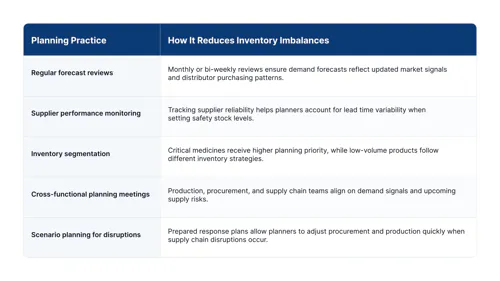
These planning routines create structure for decision-making across procurement, production, and supply chain teams. Consistent execution allows planners to identify supply risks earlier and adjust inventory plans before disruptions occur.
Maintaining Balanced Inventory in Pharmaceutical Supply Chains
Pharmaceutical inventory planning requires careful balance. Stockouts interrupt patient treatment and disrupt production schedules. Overstocking increases costs and introduces expiry risk.
Planners reduce these risks by improving forecasting accuracy, dynamically adjusting safety stock levels, and maintaining real-time visibility across supply operations.
Integrated planning platforms further strengthen these efforts by connecting demand forecasts, supplier timelines, and inventory levels in a single system. When these planning capabilities operate together, pharmaceutical manufacturers can maintain reliable product availability without accumulating excess inventory.
Frequently Asked Questions
How can planners prevent stockouts in pharmaceutical supply chains?
Planners prevent stockouts by improving demand forecasting, monitoring supplier lead times, and maintaining appropriate safety stock levels.
What causes excess inventory in pharma supply chains?
Excess inventory often results from inaccurate forecasts, static safety stock levels, and poor coordination between procurement and production teams.
How do reorder points help manage pharmaceutical inventory?
Reorder points determine when new purchase orders should be placed based on demand, lead time, and safety stock requirements.
Why is real-time visibility important for pharma inventory planning?
Real-time visibility allows planners to track inventory levels, purchase orders, and production status, enabling faster adjustments to prevent stockouts.
What is safety stock in pharmaceutical supply chains?
Safety stock is additional inventory held to protect against demand variability or supplier delays.
How does demand forecasting affect pharmaceutical inventory planning?
Accurate forecasting allows planners to calculate appropriate safety stock levels and reorder points.