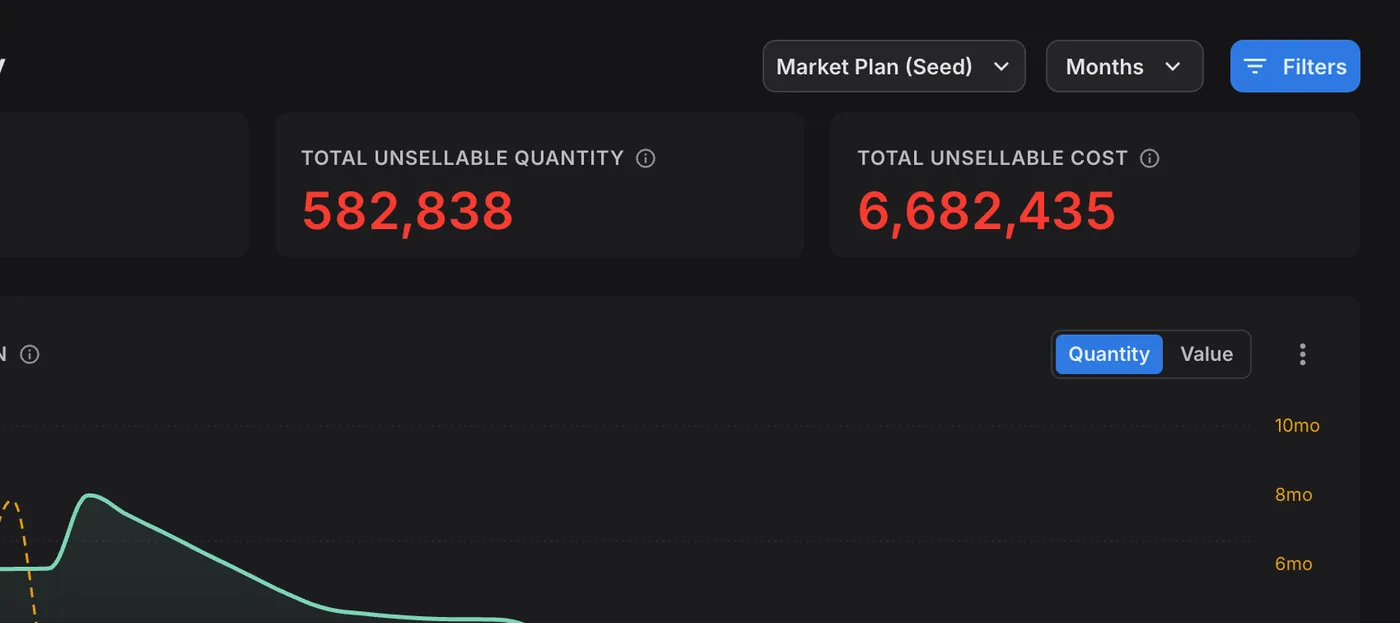
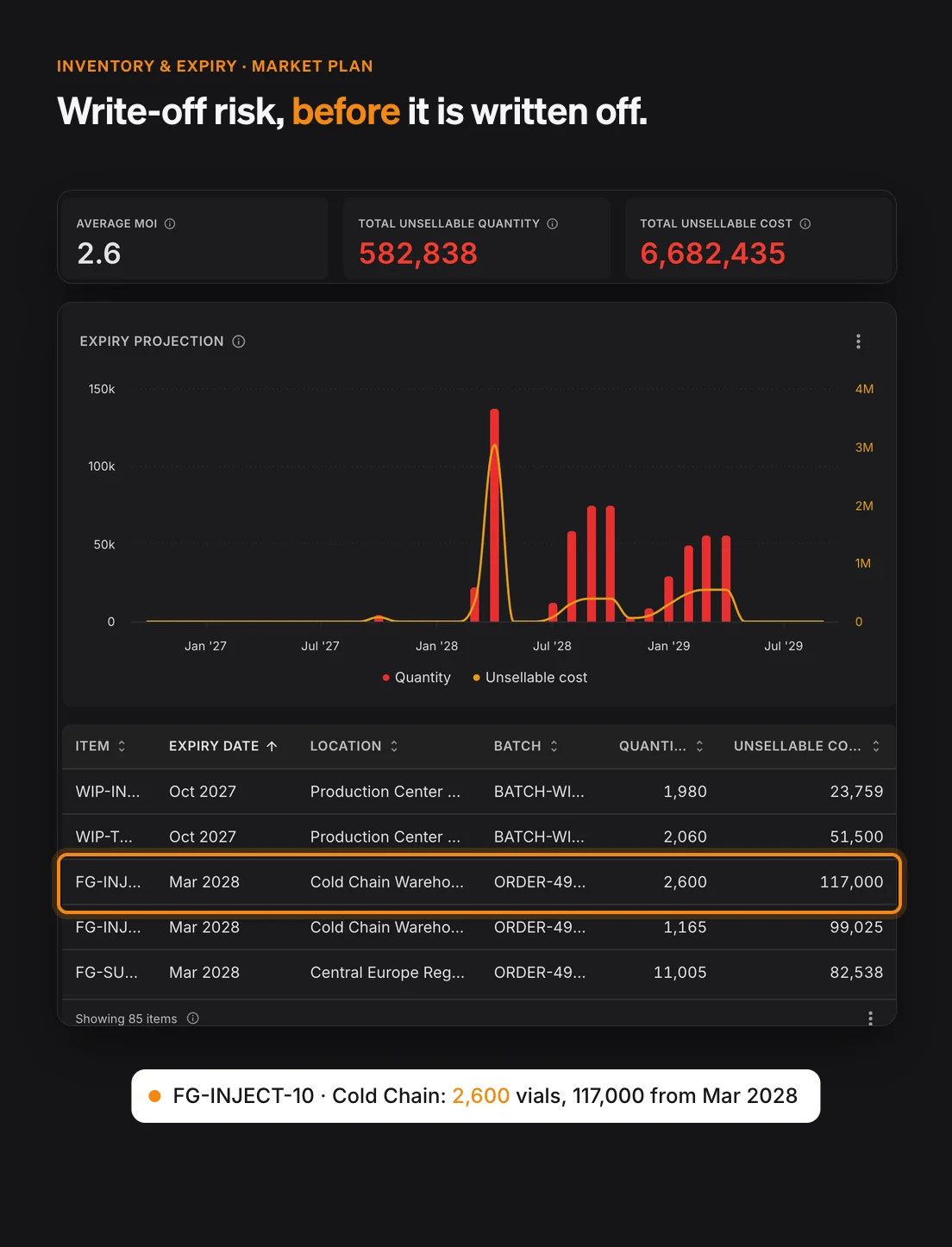
The supply plan projects 582,838 units going unsellable, worth 6,682,435 in cost.
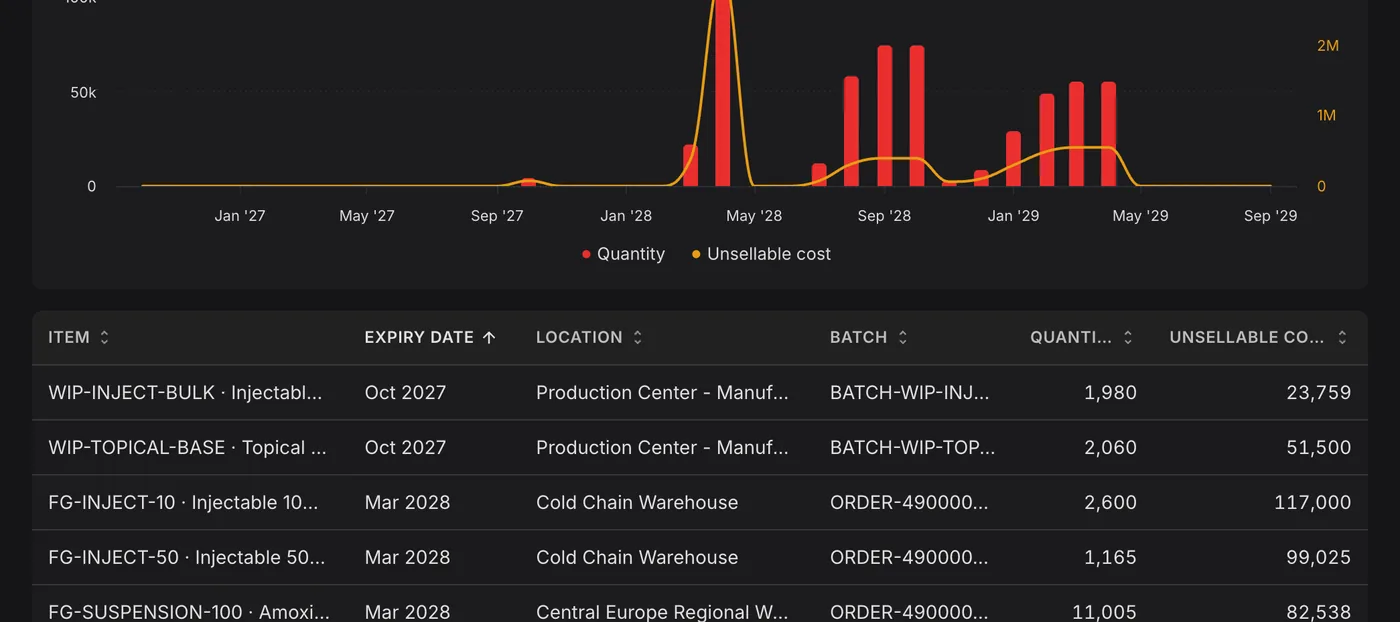
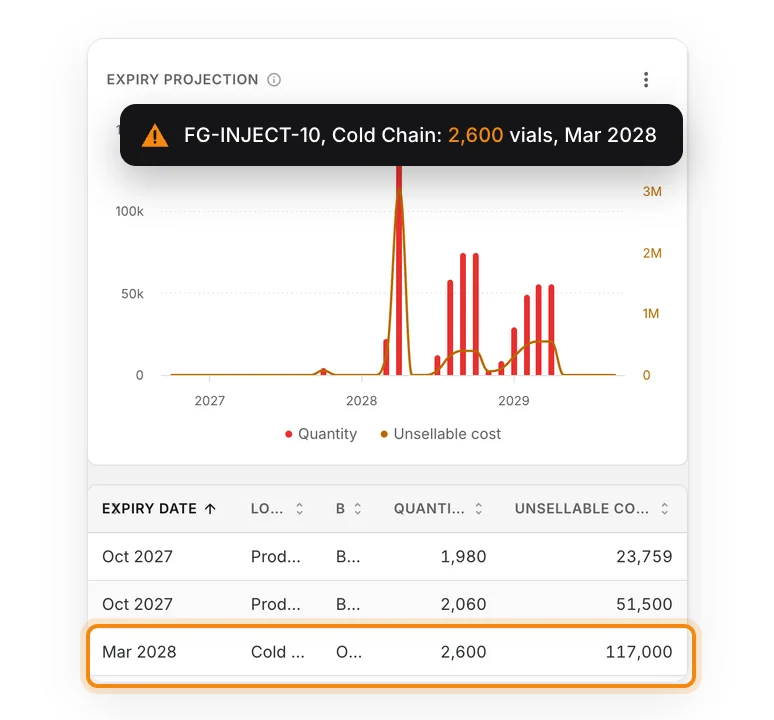
Which batch expires, and in which warehouse
2,600 vials of FG-INJECT-10 are due to expire in March 2028. The batch, its location and its cost are listed.
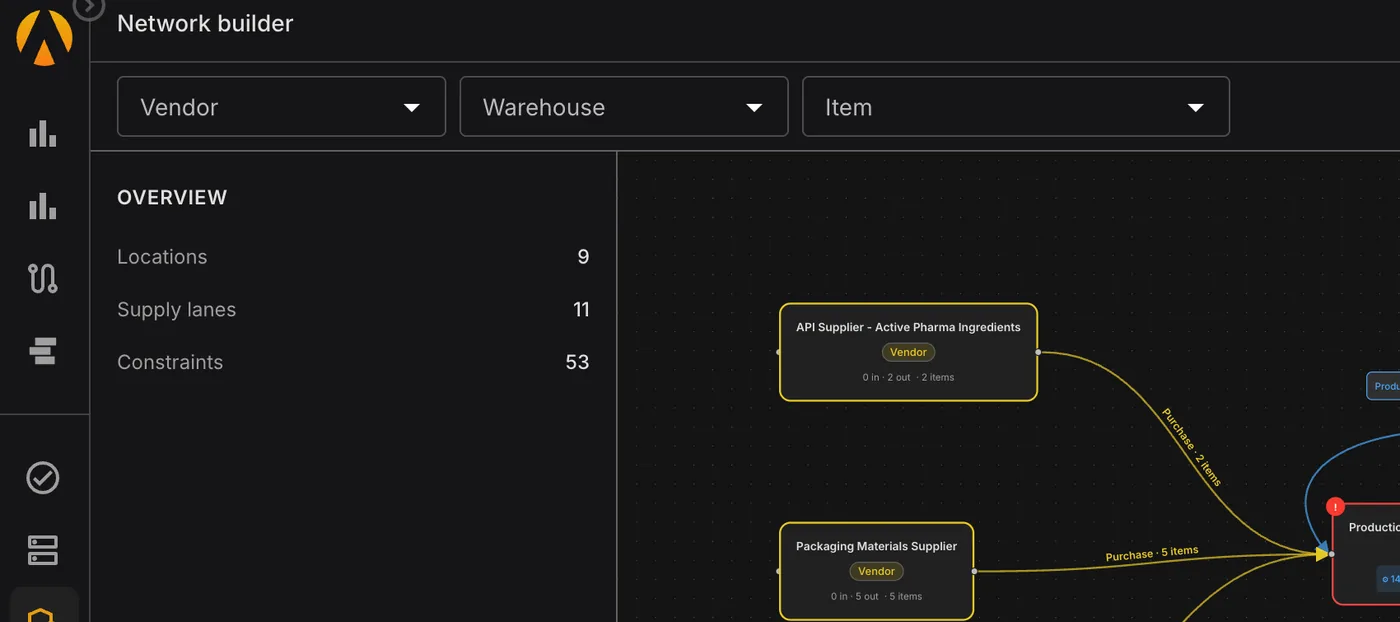
All your supplier lanes on one map
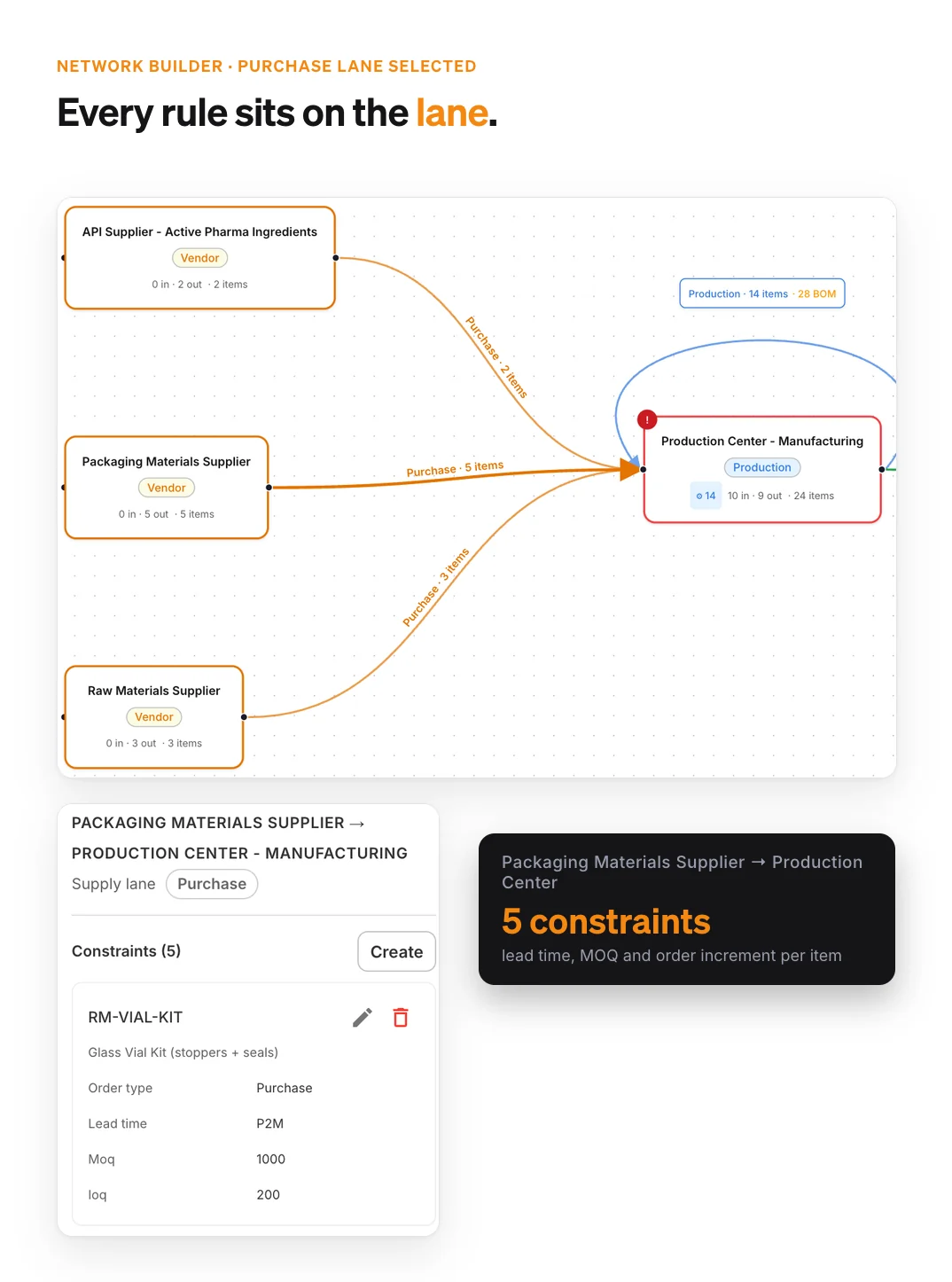
Nine locations and 11 supply lanes carry 53 constraints. The plan applies every one on each run.
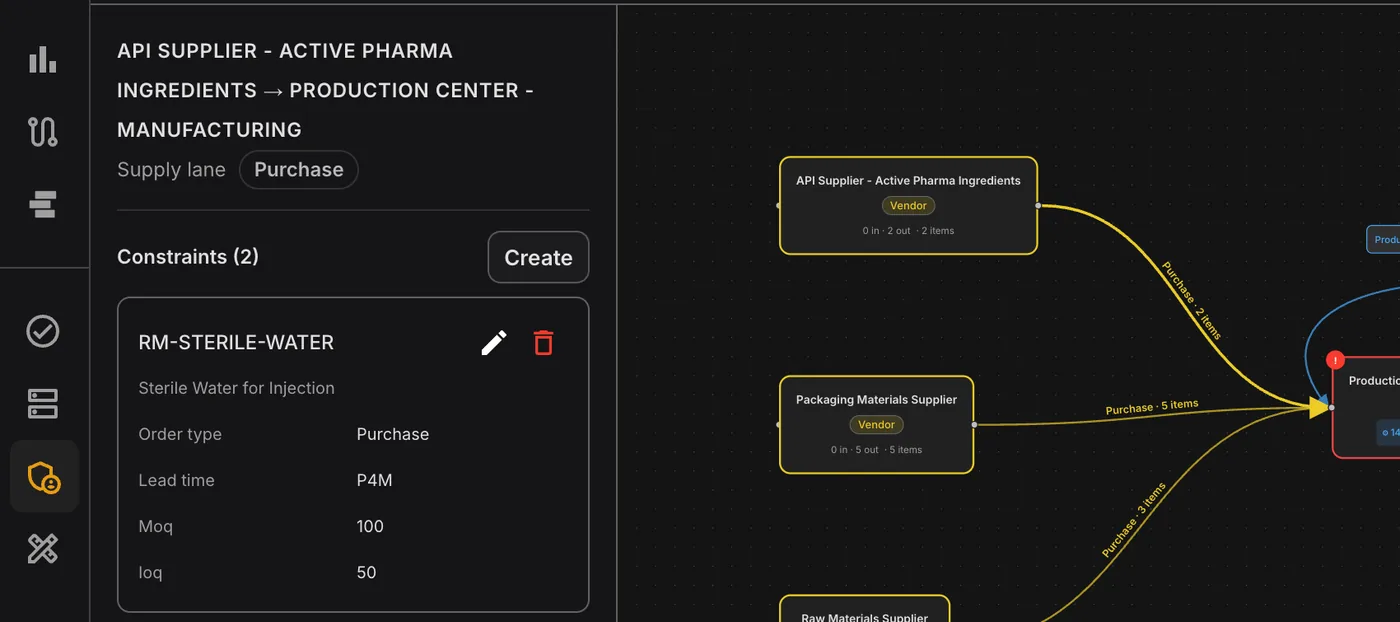
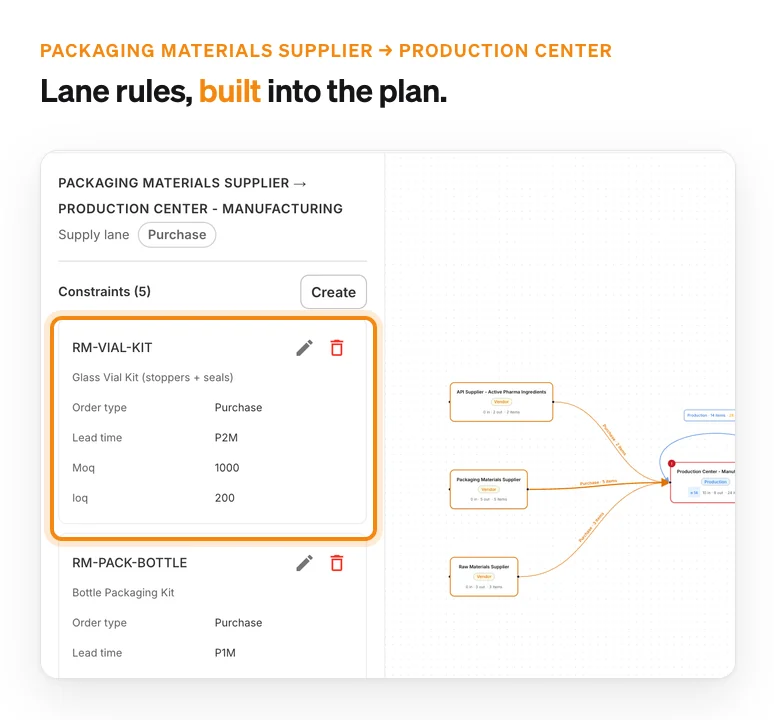
MOQ and lead time, applied per lane
Sterile Water for Injection has a 4-month lead time, an MOQ of 100 and steps of 50. Planned orders are rounded to fit.
Constraints built in, not discovered later
In disconnected spreadsheets, constraints get missed, ignored, or discovered only when plans break. PLAIO embeds constraint awareness into every planning decision, ensuring constraints are understood, visible, and factored into every recommendation the system makes.
Stock on the shelf may still be useless to the market that needs it.
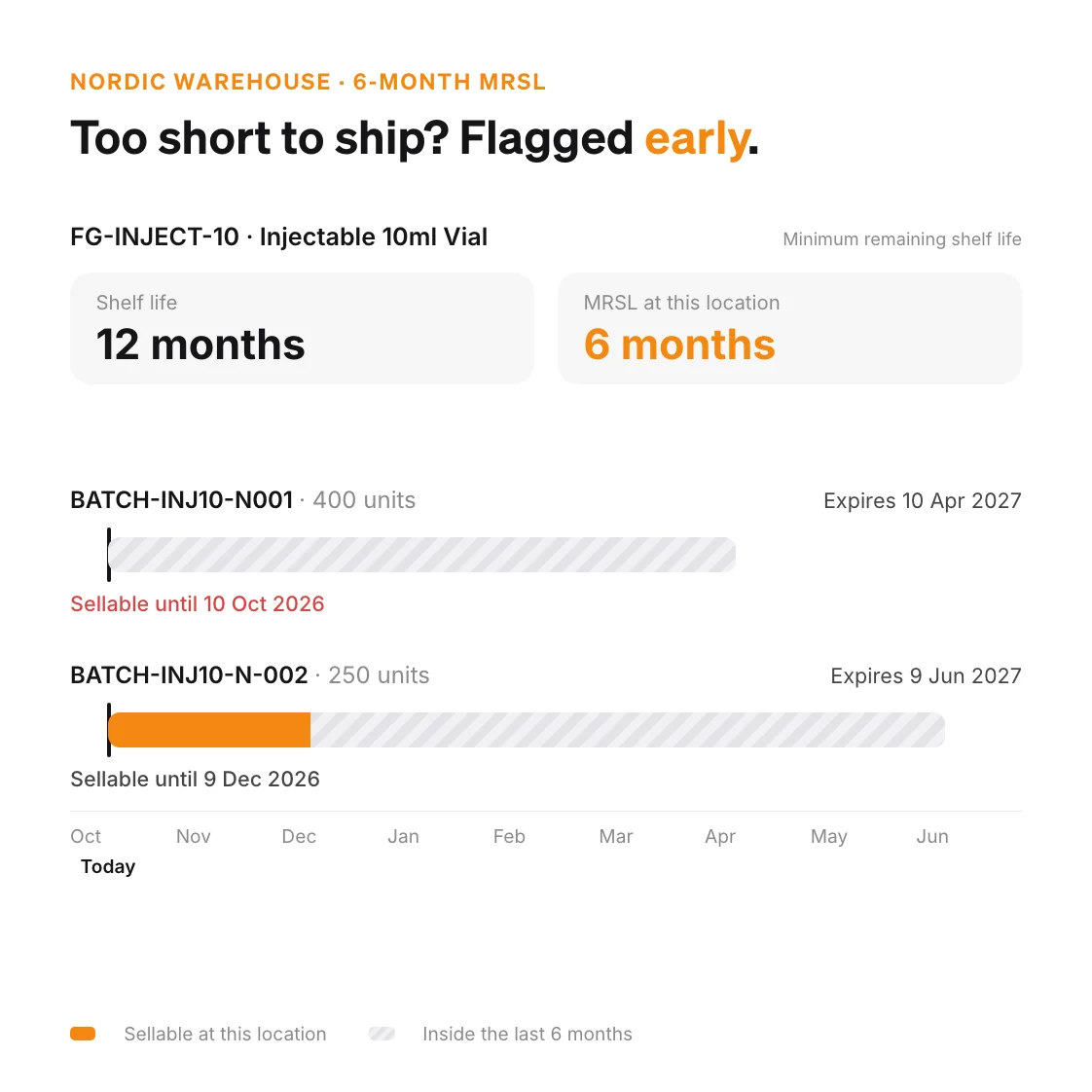
Each batch has an expiry date, and each item a shelf life. Give the item a minimum remaining shelf life, or set one per item and location, and PLAIO calculates the day each batch stops being sellable there.
If a batch will be too short-dated by the time it's needed, it doesn't count toward demand at that location. The plan orders or transfers the stock that's actually required.
Why it matters:
You catch short-dated stock in the plan months ahead. Otherwise you find it at the warehouse, when a customer rejects a delivery or finance writes off a batch.
Constraints PLAIO plans around
Respect CMO and Supplier Constraints
Define and automatically apply constraints for lead times, MOQs, batch increments, and capacity limits to eliminate infeasible recommendations.
Manage Shelf-Life Constraints
Set expiry rules and the minimum shelf life each market accepts. Batches are used first-expiry-first-out, and any batch heading for expiry shows up with its quantity and cost while you can still move it.
Embed Manufacturing Constraints
Capture your real-world manufacturing rules - like equipment compatibility, changeover times, and shift patterns - to generate feasible production schedules.
How constraint awareness works in PLAIO
Demand
Minimum remaining shelf life is set per market, so short-dated stock doesn't get counted against demand it can't serve. The rough-cut capacity plan spreads demand across each resource, which shows early when you are about to promise more than the lines can make.
Supply
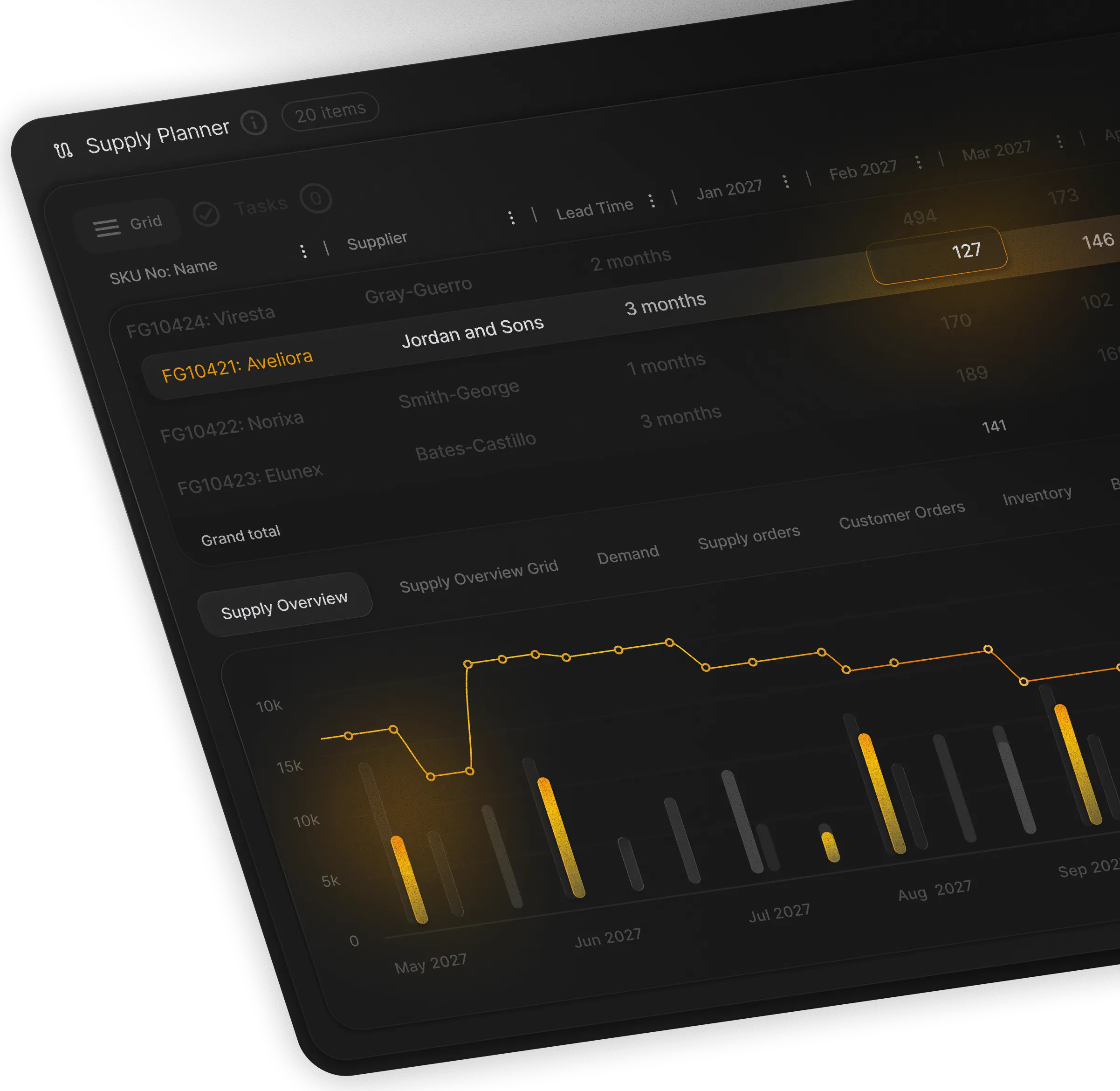
Each lane in the network carries its CMO rules, batch sizes and lead times, and the supply plan applies them automatically. It also checks the shelf life each market requires, so the orders it proposes can actually be placed.
Production
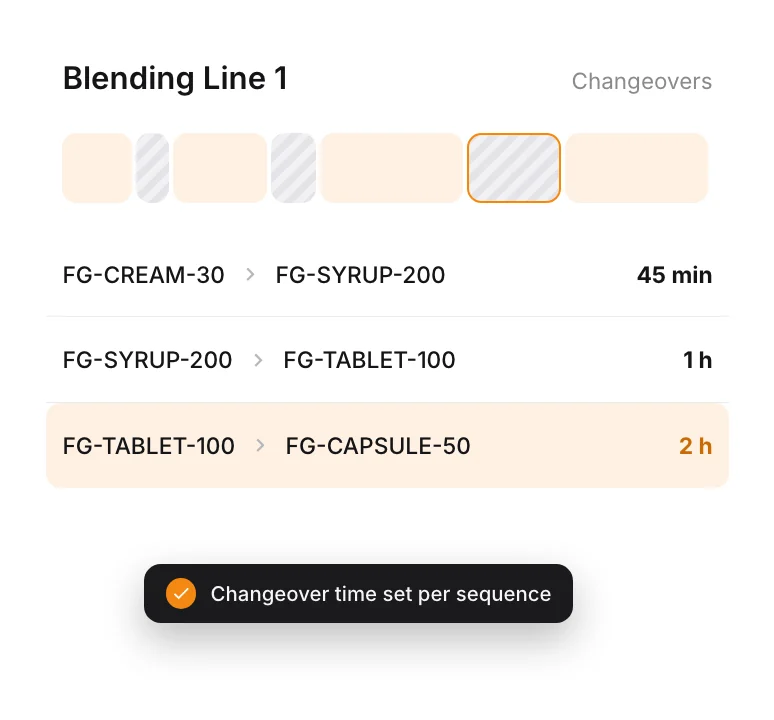
Constraint-based production planning applies cleaning rules, changeovers, and shift calendars directly to schedules, ensuring production plans remain realistic and operationally achievable. A job placed without enough changeover time is raised as an exception, not discovered on the shop floor.
It means putting the rules that limit what you can make, buy and ship inside the plan. For pharma those include shelf life and minimum remaining shelf life, batch expiry, supplier and CMO lead times and order quantities. On the manufacturing side, they cover which line can run a product, cleaning times and changeovers. Leave them out and the plan looks fine until someone tries to execute it.
Yes, per item and per stocking location. Most companies serve a market through a warehouse or distribution point, so you set six months for one market and four for another on the item at those locations. A value on the item itself is the default. PLAIO works out when each batch stops being sellable at each location and plans around that date.
You set them per item on each supply lane, next to the lead time and the maximum quantity per order. Planned orders round up to the MOQ, then in steps of the increment. A requirement of 1,130 with an MOQ of 1,000 and an increment of 200 becomes an order of 1,200. Firm orders that break the rules get flagged.
Yes. Each production step lists the resources that can run it, with setup, processing and cleaning times. Changeover times are defined per product sequence on each resource. Resources and shop floors have weekly availability patterns, date overrides and downtimes, and the scheduler stays inside them. Place a job without enough changeover time and it becomes an exception.
Open the Inventory & Expiry dashboard. It projects unsellable quantity and cost over the planning horizon, broken down by item, location and batch. It reads from the supply plan, so when you change a shelf-life rule, a lane or an order and re-run the plan, the projection moves with it.
Not as a separate registration record. Each item has a lifecycle status and first and last delivery dates at each location, which control where and when it gets planned. Open orders outside that window are flagged.
Plans that respect pharmaceutical realities
Embed shelf life, supplier and capacity limits directly into every decision so feasibility is never an afterthought.
To enhance your experience on our site and to analyze traffic, we use cookies. By clicking "Accept All," you agree to the storing of cookies on your device for analytics purposes. You can manage your settings or learn more in our Privacy Policy.
Manage Settings
Your Privacy Matters to Us
We use cookies to improve your browsing experience and analyze how our website is used. These cookies allow us to understand trends, monitor website traffic, and gather insights to make the site better for you.
We respect your privacy and are committed to transparent data usage.
Why Do We Use Cookies?
Necessary Cookies: These ensure that the website functions properly.
Analytics Cookies: These help us track site traffic, user behavior, and performance metrics. The data collected is anonymous and allows us to continuously optimize the site.
Preferences Cookies: We may use cookies to remember your preferences and tailor your experience.
Marketing Cookies: We may use cookies for marketing purposes.
Your Control, Your Choice
By clicking "Accept All," you consent to the use of all cookies. If you prefer, you can customize your choices and opt out of certain cookies. You can learn more about how we handle data and cookies in our Privacy Policy.