

If you advise pharmaceutical manufacturers, the next seven weeks contain more supply-chain-relevant policy change than the last two years. Section 232 tariffs, a 2028 generics cliff, the EU’s Critical Medicines Act, rising drug shortages and slow-moving reshoring are converging into decisions your clients need to make now, not on their usual annual planning cycle.
We’re PLAIO, planning software purpose-built for pharmaceutical supply chains, and this brief reflects the work we do alongside consultancies delivering S&OP transformation, network redesign and resilience programmes, running joint scenario workshops with your team. If you have pharma clients facing any of the above, contact us and we’ll set up a 30-minute working session - here’s what you need to know, sector by sector:
Section 232 Tariffs: The Second Deadline Lands 29 September
The default duty on covered patented pharmaceuticals is 100% ad valorem, with reduced rates for some origins: 15% for the EU, Japan, South Korea and Switzerland among them, per CBP’s implementation guidance[1]. Companies named in Annex III have been paying since 31 July; everyone else has until 29 September[2].
Two details catch planners out. Since 31 July, importers of covered goods must report the Chapter 99 classification whether or not duty is currently payable[1], and there is no in-transit exception[3]: what matters is the clearance date, not the sail date. Product shipping from Asia in late August lands directly on the deadline.
Generics: A Two-Year Runway, Then a Cliff
Generics and biosimilars are excluded from Section 232 for now[2]. But under the plan announced in July, imported generics stay at 0% for two years from 1 August 2026, rise to 100% for August 2028–August 2029, and 200% thereafter for companies without US manufacturing commitments[4]. That is a network-design question your clients should be modelling now, not in 2028.
The EU Critical Medicines Act Rewrites Procurement Logic

Parliament and Council reached provisional agreement on 12 May 2026[5], with the final text expected in the Official Journal towards the end of the year. The practical shift: contracting authorities move away from lowest-price awards and must apply resilience requirements in critical-medicines tenders[6], with EU-preference incentives for medicines heavily dependent on third-country suppliers and a “Strategic Projects” designation giving faster funding and permitting for EU manufacturing of critical medicines and APIs.
Contingency-stock mandates in one member state must not degrade supply elsewhere in the Union[7], which makes multi-market inventory allocation a compliance issue, not just a cost one.
Shortages Are Rising Again and Lasting Longer
Active US shortages hit 227 in Q2 2026, the third consecutive quarterly increase[8], though still below the 323 peak of Q1 2024. Roughly half of this year’s new shortages involve single-manufacturer products[9], and contrast agents alone accounted for 10% of new shortages in 2026.
More striking is USP’s finding that the average shortage now runs over five years[10], up from 4.3 in 2024 and about two in 2019, while discontinuations jumped 60% from 2024 to 2025, concentrated in the lowest-priced products.
Reshoring: Pledges Are Large, Execution Is Slow

Announced US commitments now exceed $480bn across roughly 22 sites and 44,000 jobs[11], yet upstream equipment suppliers have not seen matching order flow. On the regulatory side, the FDA named seven PreCheck pilot participants on 29 June[12] (Eli Lilly, Regeneron, Amneal, Cellares, Fujifilm Biotechnologies, Kriya Therapeutics and Kyowa Kirin) from more than 80 applicants, shifting facility-readiness work upstream of the application[13]. The gap between announcement and validated capacity is where your clients’ 2027–2029 supply plans will be won or lost.
What This Means for the Engagements You’re Running
- Landed cost is now a planning variable, not a finance output. Sourcing decisions, safety-stock placement and pre-deadline build-ahead all move with tariff status by company, origin and HTSUS line. Static annual plans can’t hold this.
- Dual-sourcing arguments finally clear the business case. With half of new shortages sole-source and shortages averaging five years, the cost of a single-site failure now visibly exceeds the cost of qualifying a second source.
- EU and US requirements are pulling in different directions. Clients selling into both need scenario capability at multi-market, multi-echelon level: EU-preference procurement and contingency stocks on one side, tariff-driven US onshoring on the other.
Most of the pharma planning teams we meet are trying to answer these questions in spreadsheets, where a single scenario takes days to build and can’t respect batch sizes, market-specific expiry dates or GMP constraints. That’s a hard place to advise from.
Are You a Supply Chain Consultancy With Pharma Clients?
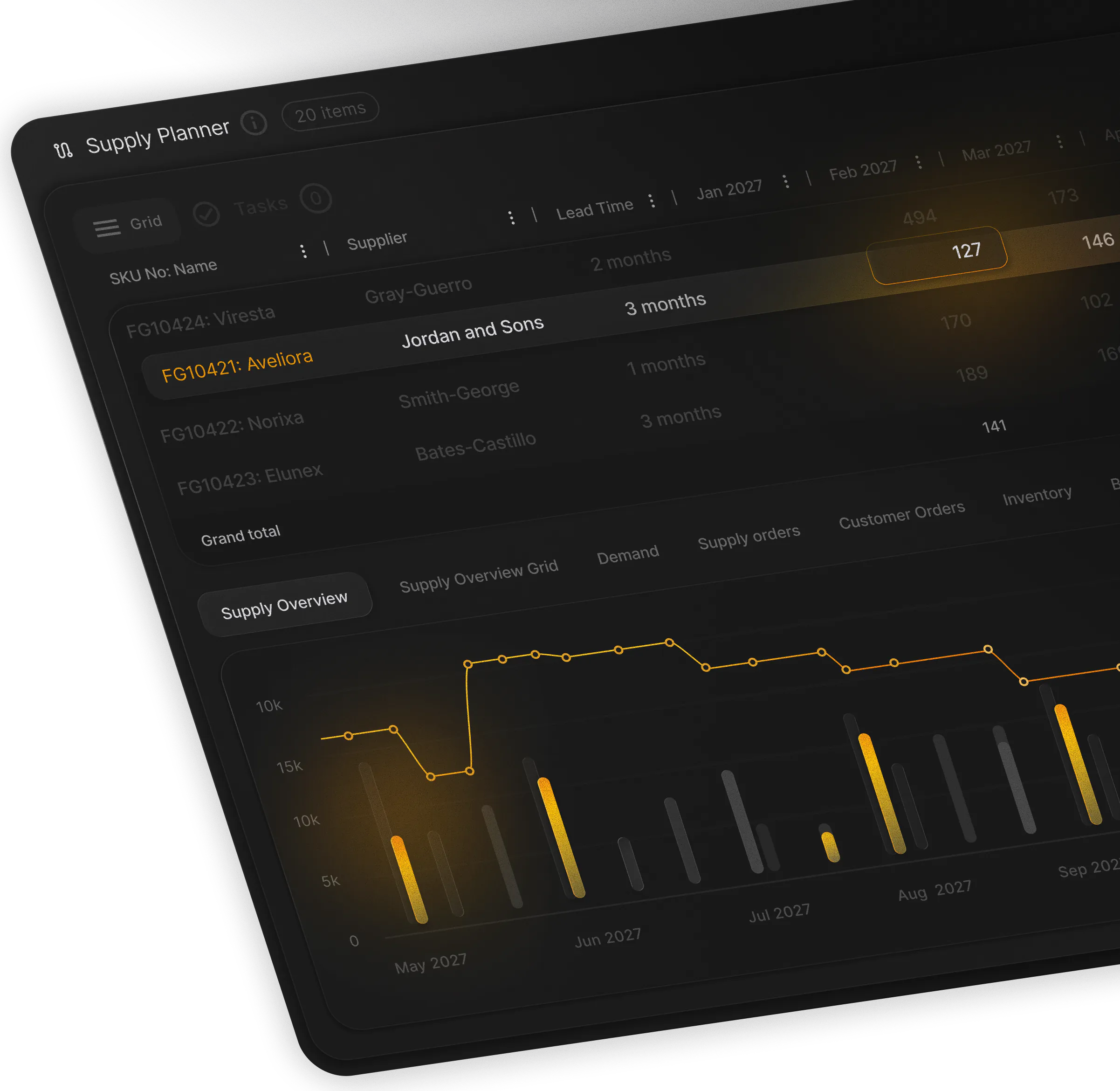
PLAIO is planning software purpose-built for pharmaceutical supply chains: demand, supply, manufacturing and purchase planning in one system, respecting batch/lot sizes, capacity, lead times and market-based expiry dates, and integrating with SAP and MS Dynamics rather than replacing them. We work alongside consultancies delivering S&OP transformation, network redesign and resilience programmes, and we’re happy to run a joint scenario workshop with a client of yours.
If you have pharma clients facing any of the above, contact us and we’ll set up a 30-minute working session. Or see how PLAIO’s supply planning ties tariff status, dual-sourcing and multi-market allocation into a single plan.
References
- “US CBP Issues Implementation Guidance for Section 232 Tariffs on Patented Pharmaceuticals.” Baker McKenzie Global Import Blog, 7 August 2026. https://globalimportblog.bakermckenzie.com/2026/08/07/us-cbp-issues-implementation-guidance-for-section-232-tariffs-on-patented-pharmaceuticals/
- “Trump Administration Imposes Section 232 Tariffs on Patented Pharmaceutical Imports: Tiered Rate Structure Takes Effect Beginning July 31, 2026.” Crowell & Moring, July 2026. https://www.crowell.com/en/insights/client-alerts/trump-administration-imposes-section-232-tariffs-on-patented-pharmaceutical-imports-tiered-rate-structure-takes-effect-beginning-july-31-2026
- “100% Duties, Two Deadlines: Section 232 Pharmaceutical Tariffs Take Effect July 31, 2026.” Mallory Group, 29 July 2026. https://www.mallorygroup.com/blog-posts/100-duties-two-deadlines-section-232-pharmaceutical-tariffs-take-effect-july-31-2026
- “A New Round in US Pharma Tariffs: What's at Play.” DCAT Value Chain Insights, July 2026. https://www.dcatvci.org/features/a-new-round-in-us-pharma-tariffs-whats-at-play/
- “European Critical Medicines Act.” Cuatrecasas, 22 May 2026. https://www.cuatrecasas.com/en/spain/life-sciences-healthcare/art/european-critical-medicines-act
- “Euro Roundup: EU Lawmakers Reach Agreement on Critical Medicines Act.” RAPS, 14 May 2026. https://www.raps.org/resource/euro-roundup-eu-lawmakers-reach-agreement-on-critical-medicines-act.html
- “European Commission Welcomes Political Agreement on Critical Medicines Act.” ESWI / European Commission, 21 May 2026. https://eswi.org/education-hub/european-commission-welcomes-political-agreement-critical-medicines-act
- “Active US Drug Shortages Rise for Third Straight Quarter.” AJMC, July 2026. https://www.ajmc.com/view/active-us-drug-shortages-rise-for-third-straight-quarter
- “9 New Drugs in Shortage.” Becker's Hospital Review, August 2026. https://www.beckershospitalreview.com/pharmacy/9-new-drugs-in-shortage/
- “2026 Annual Drug Shortages Report: Rising Discontinuations, Supply Chain Risk.” U.S. Pharmacopeia (USP), 9 June 2026. https://www.usp.org/news/usp-2026-annual-drug-shortages-report-rising-discontinuations-supply-chain-risk
- “FAQ: Where US Pharma Reshoring Stands in 2026.” Pharmaceutical Commerce, 8 July 2026. https://www.pharmaceuticalcommerce.com/view/faq-where-us-pharma-reshoring-stands-in-2026
- “FDA Selects Seven Participants for PreCheck Pilot Program to Advance US Drug Manufacturing.” U.S. Food and Drug Administration, 29 June 2026. https://www.fda.gov/news-events/press-announcements/fda-selects-seven-participants-precheck-pilot-program-advance-us-drug-manufacturing
- “FDA PreCheck Pilot Accelerates US Drug Manufacturing.” AllSci, 30 June 2026. https://allsci.com/news/regulatory/fda-launches-precheck-pilot-program-to-accelerate-domestic-drug-manufacturing-facility-approvals/