
TLDR:
AI-driven supply planning helps pharma companies move from reactive, spreadsheet-based planning to structured, data-driven decision-making.
By improving forecasting accuracy, optimizing inventory dynamically, and embedding risk modeling into everyday planning, AI reduces excess stock, minimizes disruptions, and increases control.
Success depends on strong data foundations, phased implementation, and integrating AI into core planning processes rather than treating it as a standalone tool.
Best Practices for AI-Driven Supply Planning in the Pharma Industry
Pharmaceutical supply chain management sits at the intersection of two forces that rarely align: speed and precision. Products have fixed shelf lives, strict cold chain requirements, and regulatory scrutiny at every step.
At the same time, demand can shift rapidly based on seasonality, epidemiological trends, or new clinical data. Under these conditions, traditional supply planning models become fragile.
Traditional supply planning typically relies on:
-
Static forecasts updated monthly or quarterly
-
Manual spreadsheet adjustments
-
Reactive inventory corrections
-
Limited cross-functional visibility
When forecasts change or suppliers miss timelines, teams intervene manually. This absorbs volatility, but it does not control it.
AI-driven supply planning in the pharma industry uses machine learning models to:
-
Improve demand forecasting accuracy
-
Optimize inventory management across SKUs and sites
-
Strengthen risk control within regulated supply chains
In practice, planning decisions are recalculated systematically rather than manually. This shift changes how planning teams operate, moving from reactive correction to structured control.
For this reason, defining clear best practices for AI-driven supply planning in the pharma industry is no longer optional.
Why Traditional Supply Planning Models Break Under Volatility
In pharma, plans rarely collapse all at once. They drift.
A forecast gets adjusted to protect service. A supplier update comes in late. A production slot moves by two days. None of it feels critical in isolation.
But by the end of the cycle:
-
Inventory is misaligned
-
Distribution priorities have shifted multiple times
-
Planners reconcile numbers across conflicting versions of the truth
This pattern is common across mid-market pharmaceutical companies. Demand forecasting, inventory management, and procurement decisions often sit in separate tools, stitched together through spreadsheets.
When something changes, planners respond manually, increasing variability across the pharmaceutical supply chain.
Forecast Bias and Reactive Replanning
Forecast bias rarely announces itself. It shows up in small adjustments that feel reasonable at the time. A planner increases projections to avoid a potential stockout.
Another trims them to prevent excess inventory. Each change makes sense in context, especially under service pressure.
The problem is cumulative. Repeated overrides distort historical data and blur the signal planners rely on for demand forecasting.
Instead of improving the model, teams spend their time correcting it.
The planning cycle becomes reactive, with effort focused on repairing yesterday’s adjustments rather than strengthening tomorrow’s plan.
The Hidden Cost of Excess Safety Stock
Safety stock is intended to create stability. In practice, it often compensates for uncertainty that has not been properly modeled. As forecasting confidence declines, buffers expand.
In the pharma supply chain, those buffers are expensive. Excess inventory increases expiry exposure, especially for life-saving therapies with fixed shelf lives. Cold chain storage costs rise. Working capital tightens.
What looks like prudence on a service dashboard can quietly erode margin inside inventory management. Over time, safety stock stops absorbing risk and starts concealing it.
What AI-Driven Supply Planning Changes in Practice
The difference is not speed. It is controlled. In AI-driven supply planning, decision logic is embedded directly into the model.
Instead of rebuilding the plan, teams oversee a system that recalculates impact in a structured way.
That shift tightens planning discipline and prevents small errors from compounding across cycles.
Moving from Manual Intervention to Modeled Response
In many pharmaceutical companies, planners act as the stabilizing mechanism within the supply chain. When conditions change, they intervene.
Artificial intelligence (AI) changes that role.
Algorithms process demand signals, supplier performance, and capacity constraints in parallel, producing coordinated adjustments across SKUs and locations.
The planner shifts from constant correction to validation and oversight.
This reduces reactive replanning and increases consistency in demand forecasting decisions.
Replacing Buffer-Based Planning with Signal-Based Inventory Management
Excess safety stock often expands when forecasting confidence declines.
Buffers grow not because demand requires them, but because uncertainty has not been modeled precisely.
AI-powered inventory management reduces that dependency by recalculating stock levels based on demand variability, supplier reliability, and real-time inputs.
Inventory decisions become responsive to data rather than protective instinct.
For mid-market pharmaceutical companies, this improves efficiency without increasing risk.
Embedding Risk Management into Everyday Supply Chain Decisions
AI-driven supply planning integrates scenario modeling directly into routine supply chain management processes. Supplier disruptions, production delays, and demand surges can be simulated before they affect service levels.
For life-saving therapies, this is not optional. When risk modeling becomes embedded rather than reactive, availability becomes more predictable, and patient safety is more protected.
Most AI failures in pharma do not stem from weak algorithms. They stem from unstable planning foundations.
A Practical Roadmap for Mid-Market Pharmaceutical Companies
The most common mistake pharmaceutical companies make when adopting AI is selecting the tool before understanding the data.
AI algorithms are only as reliable as the historical data they are trained on.
Before implementing any AI-powered solution, audit your data architecture.
Consolidate demand signals, inventory records, supplier lead times, and batch manufacturing data into a single accessible layer.
Key questions to answer:
-
Is the demand history clean and structured?
-
Can the system distinguish real demand from anomalies such as backorders?
-
Are supplier performance records usable?
-
Do planning inputs reflect shelf life and batch constraints?
Without disciplined data foundations, AI-driven supply planning in the pharma industry cannot deliver reliable results.
Phase 1: Stabilize Planning Foundations
Begin by strengthening core planning architecture:
-
Clean and validate historical data
-
Standardize master data across systems
-
Align demand forecasting assumptions
-
Reduce spreadsheet dependency
This phase reinforces inventory management discipline and supports compliance by ensuring clearer data ownership and traceability.
Phase 2: Pilot AI-Driven Forecasting
Once foundations are stable, introduce AI in a controlled scope. Focus on high-variability SKUs or products with significant expiry exposure.
Track forecast accuracy, service levels, and inventory movement across multiple planning cycles.
Expansion should follow demonstrated improvement, not enthusiasm.
Phase 3: Expand into Inventory Optimization and Risk Modeling
After forecasting stabilizes, extend the model into broader planning decisions:
-
Dynamic safety stock recalculation
-
Multi-location inventory balancing
-
Supplier disruption simulation
-
Capacity constraint modeling
At this stage, structured risk management is embedded in routine supply chain management activities rather than being triggered only during disruptions.
Phase 4: Integrate Governance and Continuous Improvement
In regulated pharma environments, model governance is non-negotiable. Planning logic must remain transparent, version-controlled, and audit-ready.
Validation documentation and structured change management protect both performance and compliance.
Ongoing review strengthens model accuracy over time as new historical data is incorporated.
Treat Implementation as a Roadmap, Not a Project
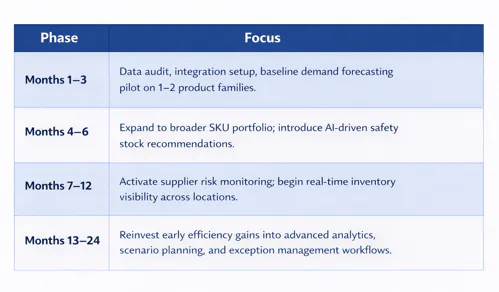
AI-enabled supply chain management is not a one-time deployment. Value compounds as models improve and processes adapt.
A structured 12–24-month roadmap typically looks like this:
Common Pitfalls to Avoid
-
Choosing tools before fixing data
-
Going too broad too quickly
-
Siloed implementation across functions
-
Underestimating change management
From Reactive Planning to Structural Stability
Reactive planning is expensive, not always in obvious ways, but over time. Each manual adjustment, buffer increase, and last-minute production change adds variability that builds across planning cycles.
AI-driven supply planning in the pharma industry changes how those decisions are made. When forecasting logic, inventory constraints, and supplier risk signals are embedded directly into the planning system, recalculation becomes structured rather than improvised.
Planners shift from constantly correcting instability to supervising a controlled, transparent decision process.
For mid-market pharmaceutical companies, the answer is not larger systems. It is planning tools built for regulated operations, where transparency, traceability, and compliance are part of everyday workflows.
Platforms such as PLAIO combine AI-powered forecasting, scenario modeling, and inventory optimization within a pharma-specific framework. It comes from systems built to handle volatility without continuous planner-led correction
Frequently Asked Questions
What is AI-driven supply planning in the pharma industry?
It uses AI algorithms to improve demand forecasting, inventory management, and risk modeling across the pharmaceutical supply chain.
How does AI improve demand forecasting in pharma?
AI analyzes historical data and real-time signals to reduce forecast bias and improve planning accuracy.
Does AI-driven supply planning support regulatory compliance?
Yes. Transparent modeling, validation documentation, and audit trails support ensuring compliance in regulated environments.
Is AI suitable for mid-market pharmaceutical companies?
Yes. A phased roadmap allows controlled implementation without enterprise-scale disruption.
How does AI reduce excess safety stock?
AI replaces buffer-based planning with signal-driven inventory management based on demand variability and supplier performance.
What data is required for AI-driven supply planning?
Clean historical demand data, supplier lead time records, inventory levels, and defined planning constraints.
How long does it take to implement AI-driven supply planning in the pharma industry?
Most mid-market pharmaceutical companies see measurable improvements within three to six planning cycles when implementation follows a structured roadmap.