TLDR:
Pharmaceutical supply chains operate under tightly connected constraints. Disruptions make it difficult to trace impact across systems.
Connecting AI directly to a planning engine addresses this. It combines real-time data with structured reasoning, allowing teams to evaluate impact and act faster.
This shift goes beyond automation. It changes how planning decisions are made.
The pharma supply chain is entering a different phase.
Planning systems are no longer limited to dashboards or static reporting. They are starting to become accessible through direct interaction.
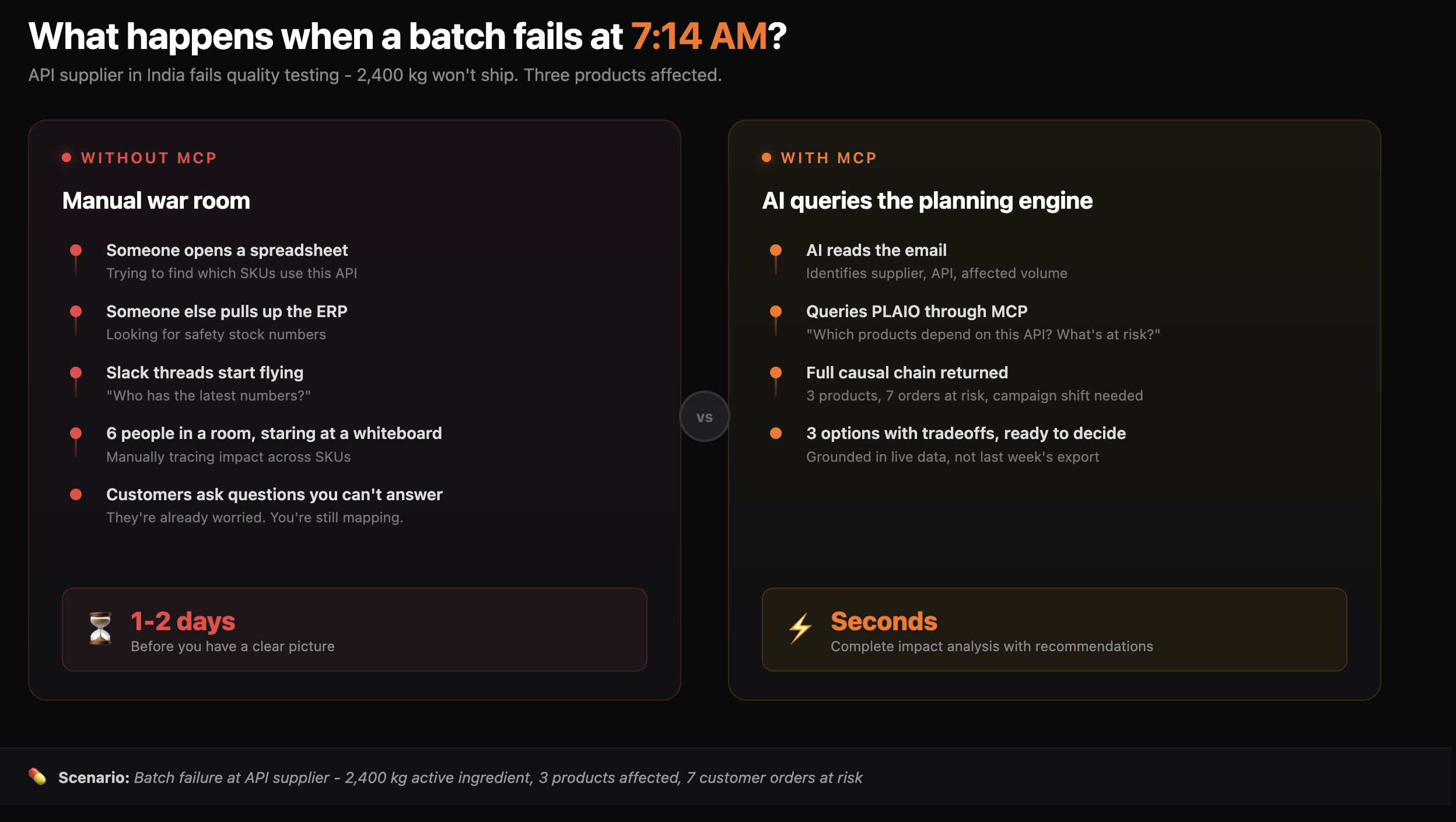
A failed batch at an API supplier creates an immediate impact:
-
2,400 kg of active ingredient does not ship
-
Multiple products are affected at once
Across the pharmaceutical industry, this situation triggers the same sequence. Teams move between spreadsheets, ERP systems, and internal threads to understand which SKUs are affected, which customer orders are at risk, and what production runs need to change.
The process takes time. Sometimes a full day, sometimes longer. By the time the impact is clear, customer questions have already started.
What if your AI assistant could query the planning engine directly?
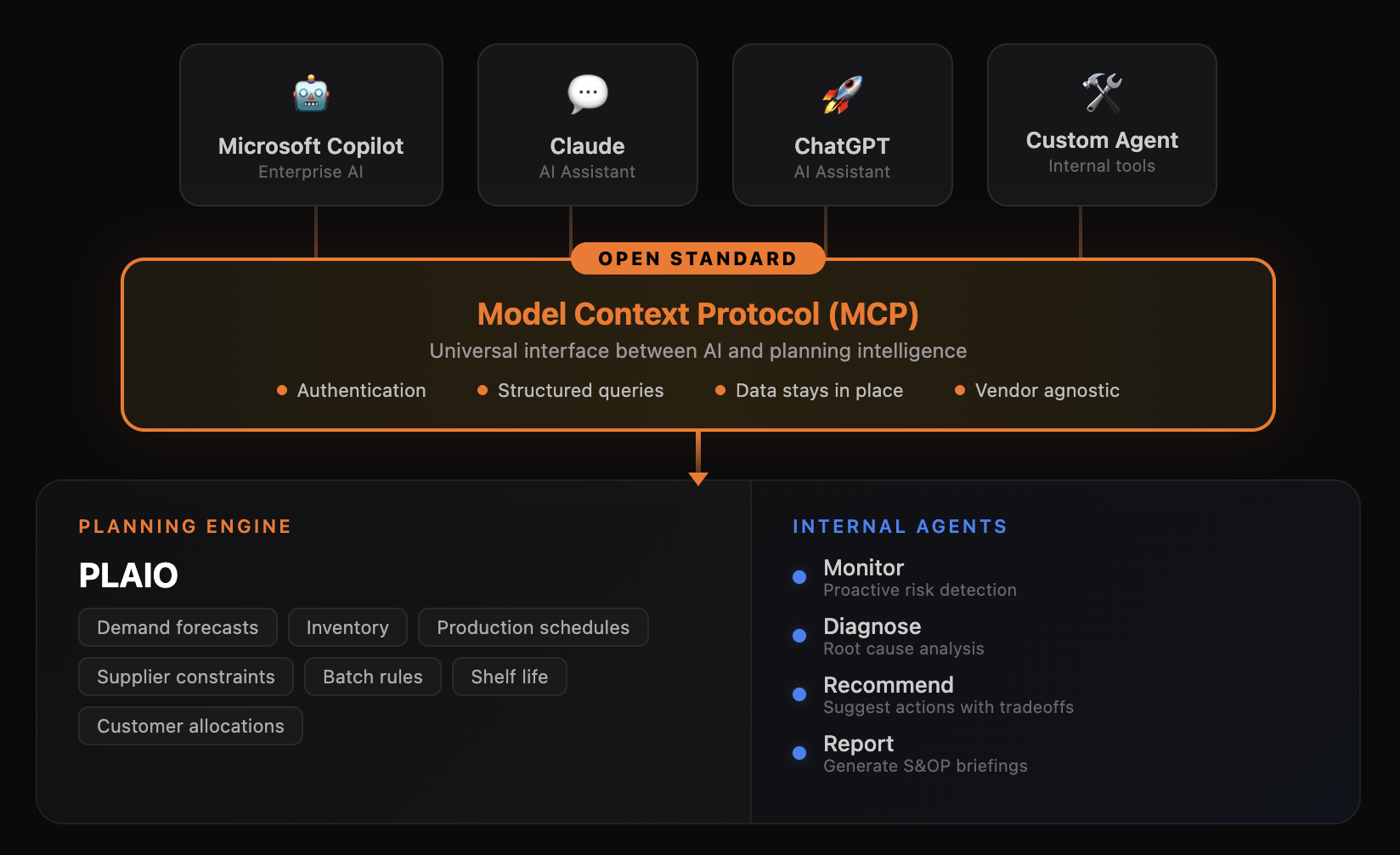
Not a chatbot or a summary of yesterday’s report. This would be a real-time interaction with the system that holds demand forecasts, inventory positions, production schedules, and supplier constraints.
The difference is immediate.
Why causality changes everything
Most AI tools in supply chain today focus on two areas. They summarize existing data or generate predictions from patterns. Both are useful, but neither reflects how decisions are actually made.
Pharma planners do not lack data. They need to understand how constraints interact. Planning decisions depend on multiple factors:
-
Batch sizes
-
Shelf life
-
Equipment compatibility
-
Cleaning sequences
-
Regulatory requirements
-
Customer allocation rules
These constraints are interconnected. A disruption does not move in a straight line. It spreads across the system. This defines how pharmaceutical planning operates.
When AI connects directly to a planning engine that understands these constraints, the interaction changes. Instead of retrieving data, the system evaluates options. It presents tradeoffs and recommends actions based on service level priorities.
This interaction is enabled by a direct connection between AI and the planning engine.
What this looks like in practice
- Scenario planning in natural language
Instead of building scenarios manually, planners describe the change.
“What happens if we delay the Lisbon campaign by two weeks and pull forward the Copenhagen batch?”
The system evaluates constraints and identifies what works, what breaks, and what needs adjustment. - Executive briefings grounded in live data
The AI queries PLAIO for service levels, at-risk orders, inventory health, and production utilization. It generates an S&OP summary based on current data, not static exports. - Supplier risk assessment in real time
“Which products have single-source API dependencies with less than 60 days of safety stock?”
This question previously required cross-functional coordination. The system now returns the answer directly. - Faster onboarding for planners
New team members can ask how the supply chain operates, how products are connected, and why decisions were made. Responses are based on actual planning data, not outdated documentation.
The quiet shift
Technology adoption tends to follow a pattern:
-
Processes are digitized
-
Then optimized
-
Then systems begin to participate in decisions
Pharma supply chain planning remains between the first two stages. Data exists across ERPs, spreadsheets, and planning tools. Some processes have improved, such as forecasting and order suggestions.
The next step requires systems to evaluate context and tradeoffs.
A planning engine must interact directly with AI. It operates within the decision process, not as a separate layer. It reflects the constraints of pharmaceutical manufacturing and works alongside planners.
The planning engine becomes operational intelligence
The implications extend beyond disruption management. When a planning system connects with AI agents, it becomes part of a broader operational layer:
-
ERP systems connect to it
-
Quality systems connect to it
-
Commercial inputs connect to it
The AI interface makes this accessible through direct questions.
Decision-making becomes more consistent and less dependent on manual coordination. Organizations that adopt this model will:
-
Plan faster
-
Respond with greater clarity and consistency
Others will continue to rely on manual updates and fragmented views. In pharma, delays have direct consequences. A stockout affects patient access to medication. Response time matters.
This is where planning is going
We built PLAIO to make pharmaceutical supply chain planning simple. That mission remains.
What has changed is how simplicity is defined. It no longer comes from a better interface or a faster algorithm. It comes from access to planning intelligence at the moment decisions are made.
-
A dashboard for the big picture.
-
A detailed view for deeper analysis.
-
And now, a conversation for working through complex decisions.
The planning engine becomes accessible.
PLAIO is a pharma-native planning platform covering demand, supply, and production. It is used by pharmaceutical manufacturers and CDMOs across Europe and North America.
To see how AI-connected planning works in practice, get in touch.
