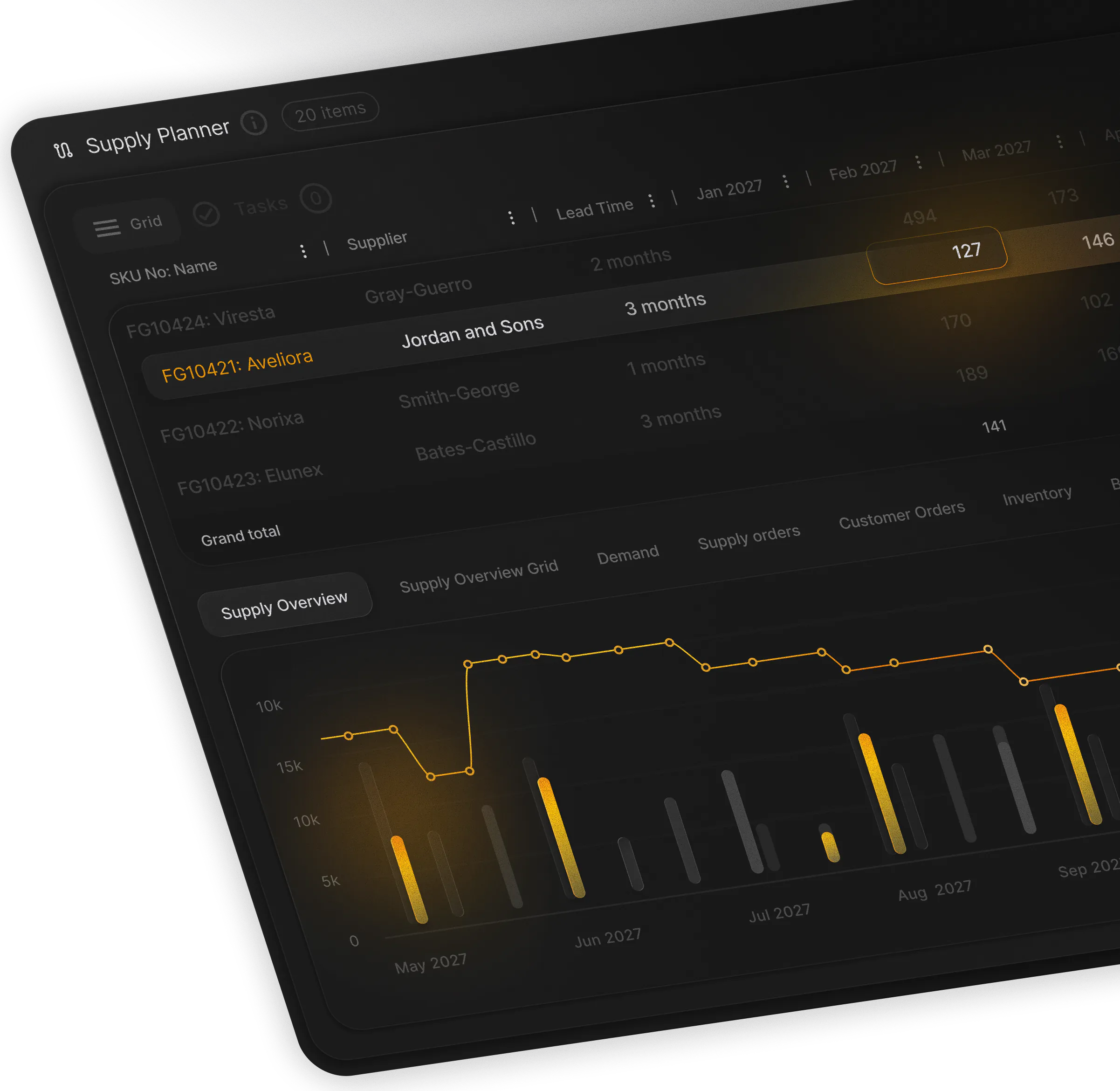


In my years helping pharmaceutical companies optimize their operations, I’ve seen one question come up repeatedly: what is the best pharma supply chain planning software? The answer, however, isn’t found in a feature list for a generic ERP module or a powerful-but-fragile spreadsheet. The truly superior platforms are those designed specifically for the industry’s realities. Generic software consistently fails because it cannot manage three core requirements out-of-the-box: batch-level expiry, constraint-based production, and full transparency into planning decisions. This gap forces brilliant planning teams into reactive firefighting, drives up costs from waste and write-offs, and leaves critical decisions undocumented. The only sustainable solution is a platform built from the ground up for the pharmaceutical operational model, delivering the end-to-end visibility and resilience needed to thrive.
The High Cost of Mismatched Tools
I’ve spent most of my career in operations research, with the last several years focused entirely on the pharmaceutical industry. I’ve seen brilliant planning teams held back by tools that are fundamentally unfit for their work. You know the symptoms because your team lives them every day. It’s the Monday morning scramble to update the sprawling “master spreadsheet”: a fragile behemoth that represents a massive business risk. One broken formula or one key planner on vacation can bring the entire process to a halt. It’s the data silos across your ERP, Quality Management System (QMS), and Laboratory Information Management System (LIMS) that force your team into multi-hour data-gathering exercises for every “what-if” scenario. A simple question like, “What happens if we pull forward the launch date for Product X by two months?” triggers a cascade of manual work instead of a quick simulation.
This constant data reconciliation and manual translation forces you to operate in a reactive state. Instead of strategically positioning inventory or optimizing production campaigns, your planners are stuck in a cycle of firefighting: expediting API shipments at exorbitant costs, begging QC labs to prioritize a sample, and making last-minute production schedule changes that disrupt the entire facility. The problem isn’t your team’s dedication or skill; it’s the mismatch between generic tools and the non-negotiable realities of pharma. A purpose-built solution isn’t a luxury; it’s a necessity for moving from reactive firefighting to proactive control.
Key Capabilities of the Best Pharma Supply Chain Software (And Where Generics Fail)
The disconnect between generic software and pharmaceutical needs creates three critical, and often intertwined, failures. These aren’t minor inconveniences. In our industry, a stockout isn’t just a missed sale; it means a patient is at risk of missing a life-saving medicine. An expired batch isn’t a minor inventory loss; it’s a primary reason why 72% of all pharmaceutical returns are due to expired drugs[1], representing billions in lost value and wasted resources. The best software addresses these challenges head-on.
1. Advanced Shelf-Life Management with Batch-Level Granularity
In nearly every other industry, inventory is a single number representing a quantity of a specific SKU. In pharma, inventory isn’t a single number; it’s a collection of distinct, individual batches, each with its own unique expiry date, potency, and quality status. Generic tools that treat inventory as a homogenous pool are fundamentally blind to this reality. They can’t distinguish a batch of high-value biologics expiring in 36 months from one expiring in 14.
This blindness leads directly to preventable, high-cost failures. Planners, unable to see the full shelf-life profile of their inventory across the network, inadvertently allocate long-shelf-life batches to markets that would accept shorter-dated products. Meanwhile, shorter-dated batches sit in a warehouse until they can no longer meet the minimum shelf-life requirements of any market, forcing them to be written off.
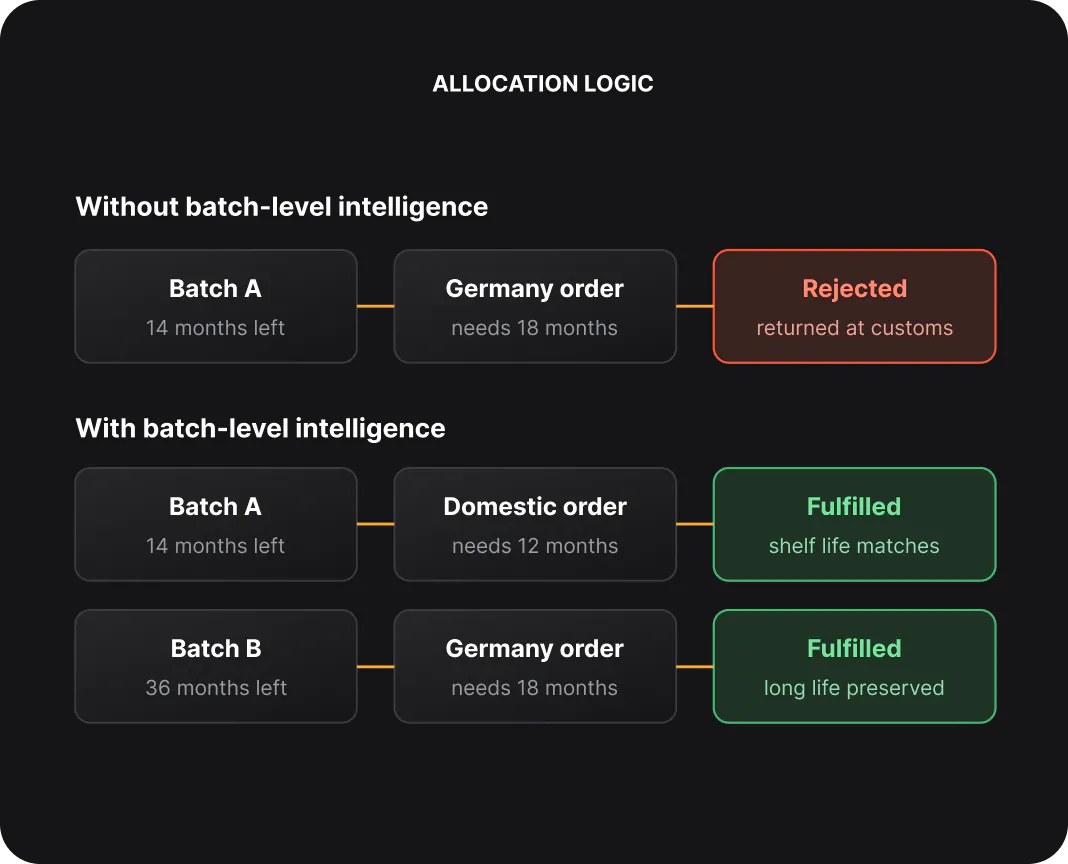
A Concrete Example: The Multi-Million Dollar Allocation Error Imagine you have two batches of a finished drug. Batch A expires in 14 months, and Batch B expires in 36 months. You receive two orders of equal size: one for Germany, which has a strict regulatory requirement of 18 months’ remaining shelf life upon import, and another for your domestic market, which accepts 12 months. A generic ERP or spreadsheet-based system sees one undifferentiated pool of stock. It might randomly (or using a simple FIFO logic) assign Batch A to the German order. The shipment is sent, only to be rejected at customs, resulting in costly return logistics, wasted transport capacity, and a potential stockout in a key market. Batch B, with its valuable 22 extra months of shelf life, is used to fulfill the domestic order where that long life was not required. A purpose-built system would have automatically flagged Batch A as ineligible for the German order and reserved it for the domestic one, saving the company from a significant financial loss and a major operational headache.
Self-Assessment Checklist: Shelf-Life Management
- Can my current system automatically prevent the allocation of a batch to a market where it doesn’t meet the minimum remaining shelf-life requirement?
- Does our planning process proactively identify and prioritize the use of shorter-dated inventory for eligible orders?
- Can I, in under a minute, generate a report showing the total value of inventory that will expire in the next 3, 6, and 12 months, broken down by product and location?
- Is batch-level data (like expiry date and quality status) an integrated part of my planning environment, or is it something planners must look up manually in another system?
How to solve it:
- Implement Full Batch Traceability: Your system must be built on a foundation of full batch-level traceability. This isn’t just about the finished good; it’s about tracking every batch from raw material and API lots through intermediate stages to the final packaged product, maintaining a complete genealogy across the entire supply network.
- Automate Shelf-Life Rules: The platform must be able to model and automatically enforce complex, market-specific shelf-life requirements during the planning and allocation process. This should be a configurable rule (e.g., “Market X requires 75% of total shelf life remaining at time of receipt”), not a manual check by a planner.
- Drive Intelligent Allocation: Use this batch-level visibility to drive intelligent allocation strategies. This means the system can automatically match the right batch with the right order, prioritizing the use of shorter-dated stock for markets that will accept it, thus preserving longer-dated stock for more demanding markets. This transforms a major source of loss into a competitive advantage and helps you minimize the waste of expensive APIs and finished goods.
2. Realistic Production Planning with Constraint-Based Feasibility
Pharmaceutical manufacturing is a world of discrete batches, complex multi-step processes, and intricate production campaigns, not a continuous, high-volume flow like automotive or consumer goods. Generic planning tools, born from these other industries, generate nonsensical requirements like “produce 7,351 units next Tuesday.” This forces a human planner to spend hours manually translating this abstract number into a realistic, executable schedule.
These tools simply don’t understand the fundamental constraints of pharma production. They don’t know about minimum and maximum batch sizes for a specific reactor, the 12-hour cleaning and changeover time required between different products on a blistering line, or the complex trade-offs of campaign sequencing to minimize contamination risk and cleaning costs. This disconnect between the plan and reality is a direct cause of inefficiency and supply disruption. Manufacturing issues are consistently reported as a leading cause of medicine shortages; in Australia, for example, they accounted for 63% of initially reported shortage reasons in 2023[2], according to the Therapeutic Goods Administration (though the exact share varies by market and reporting methodology).
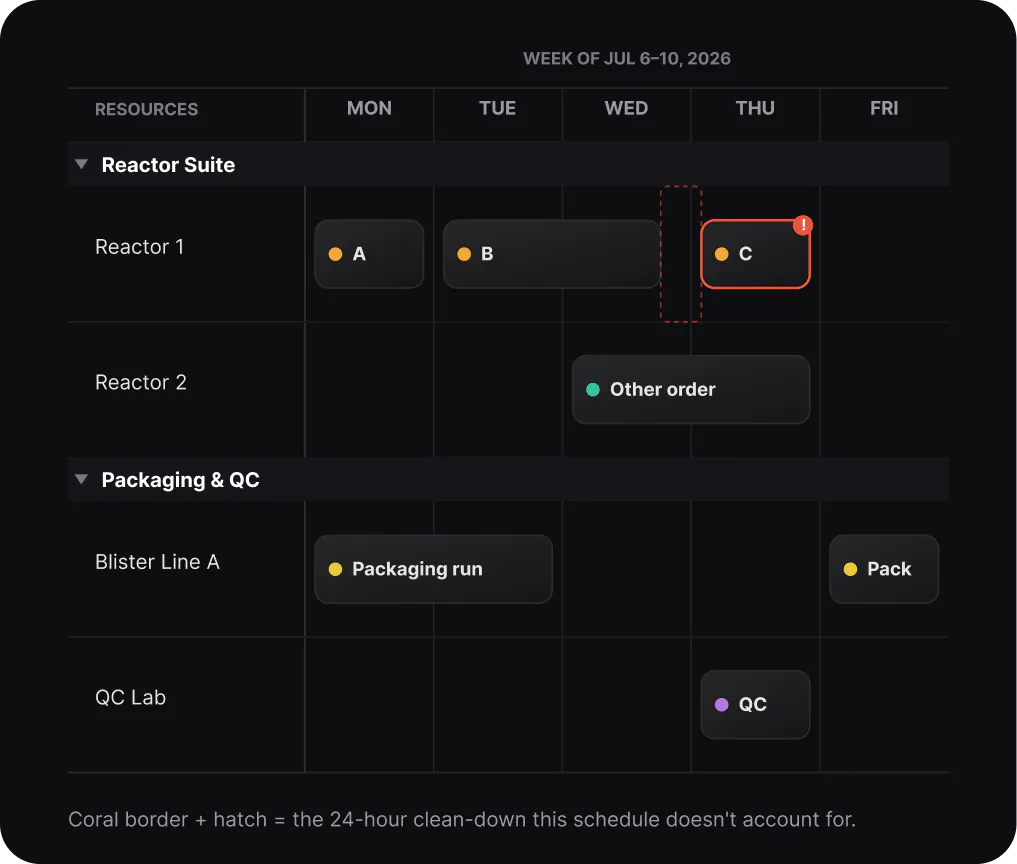
A Concrete Example: The “Feasible” but Impossible Plan An MRP run in a generic ERP system generates a list of planned orders for the week. It tells the planner to produce a small batch of Product A on Monday, a full campaign of Product B on Tuesday and Wednesday, and another small batch of Product C on Thursday. What the system doesn’t know is that Product A and C are highly potent compounds requiring a full terminal clean-down of the suite, a process that takes 24 hours. The planner immediately sees that the schedule is impossible. To execute it would require two full clean-downs, wiping out any potential profit from these small batches and causing significant delays. The planner must now manually re-sequence the entire week, delaying other orders, and trying to bundle the small requirements into future campaigns, a process that is both time-consuming and prone to error.
Self-Assessment Checklist: Production Feasibility
- Does my system generate a production plan that I can immediately share with the shop floor, or does it require significant manual rework and translation?
- Can my system model and respect multiple constraints simultaneously (e.g., machine capacity, labor availability, tooling, and QC lab throughput)?
- When a line goes down unexpectedly, can I see the full “ripple effect” on all downstream production orders and customer delivery dates in minutes?
- Can my planning tool suggest an optimal production sequence to minimize changeover times and maximize throughput, or is this dependent on the tribal knowledge of my senior planners?
How to solve it:
- Use Constraint-Based Optimization: Your tool must generate feasible schedules from the very start. It should do this by natively understanding your facility’s unique constraints (minimum/maximum batch sizes, equipment-specific run rates, changeover matrices, and labor limitations) and using constraint-based optimization to create a plan that is not just mathematically ideal but physically possible.
- Run End-to-End Feasibility Checks: A plan is only feasible if all its components are available. Your platform must support end-to-end feasibility checks that instantly show how a change in the demand forecast impacts not just the load on a specific production line, but also the required availability of the corresponding API, excipients, and primary packaging. This is the core of effective S&OP and detailed production scheduling.
- Leverage Rapid Scenario Planning: Empower planners to move from being data janitors to strategic decision-makers. Intuitive scenario planning tools should allow them to compare the trade-offs between different production strategies in minutes, not days. They should be able to answer questions like, “What is the impact on cost and service level if we run a larger campaign of Product Z now versus two smaller ones later?“
3. Full Transparency with a Complete Change History
A planning system is a decision-support tool; the formally regulated records, such as batch records, quality events, and release decisions, live in your execution and quality systems (ERP, MES, QMS). What planning software owes you is something more operational: accountability. When a number in the plan changes, everyone should be able to see who changed it, when, what it was before, and ideally why. That is how a consensus plan survives handoffs, vacations, and personnel changes, and it is how a planning organization learns from its own decisions instead of endlessly relitigating them.
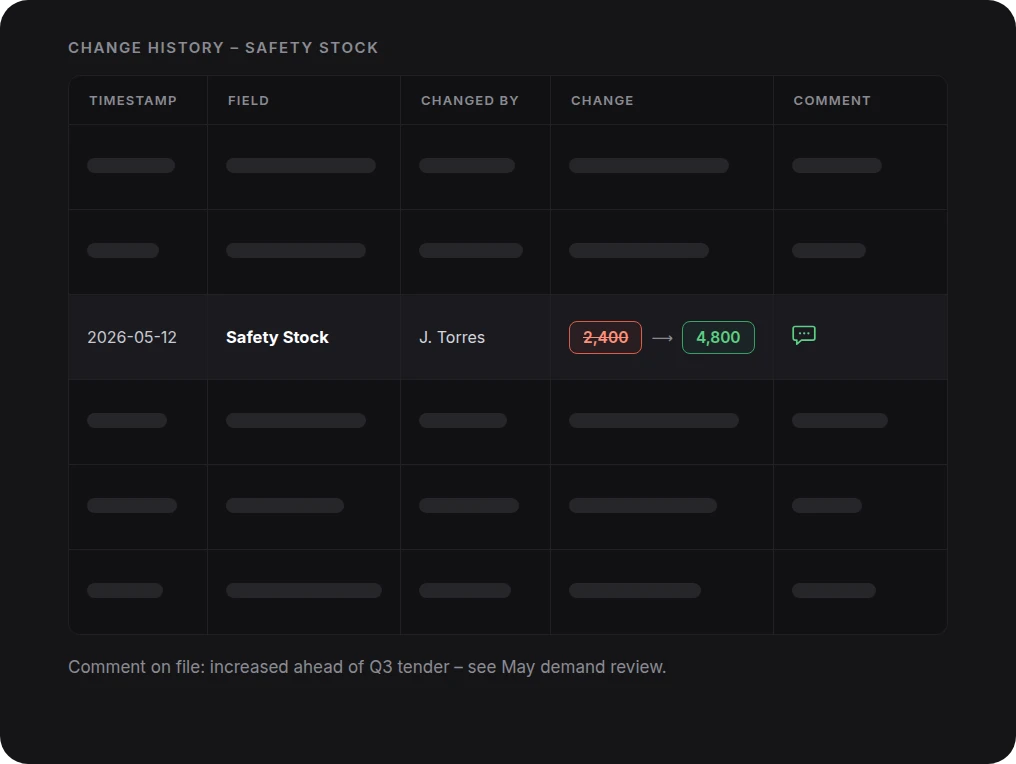
A Concrete Example: The Vanished Justification It’s the Monday supply review, and someone asks why the safety stock for Product X was doubled. The change is tying up hundreds of thousands of dollars in API. The planner who made it is on leave. In a spreadsheet, the old value is gone; nobody can even say when the change happened, let alone why. The meeting stalls, the decision gets second-guessed, and the team spends the afternoon reconstructing the reasoning from email fragments. In a system with a complete change history, anyone in the meeting pulls up the parameter’s history in seconds: exactly which planner changed it, on May 12th, from 2,400 to 4,800 units, along with the comment they left: “Increased ahead of the Q3 tender; see May demand review.” The context is restored, and the meeting moves on.
Self-Assessment Checklist: Planning Transparency
- For every critical planning parameter (e.g., safety stock level, production lead time, forecast override), can we see who changed it, when, and the before-and-after values?
- Can planners attach a comment to a change so the reasoning survives handoffs and vacations?
- When a number is challenged in an S&OP meeting, can we trace its history in seconds without leaving the planning environment?
- When last quarter’s plan went wrong, can we reconstruct the decisions that led there and learn from them?
How to solve it:
- Demand Change History at the Data Level: Every edit to planning data should be recorded automatically, capturing the user, the timestamp, the field, and the old and new values. This should give you a full history of planning assumptions and changes, not a separate log that someone has to remember to maintain.
- Keep the “Why” Next to the “What”: The value of a change record multiplies when planners can attach a comment explaining the reasoning. The justification then lives permanently alongside the change itself, instead of in an inbox that walks out the door when a planner moves on.
- Make the History Usable, Not Just Available: A change log buried in a database export helps no one. The history should be accessible right where planning happens: scoped to the exact row or parameter you are questioning, filterable by user or field, and readable in seconds during a live meeting.
A Framework for Evaluating the Best Pharma Supply Chain Planning Software
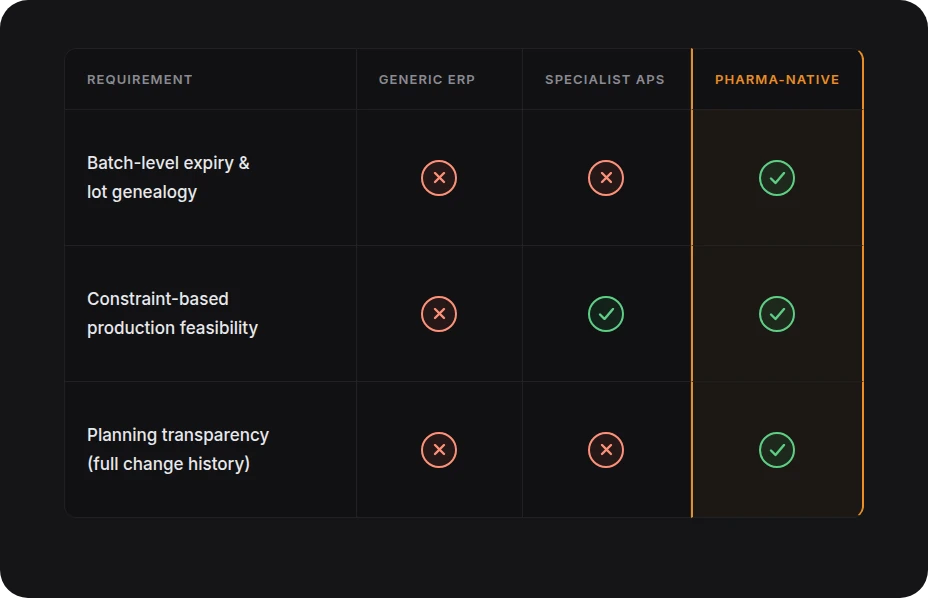
When you evaluate the software market through the lens of these three non-negotiable pillars (batch-level expiry, constraint-based feasibility, and planning transparency), the choices become much clearer. The critical question to ask any vendor is: “Does this solution solve for all three of these core pharma requirements out-of-the-box?”
Objection 1: “Our ERP can be customized. Isn’t that the safest bet?”
Many companies default to their incumbent ERP provider, viewing it as the lowest-risk path. While these platforms are powerful transactional systems, they are fundamentally blank slates when it comes to advanced planning. They require immense, high-risk, multi-year customization projects just to understand pharma basics like market-specific shelf-life rules or campaign-based manufacturing. Each piece of custom code introduces a new point of failure and must be painstakingly specified, built, tested, and maintained.
You end up paying twice: once for the module license, and again for a massive services engagement to build what a pharma-native tool provides on day one. This custom-built solution then becomes a maintenance nightmare. Every time the core ERP is updated, you risk breaking your customizations, forcing a new round of expensive rework and retesting. This approach creates a fragile, rigid system that is difficult and expensive to maintain.
Objection 2: “What about a specialized Advanced Planning System (APS)? They have great optimizers.”
Specialist APS tools are a significant leap beyond ERPs and are rightly favored by planners for their powerful optimization engines. They often excel at modeling complex production constraints. However, their core data models were not designed for the pharmaceutical world. They cannot natively handle batch-level expiry and full lot traceability, and they rarely give planners any visibility into the history of the plan itself: who changed what, when, and why. This forces you to maintain disconnected systems and build fragile, expensive integrations to bridge the gaps. For example, you might manage shelf-life rules in a spreadsheet and try to feed the output into the APS, or attempt to sync batch-level data from your ERP. When these integrations fail, and they often do, the plan is based on bad data, leading to the very waste and stockouts you were trying to prevent, with some estimates showing ~4% of all pharma inventory is written off, costing 28 top companies over $11bn annually[3].
The Alternative: A Pharma-Native Solution
This brings me to why my colleagues and I built PLAIO. As a founding team of former pharma planners and supply chain experts, we lived this pain firsthand. A pharma-native platform is a fundamentally different approach. Instead of retrofitting a generic tool, you start with a system built from the ground up on the core concepts of batches, expiry dates, market-specific regulatory constraints, and transparent, traceable planning decisions. The data model “thinks” the way a pharma planner does.
This “native speaker” model dramatically de-risks implementation and accelerates your time-to-value. The system already understands your business reality, so the implementation process is one of configuration, not custom coding. You are teaching the system your specific products and market rules, not teaching it what a batch is. This allows for faster deployment, lower risk, and a system that can evolve with your business instead of holding it back.
The Path to Proactive Control: Choosing the Right Pharma Planning Software
The pharmaceutical supply chain is only growing more complex, a reality highlighted by the World Health Organization’s finding that the number of molecules in shortage in two or more countries rose 101% between September 2021 and early 2024[4], and a key theme at recent industry events like LogiPharma. Sticking with spreadsheets or generic software is an active acceptance of unnecessary risk, cost, and waste. It burns out your most valuable asset, your planning team, by forcing them to spend their days gathering and cleansing data instead of making the critical decisions that protect patients and drive the business forward.
Ultimately, the best pharma supply chain planning software is not a generic tool you force to fit your process. It is a strategic partner that understands your world of batches, constraints, and accountable decisions from day one. By prioritizing a pharma-native solution, you empower your team with the end-to-end visibility and intelligent optimization needed to navigate complexity, reduce waste, and ensure that life-saving medicines reach the patients who depend on them. The right tool unifies your data, respects your operational reality, and keeps a transparent record of every planning decision. It gives your team the power to anticipate problems, evaluate trade-offs, and make decisions with confidence. It’s time to move from reactive firefighting to proactive, confident, and accountable supply chain management. If you’re ready to see what a purpose-built platform can do for your team, I encourage you to request a demo and see the difference for yourself.
References
- Russo, Holly. “Pharmaceutical Waste and the Bottom Line.” Healthcare Financial Management Association (HFMA), 3 May 2017. https://www.hfma.org/operations-management/53966/
- Therapeutic Goods Administration. “Medicine Shortages Report 2024.” Australian Government, Department of Health and Aged Care, July 2024. Version 1.0. https://www.tga.gov.au/sites/default/files/2024-07/medicine-shortages-report-2024.pdf
- “Inventory Write Offs in Pharmaceutical Manufacturing.” nVentic. https://nventic.com/insights/inventory-write-offs-in-pharmaceutical-manufacturing/
- World Health Organization. “Shortages Impacting Access to Glucagon-Like Peptide 1 Receptor Agonist Products; Increasing the Potential for Falsified Versions.” World Health Organization, 29 January 2024. https://www.who.int/news/item/29-01-2024-shortages-impacting-access-to-glucagon-like-peptide-1-receptor-agonist-products--increasing-the-potential-for-falsified-versions