PLAIO vs SAP IBP

The SAP IBP alternative built for pharma

IBP is a planning suite for every industry, configured project by project. PLAIO was built for pharma, so shelf life, batches, CMOs and line scheduling are there on day one. It works with SAP ECC and S/4HANA. Every claim about IBP below links to SAP’s documentation.

Put a few of your SKUs through PLAIO

30 minutes with a PLAIO planning specialist. Bring a few SKUs and the questions on your IBP shortlist.

Goes straight to our team. Never shared or sold.

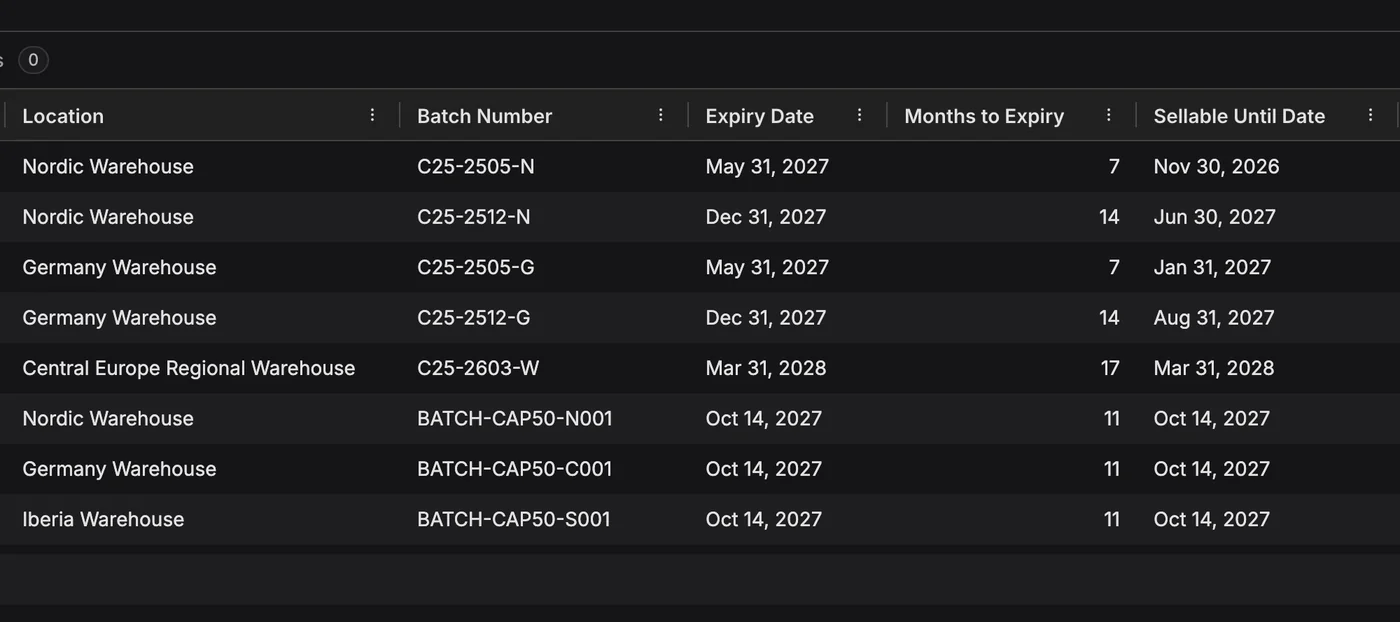
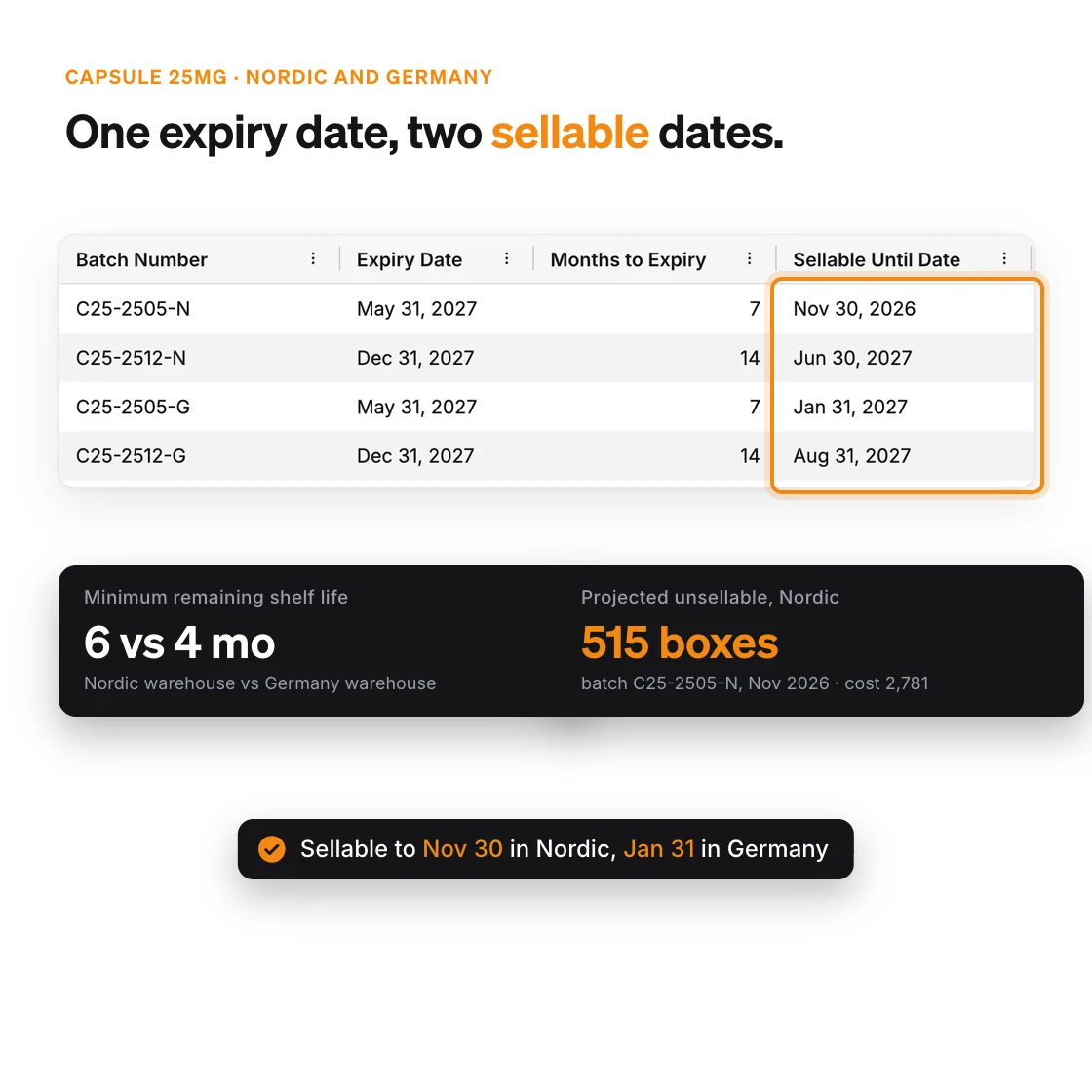
Shelf life set per market. Inventory by batch for Capsule 25mg: two batches expiring May 31, 2027 are sellable until Nov 30, 2026 in the Nordic warehouse and until Jan 31, 2027 in the Germany warehouse.
Trusted by

Leading pharmaceutical companies

Azurity
Coripharma
MS Pharma
Navamedic
AGM Pharma
Adalvo
Frostpharma
CNX Therapeutics
Arcera
Sun Wave Pharma

PLAIO vs SAP IBP, row by row

Topic PLAIO SAP IBP
Shelf life, batches and CMOs
Shelf life in every supply run ✓Every run. Batches go first-expiry-first-out; stock that will expire unsold shows with quantity and cost.20–Only in the dedicated shelf life heuristics. SAP says the other heuristics and the optimizer don’t consider it.2
Minimum shelf life per market ✓Set per item, or per item and location, so each market gets its own minimum.19–Set on demands in order-based planning, which needs real-time integration with ECC or S/4HANA.4,3
Batch-level planning ✓Stock is planned batch by batch, under the batch numbers your ERP sent.20,23–Order-based only, fed by ECC or S/4HANA. Time-series planning aggregates batches and doesn’t peg them to demand.3,2
CMO lanes and order rules ✓Lead time, MOQ, increment, maximum and frozen period on every CMO lane. A CMO order can consume a BOM.20–Subcontracting in order-based planning.10 In time-series planning, lot sizes and lead times are configured into the planning area.12
Planning and scheduling
Production scheduling on named lines ✓Built in: jobs on lines with changeovers, waits, shifts and downtime.21✕Not in IBP. SAP sells detailed scheduling separately, as SAP S/4HANA Manufacturing for planning and scheduling.13
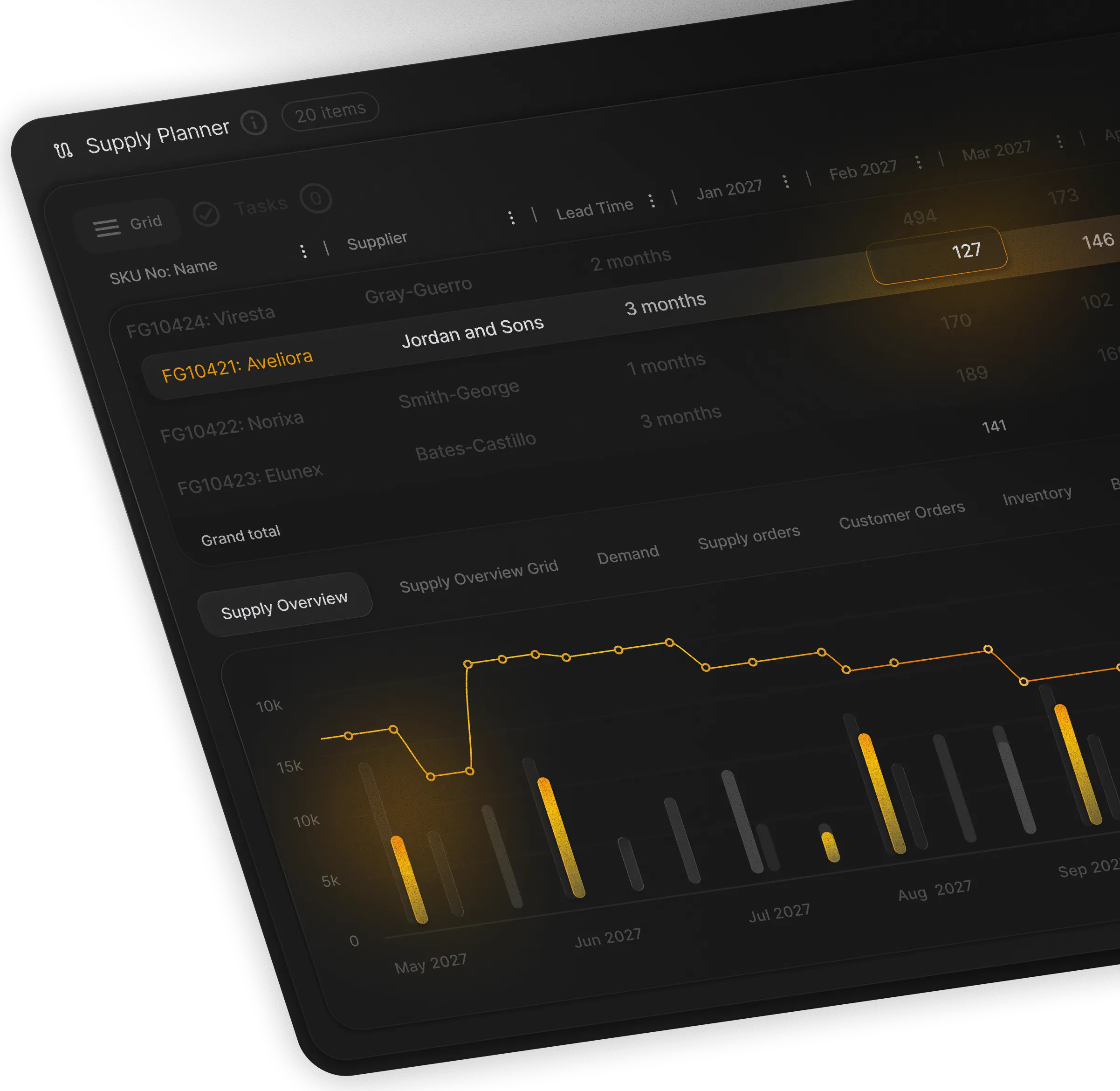
Demand, supply and production in one product ✓One connected workflow, from forecast to the shop-floor schedule.20,21–Demand, supply and inventory are separate IBP applications. Scheduling is a separate SAP product.1,13
Explainable supply plan ✓Deterministic: the same inputs give the same plan, and every order traces to its net requirement.22–Heuristics or a cost optimizer, set up as planning profiles. The optimizer may break soft constraints when that is cheaper.5,12
Optimizer ✓Pick two objectives and get up to three schedule alternatives, saved as scenarios.22✓A cost-minimizing network optimizer in IBP for response and supply. SAP also has a consulting service for it.5
Forecasting ✓ML forecast per item and location, with accuracy and bias tracked at the lag you choose.22✓A library of statistical and ML algorithms plus demand sensing, set up in forecast models.6,7
SAP, other ERPs and rollout
Setup ✓Load the spreadsheets you already keep. Planners map their own columns.24–A configuration expert builds the planning area: time profiles, levels, key figures, profiles and view templates.12
Who builds the ERP connection ✓PLAIO’s team. AI drafts the mapping and a consultant checks it.23–SAP’s onboarding centre points you to an implementation partner and SAP Activate.15
Non-SAP ERPs ✓Customers run SAP, NetSuite and Business Central, and PLAIO works with Oracle too.23–Through SAP integration products. SAP notes each separate product needs its own licence.8
SAP ECC and S/4HANA ✓Plan on ECC today and switch feeds at S/4HANA go-live. Approved orders return with approver and timestamp.23✓Real-time integration through SAP’s Core Interface (CIF). Shelf life planning depends on it.9,3
Planner interface ✓Visual planners: supply charts, an exceptions list per plan and a production Gantt.20,18✓Planner Workspaces in the browser and the SAP IBP add-in for Excel, where simulations run.11

From each vendor’s public documentation, checked October 2026.

Where PLAIO pulls ahead

The rows above in more detail, on the subjects pharma planners raise first.

Shelf life and expiry

PLAIO

In PLAIO, shelf life is part of every supply run. Set a minimum remaining shelf life per item, or per item and location, and PLAIO works out the day each batch stops being sellable in each market. A batch that will be too short-dated when it’s needed doesn’t count toward that demand, so the plan orders or moves the stock you actually need. Nobody has to remember a separate shelf-life pass.19,20

SAP IBP

IBP splits shelf life across two routes, and neither is the default. Order-based shelf life planning needs real-time integration with ECC or S/4HANA plus the finite heuristic.3 In time-series planning it lives in its own heuristic, which SAP says runs longer and uses more memory than the standard one. SAP also says no other heuristic, and not the optimizer, considers shelf life; combining them means running the optimizer in coupled mode with the distribution heuristic.2,5 For a pharma team, that is a design decision to make, configure and test before expiry shows up in the plan.

Capsule 25mg batches with expiry, months to expiry and sellable-until dates: the May 2027 batch stops being sellable on Nov 30, 2026 in the Nordic warehouse (6-month minimum) and on Jan 31, 2027 in Germany (4-month minimum); 515 boxes are projected unsellable in the Nordic warehouse

CMOs and order rules

PLAIO

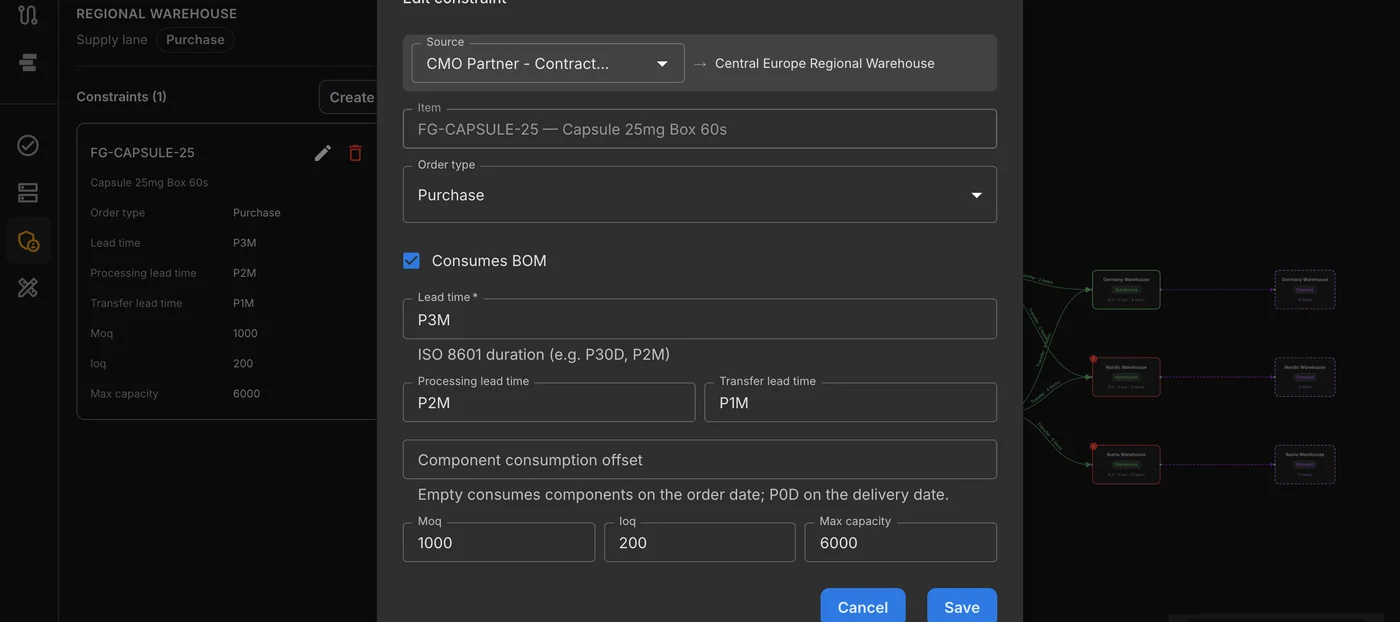
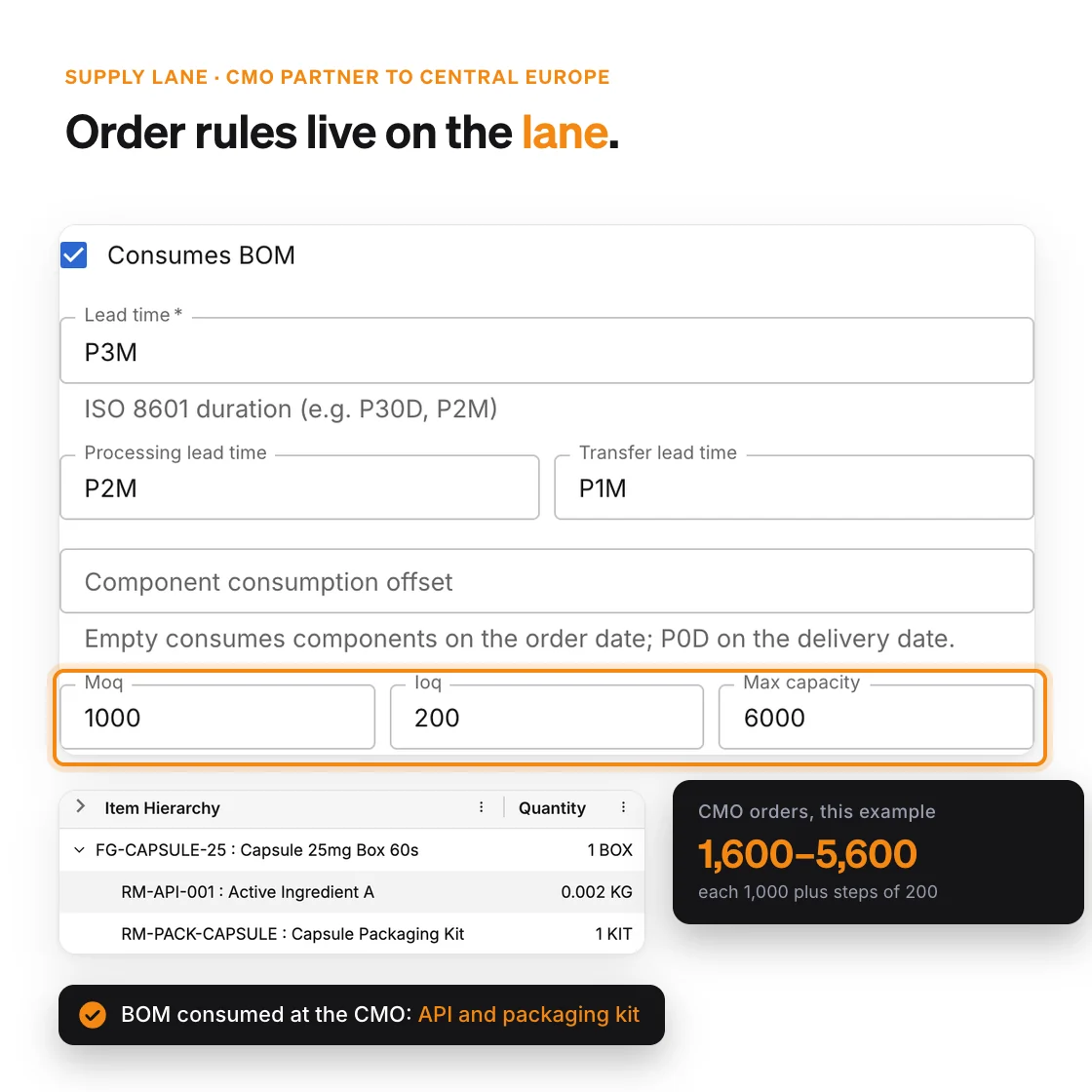
In PLAIO a CMO is a lane like any other, with its lead time (split into processing and transfer if you like), MOQ, order increment, maximum order size and frozen period already on the screen. Planned orders round up to the MOQ, then in steps of the increment: a need for 1,130 with an MOQ of 1,000 and steps of 200 comes back as 1,200. Tick Consumes BOM and the components you supply to the CMO are planned too.19,20

SAP IBP

IBP covers contract manufacturing as subcontracting in order-based planning, where the run creates subcontracting requisitions and works out component demand from a production data structure on the lane.10 In time-series planning, lot sizes, sourcing and lead times are master data types and key figures that a configuration expert has to add to the planning area.12 Either way, someone builds the CMO model before a planner can use it.

A CMO supply lane with Consumes BOM ticked, a 3-month lead time split into processing and transfer, MOQ 1,000, increment 200 and max 6,000, next to the bill of materials the CMO consumes: Active Ingredient A and a capsule packaging kit

Optimizers and scheduling

PLAIO

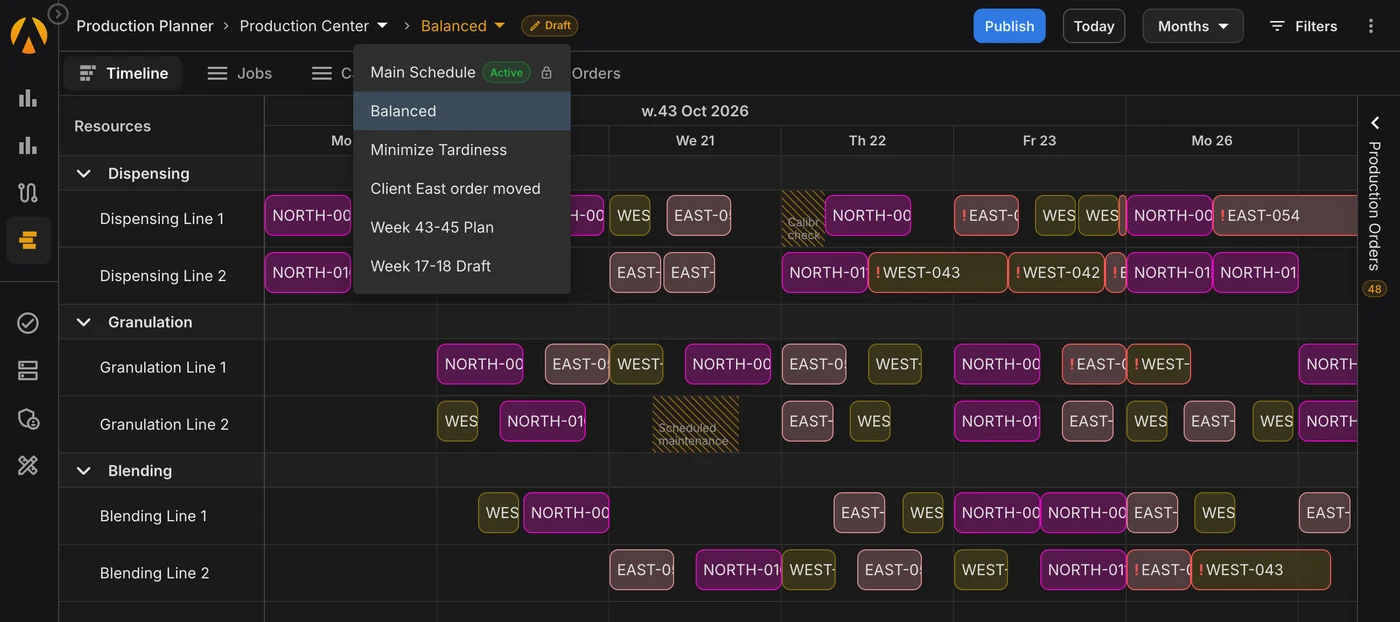
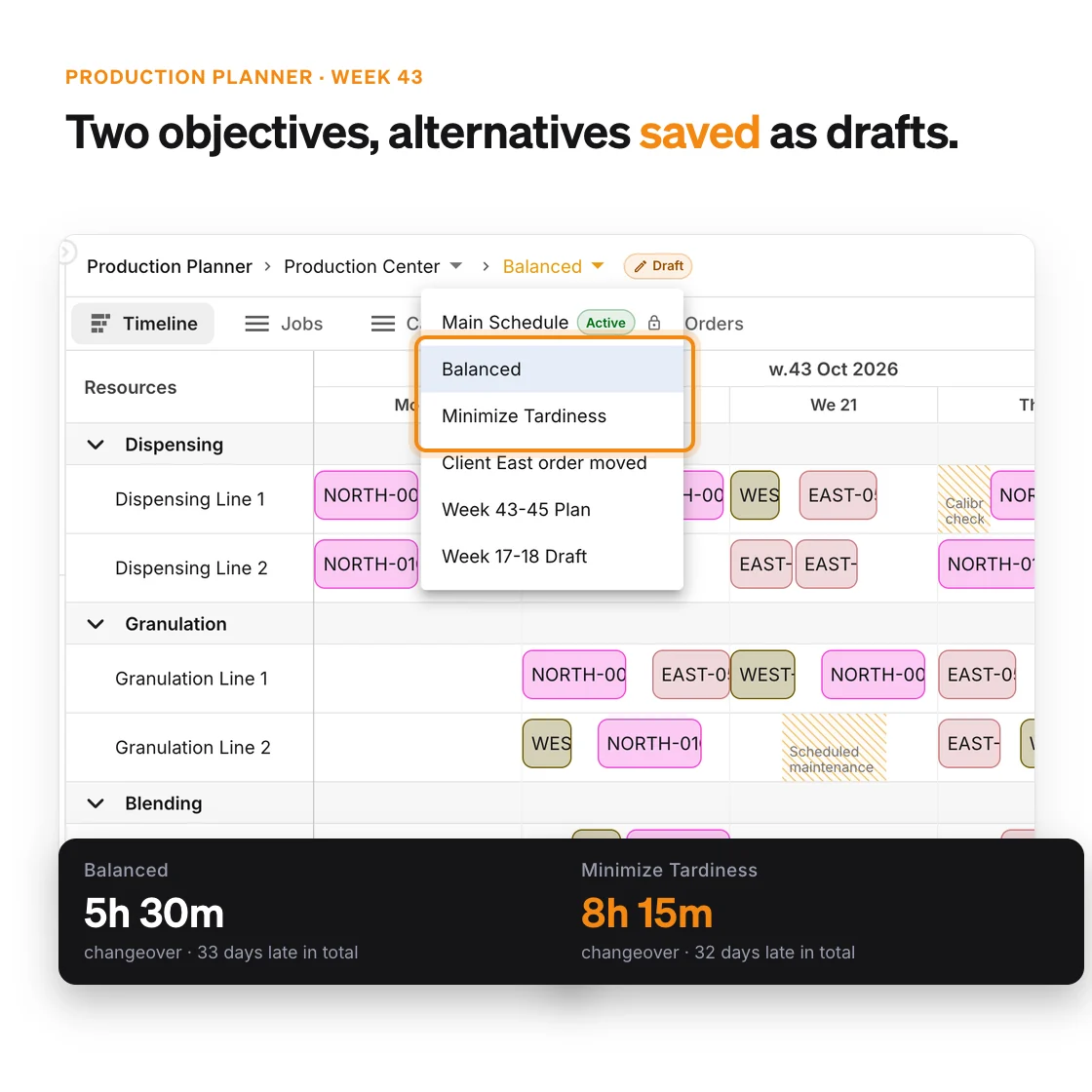
PLAIO takes you from the supply plan to a shop-floor schedule in the same product. Supply is a deterministic simulation, so any order suggestion can be explained and reproduced. Production uses a constraint-based optimizer: pick the orders and two objectives, and PLAIO saves up to three alternatives as scenarios, with jobs on named lines checked against changeovers, cleaning, waits, shifts and downtime. A fixed seed means the same inputs give the same alternatives.21,22

SAP IBP

IBP’s optimizer is a network cost model. It turns the supply chain into a mixed integer linear program and looks for the lowest total cost, and soft constraints such as safety stock carry violation costs, so it will break them when that comes out cheaper.5 It stops at the network. Machine-level scheduling is a separate SAP product, SAP S/4HANA Manufacturing for planning and scheduling, so a pharma site that wants a line schedule buys and runs a second system.13

Production schedule on named dispensing, granulation and blending lines with the scenario menu open: Main Schedule active and locked, Balanced and Minimize Tardiness saved as draft alternatives, with their total changeover time and days late

Working with SAP ECC and S/4HANA

PLAIO

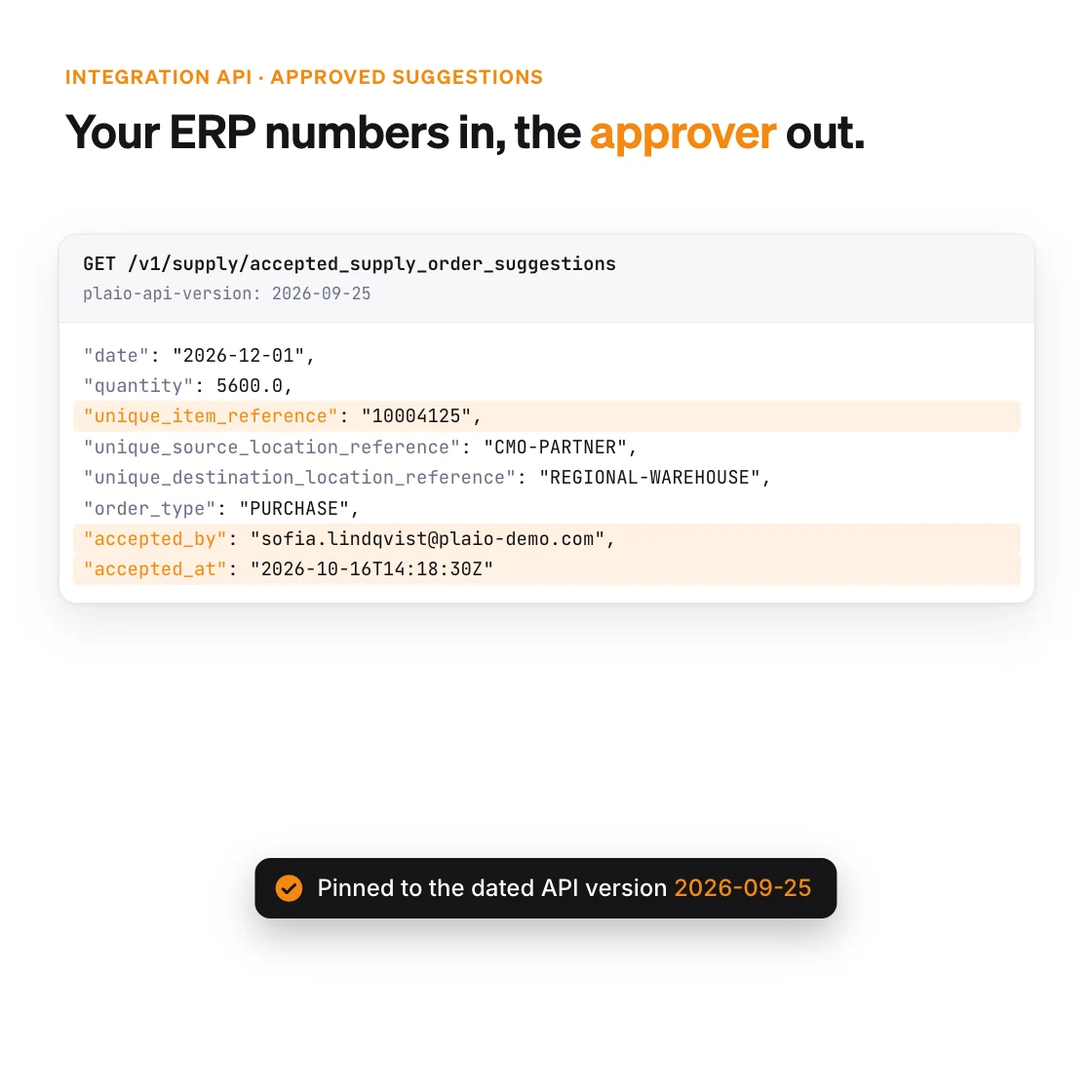
You don’t need IBP to plan well on SAP. SAP stays the system of record: your IT team gives PLAIO access to SAP or the warehouse it feeds, and our team builds the connection. Items, batches and orders keep their SAP numbers, and approved suggestions go back with the approver and a timestamp. One customer plans in PLAIO against ECC today and switches the feeds when S/4HANA goes live. Your integration is pinned to a dated API version, so a PLAIO release doesn’t change it.23

SAP IBP

IBP’s strongest link is SAP to SAP. Real-time integration uses the Core Interface (CIF) to pass ECC or S/4HANA data almost in real time, and several features depend on it, shelf life planning among them.9,3 Anything outside that runs through Cloud Integration for data services, Cloud Integration or HANA smart data integration, and SAP notes that each separate product needs its own licence.8 IBP is public cloud, upgraded on SAP’s schedule: test system first, production two weeks later.14

The Integration API response for an approved CMO order suggestion: the ERP’s own item number 10004125 and location codes, the approver’s account and the approval timestamp, requested with the dated API version 2026-09-25

Rollout and who runs it

PLAIO

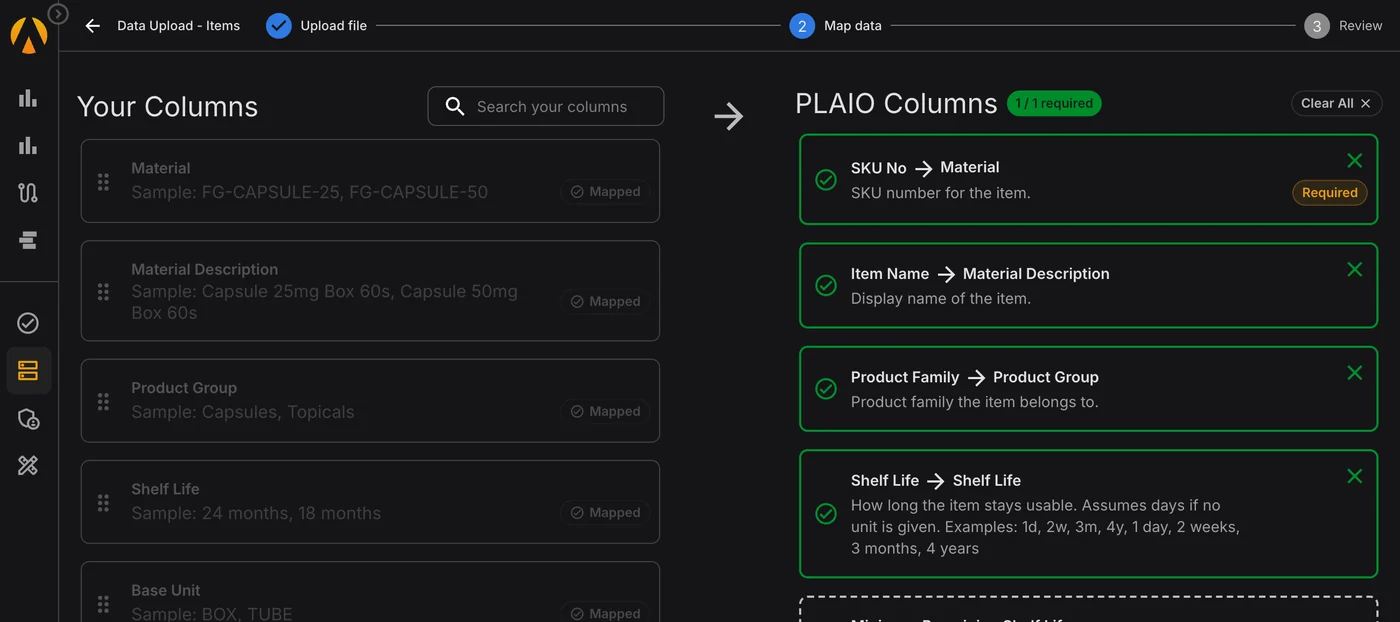
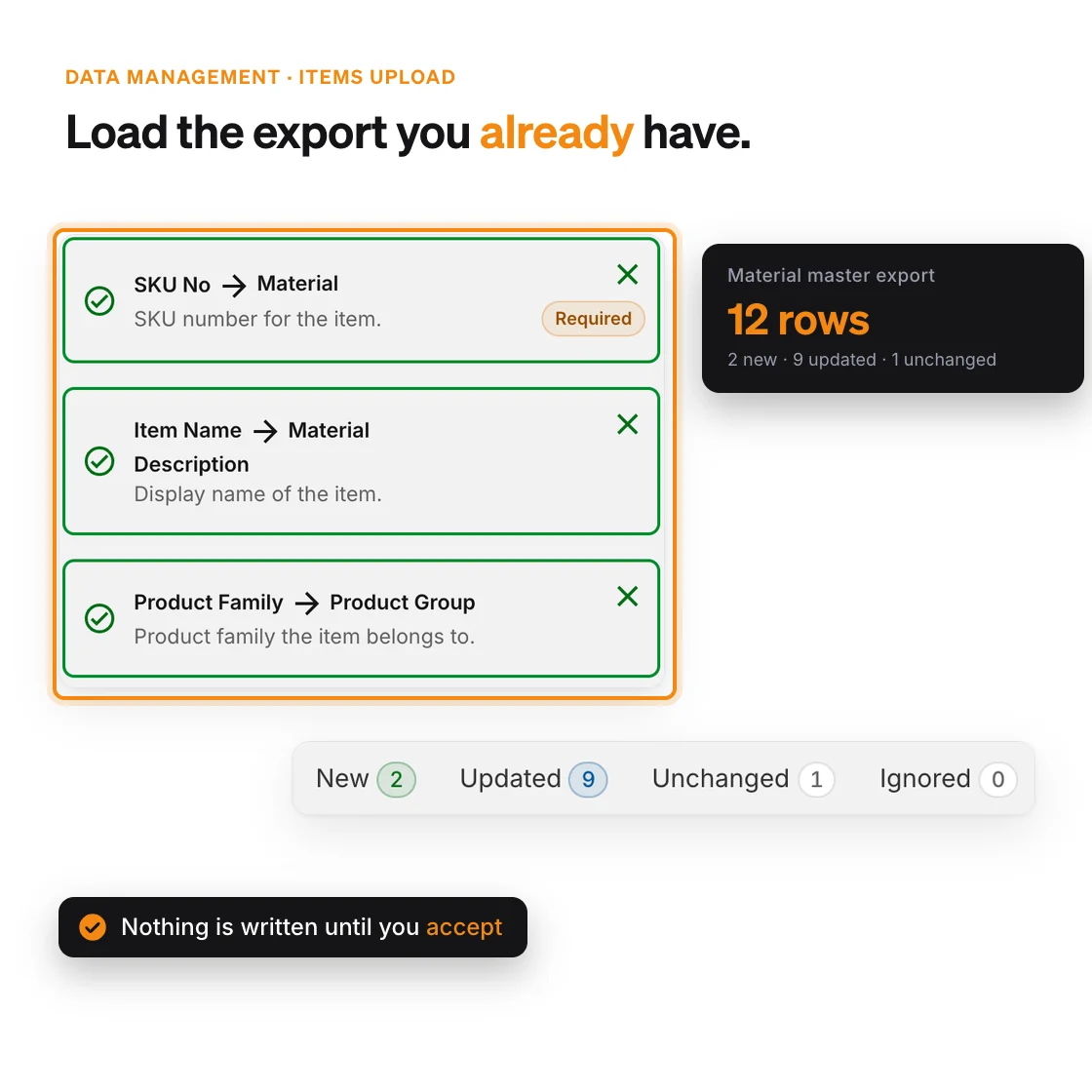
A PLAIO rollout starts with one module and the files your team already keeps. Upload an export, drag its headers onto PLAIO’s, and review new, updated and unchanged rows before anything is written. The first plan doesn’t wait for the ERP feed; when the feed arrives it matches on the same SKU numbers, so nothing is redone.24

SAP IBP

IBP is configured before it is used. A configuration expert sets up the planning area, its time profiles, planning levels, key figures and planning profiles, then builds the view templates planners open in Excel.12 SAP’s onboarding centre recommends picking an implementation partner and running the project with SAP Activate.15 That is a project team and a partner contract before the first plan, and the same people to call whenever the model needs to change.

Uploading a material master export: its headers Material, Material Description and Product Group dragged onto PLAIO’s SKU No, Item Name and Product Family, and the review step counting 2 new, 9 updated and 1 unchanged rows before anything is written

Which one fits your team

Why pharma teams choose PLAIO over SAP IBP

  • Shelf life by market, batches, MOQs and CMO lead times are in the plan from the first run, with no shelf-life heuristic to configure.19,20
  • Demand, supply and line-level production scheduling in one product, where IBP needs a second SAP product to schedule.21,13
  • Planning stays off your S/4HANA migration’s critical path: plan on ECC now and switch feeds later.23
  • You start from your spreadsheet exports, and PLAIO’s team builds the ERP connection. No configuration project, no implementation partner.24,23
  • Your ERP doesn’t have to be SAP. PLAIO customers also run NetSuite and Business Central.23

SAP IBP may suit you if…

  • You plan many industries or business units on one global platform, not pharma alone.1
  • You already have an SAP planning team or partner who will configure and maintain planning areas.12,15

Questions teams ask when ==IBP is on the list==

It’s SAP’s answer, not the only one. SAP has said mainstream maintenance for SCM 7.0, which includes APO, ends in 2027, with optional extended maintenance to 2030.16 SAP Note 2456834 describes APO as partly succeeded by S/4HANA and IBP, with no automated migration.17 So either way you rebuild. PLAIO lets you rebuild on a pharma data model, connected to ECC today and to S/4HANA when you get there.

Yes. PLAIO starts with one module and one planning scope, so the rest of the business stays where it is while you compare.24 PLAIO reads from SAP and sends approved orders back to it, so both tools can work off the same ERP data during the transition.23

Your IT team gives us access to SAP, or to the data warehouse it feeds, and our team builds the connection. Items, batches and orders keep their SAP numbers. SAP stays the system of record, and approved orders go back to it as planned orders and purchase requisitions with the approver and a timestamp.

Master data first: items, locations and bills of materials. Then inventory, and forecasts or sales orders. Each can come from a spreadsheet export while the SAP connection is built. When the connection is ready, each dataset moves to the live feed and the plan carries on.

Mostly it depends on how many modules, datasets and sites you bring in at the start, which is why PLAIO begins with one module and one planning scope and then widens it. The first plan doesn’t have to wait for the ERP integration.

A conversation with a PLAIO planning specialist about how you plan today, with a few of your SKUs as they would look in PLAIO. Bring the IBP questions you’re weighing and we’ll answer them on your own products. Book a time.

SAP, SAP IBP, SAP APO, SAP ECC, SAP S/4HANA and other SAP products named here are trademarks or registered trademarks of SAP SE. PLAIO is not affiliated with or endorsed by SAP. Microsoft Excel, NetSuite and Business Central are trademarks of their owners.

See your own SKUs planned in PLAIO

30 minutes on your products, markets and CMOs, with shelf life and batches in the plan from the start.

Test it on a few SKUs Prefer to read first? Choosing the best pharma supply chain planning software

Cookie settings

To enhance your experience on our site and to analyze traffic, we use cookies. By clicking "Accept All," you agree to the storing of cookies on your device for analytics purposes. You can manage your settings or learn more in our Privacy Policy.

Manage Settings
  • Your Privacy Matters to Us

    We use cookies to improve your browsing experience and analyze how our website is used. These cookies allow us to understand trends, monitor website traffic, and gather insights to make the site better for you.

    We respect your privacy and are committed to transparent data usage.

    Why Do We Use Cookies?

    Necessary Cookies: These ensure that the website functions properly.

    Analytics Cookies: These help us track site traffic, user behavior, and performance metrics. The data collected is anonymous and allows us to continuously optimize the site.

    Preferences Cookies: We may use cookies to remember your preferences and tailor your experience.

    Marketing Cookies: We may use cookies for marketing purposes.

    Your Control, Your Choice

    By clicking "Accept All," you consent to the use of all cookies. If you prefer, you can customize your choices and opt out of certain cookies. You can learn more about how we handle data and cookies in our Privacy Policy.