PLAIO vs Kinaxis

The Kinaxis alternative built for pharma

Kinaxis Maestro is a cross-industry platform. Scheduling comes from a partner application and the rollout often runs through a system integrator. PLAIO plans medicines and nothing else, with demand, supply and production scheduling in one product, implemented by our own team.

See a few of your SKUs planned with pharma rules

30 minutes with our team. Bring a few SKUs, the markets they ship to and the CMOs that make them.

Goes straight to our team. Never shared or sold.

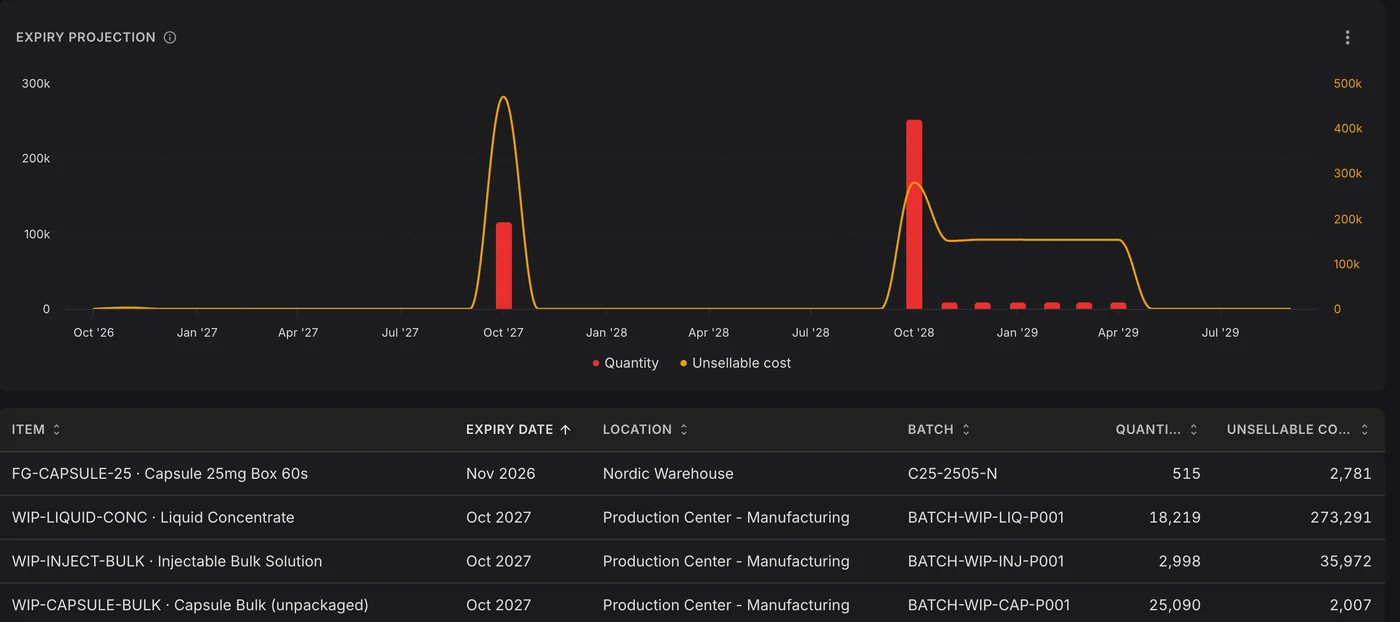
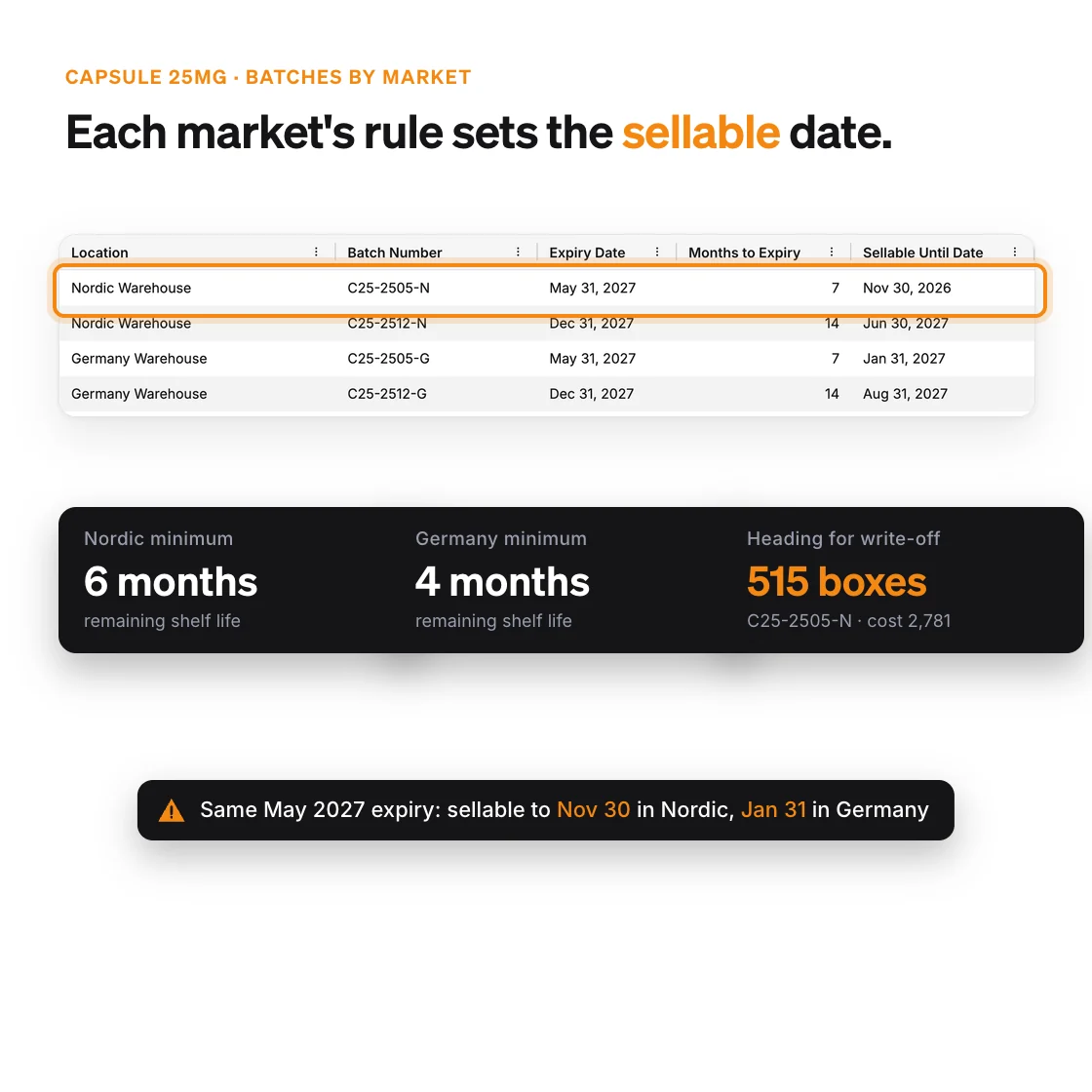
See expiry before it lands. Inventory and Expiry dashboard: the expiry projection chart and the batch list, led by Capsule 25mg batch C25-2505-N in the Nordic warehouse, 515 boxes unsellable from Nov 2026 at a cost of 2,781.
Trusted by

Leading pharmaceutical companies

Azurity
Coripharma
MS Pharma
Navamedic
AGM Pharma
Adalvo
Frostpharma
CNX Therapeutics
Arcera
Sun Wave Pharma

PLAIO and Kinaxis Maestro, side by side

Topic PLAIO Kinaxis Maestro
Who it is for
Built for ✓Pharma manufacturers, CMOs and CDMOs, with mid-market planning teams in mind. Nothing else12–Many industries, from aerospace and automotive to consumer products and high-tech. Life sciences is one of them1
What you buy ✓One product: Demand, Supply and Production modules on one data model13,14,18–Planning One base package. S&OP, production scheduling, supplier collaboration and inventory optimisation are add-on applications9
Planning scope
Production scheduling ✓Built in: a Gantt with routings, sequence-dependent changeovers, cleaning, waits, shifts and downtime14✕Not native to Maestro. A separate application, Kinaxis Production Scheduling by PlanetTogether6, added to Planning One9
S&OP ✓Included. Commercial, planning and operations agree one plan in a shared workspace, with saved forecast versions18,20–A separate S&OP application5, listed as an add-on to the Planning One package9
Supply and inventory ✓Finished goods back to the API, safety stock per item and location, batches used first-expiry-first-out13–Supply planning in the base package. Inventory optimisation and Supply Chain Optimization are extra parts of the offer3,9
Demand ✓ML forecast per item and location beside a moving average, open orders and the commercial plan. Planners pick the base18✓Machine learning forecasts, demand sensing on external signals, and a consensus plan4
Pharma rules
CMOs and suppliers ✓Each CMO lane holds lead time, MOQ, increment, maximum order and frozen period, and can consume a bill of materials13–Network and tender scenarios described for CMOs and CDMOs2. Supplier collaboration is an add-on application9
Shelf life, expiry and batches ✓In the data model: minimum remaining shelf life per market and a sellable-until date on every batch12,13✓Expiry management, shelf-life-aware allocation and batch-based supply pooling on its life sciences page2
How plans are made
A plan you can trace ✓Deterministic supply simulation: same inputs, same plan. No order reaches the ERP until a planner approves it15,16Concurrent planning that blends machine learning, optimisation and heuristics, with AI agents on top1,8,11
ERP and rollout
Who implements it ✓PLAIO’s own team. AI drafts each data mapping and a PLAIO consultant reviews it15,17–Kinaxis RapidStart or a certified partner9, such as Accenture, Deloitte or Capgemini10
Time to first plan ✓Plan on the spreadsheets you already keep while the ERP feed is built. Real data in weeks17–“As few as 12 weeks” for the base Planning One package with RapidStart9
SAP ✓Customers run SAP ECC and S/4HANA, NetSuite and Business Central. Our team builds the connection15✓S/4HANA integration on SAP-standard APIs with pre-built accelerators7

From each vendor’s public documentation, checked October 2026.

Where PLAIO pulls ahead

The five topics that usually decide a pharma planning evaluation.

Shelf life, batches and market rules

PLAIO

In PLAIO, shelf life is part of the data model from day one. Each batch keeps its expiry date. Set a minimum remaining shelf life per item, or per item and location, and PLAIO works out the day each batch stops being sellable in that market. Short-dated stock stops counting against demand it can’t serve, and the Inventory and Expiry dashboard shows what is heading for write-off and what it will cost12,13.

Kinaxis Maestro

Kinaxis covers expiry management and shelf-life-aware allocation on its life sciences page, and describes attribute-based planning as the way to build compliance into production and inventory strategies2. Maestro serves many industries on one platform1, so your markets’ rules have to be expressed in it. Ask to see them working on your own SKUs before you sign.

Capsule 25mg batches in the Nordic, Germany and Central Europe warehouses with expiry, months to expiry and sellable-until dates; the Nordic market’s 6-month minimum stops batch C25-2505-N selling on Nov 30, 2026, and 515 boxes of it are projected unsellable at a cost of 2,781

CMOs and external manufacturing

PLAIO

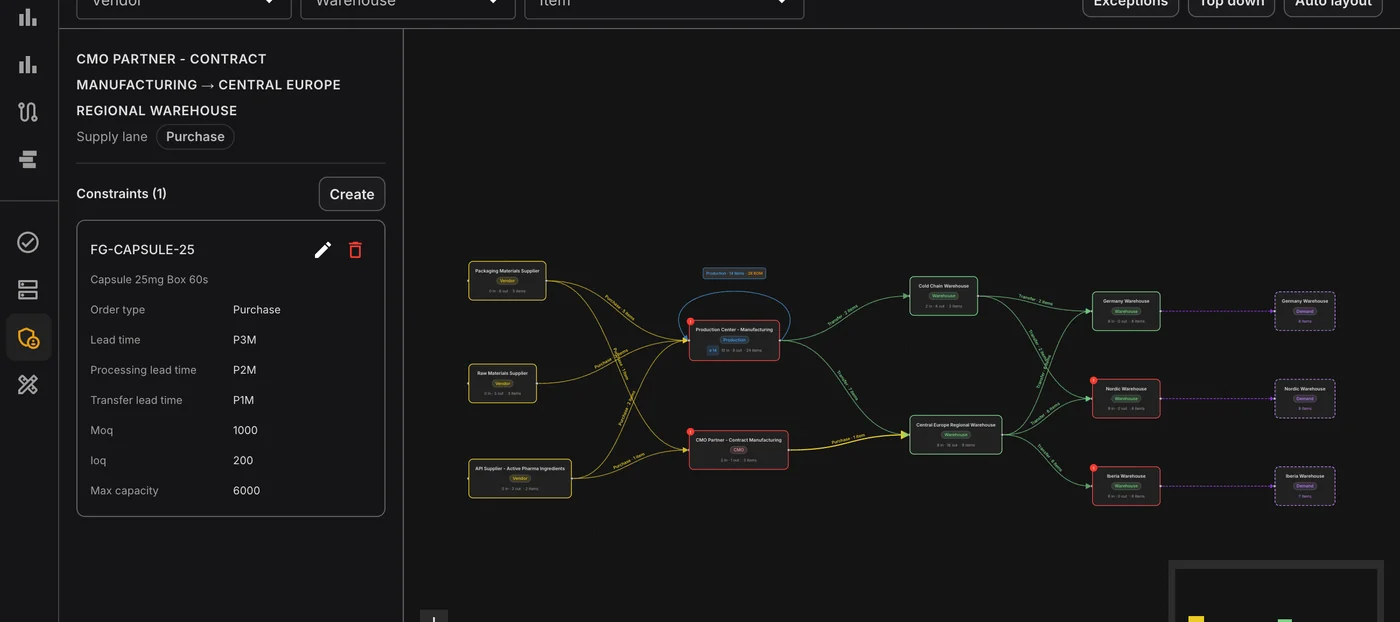
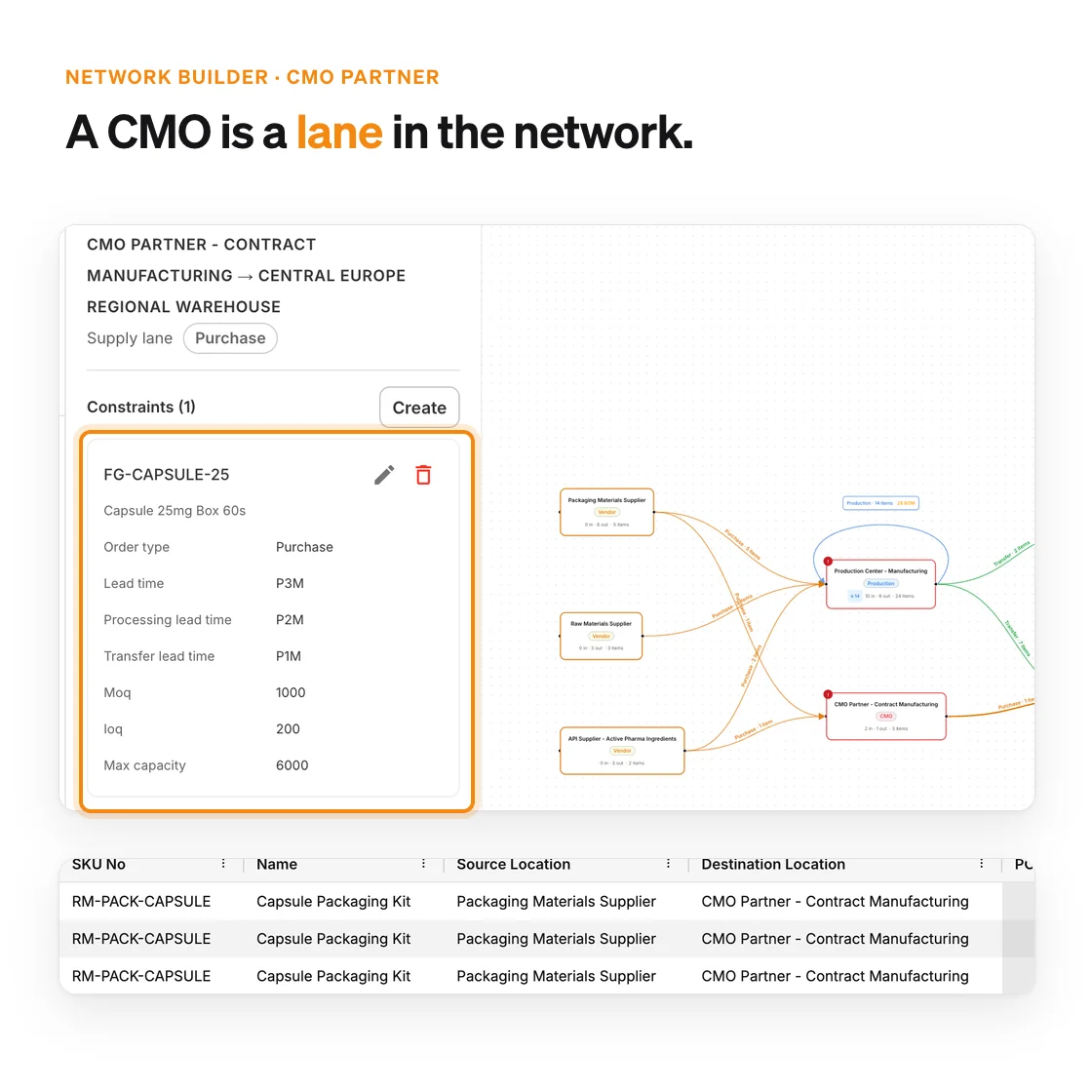
A CMO in PLAIO is a lane in the supply network, with its lead time split into processing and transfer, an MOQ, an order increment, a maximum order and a frozen period. A purchase from a CMO can consume a bill of materials, so the packaging kits you ship to them get planned as well. If you schedule a CMO’s line yourself, it can sit as its own shop floor next to yours13,14,19.

Kinaxis Maestro

Kinaxis describes connecting the end-to-end network for CMOs and CDMOs, managing tenders with scenarios and handling transportation constraints2. Supplier collaboration, the piece that works with those partners day to day, is one of the applications you add to the Planning One package9.

Network builder with the CMO lane open (Purchase, 3-month lead time split into 2 months processing and 1 month transfer, MOQ 1,000, increment 200, max 6,000), and below it the capsule packaging kits the plan orders for delivery to the CMO

How the plan is calculated

PLAIO

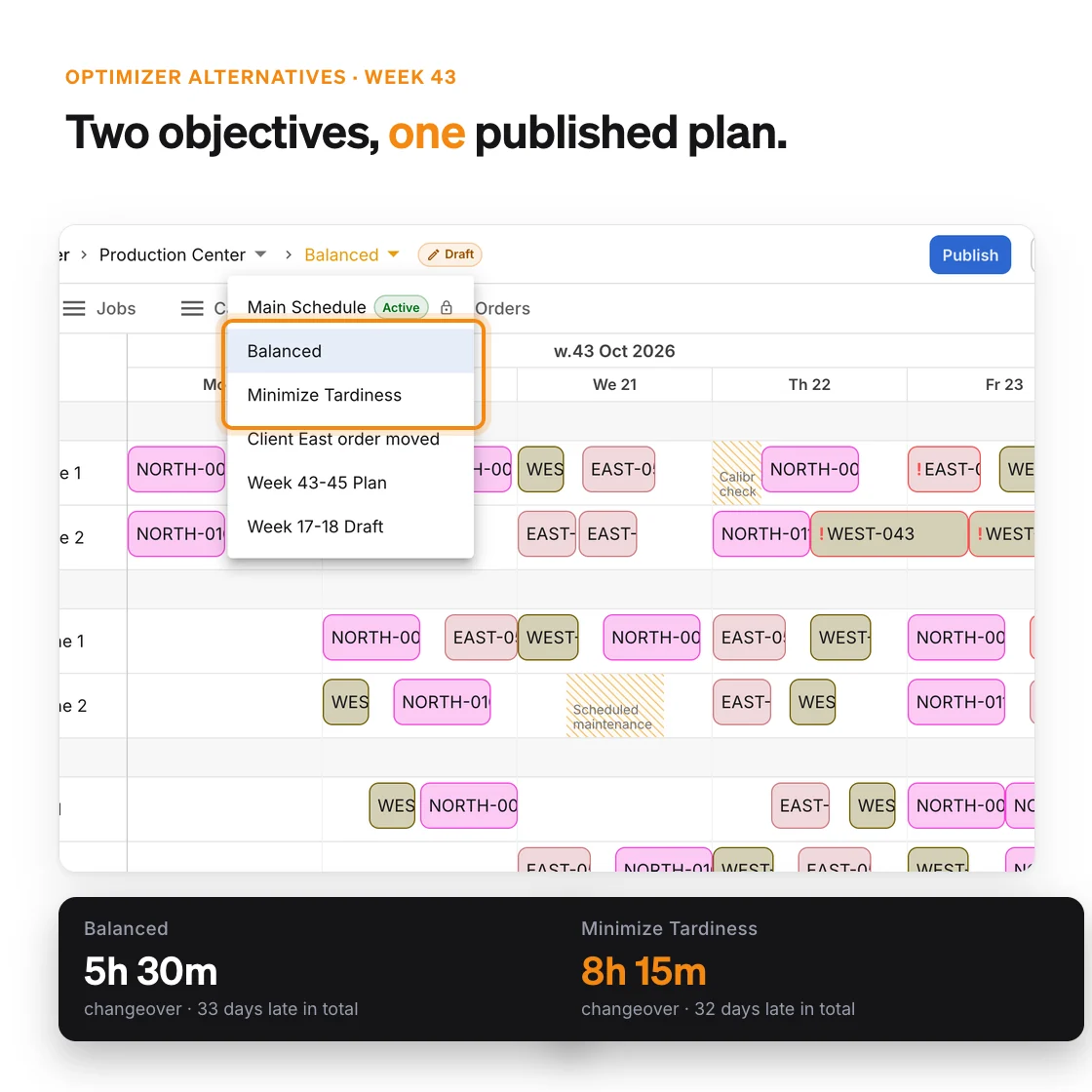
PLAIO uses a different method for each job. Machine learning drafts the forecast. The supply plan is a deterministic simulation, so any order suggestion can be reproduced from its inputs and explained to QA or finance. Production sequencing runs a multi-objective optimiser with a fixed seed and saves up to three alternatives as scenarios: Balanced, Minimize Tardiness and Minimize Changeover Time. A planner publishes one16.

Kinaxis Maestro

Maestro is built around concurrent planning, where a change propagates through the plan at once. It mixes machine learning, optimisation and heuristics, and adds a generative AI assistant and AI agents, including a no-code studio for building your own1,8,11. That is a lot of capability to configure and govern when what a pharma team mostly needs is a plan it can explain.

Scenario menu on the production schedule: Main Schedule active and locked, the optimizer’s Balanced and Minimize Tardiness alternatives saved as drafts with a Publish button, and each alternative’s changeover time and days late

Production scheduling

PLAIO

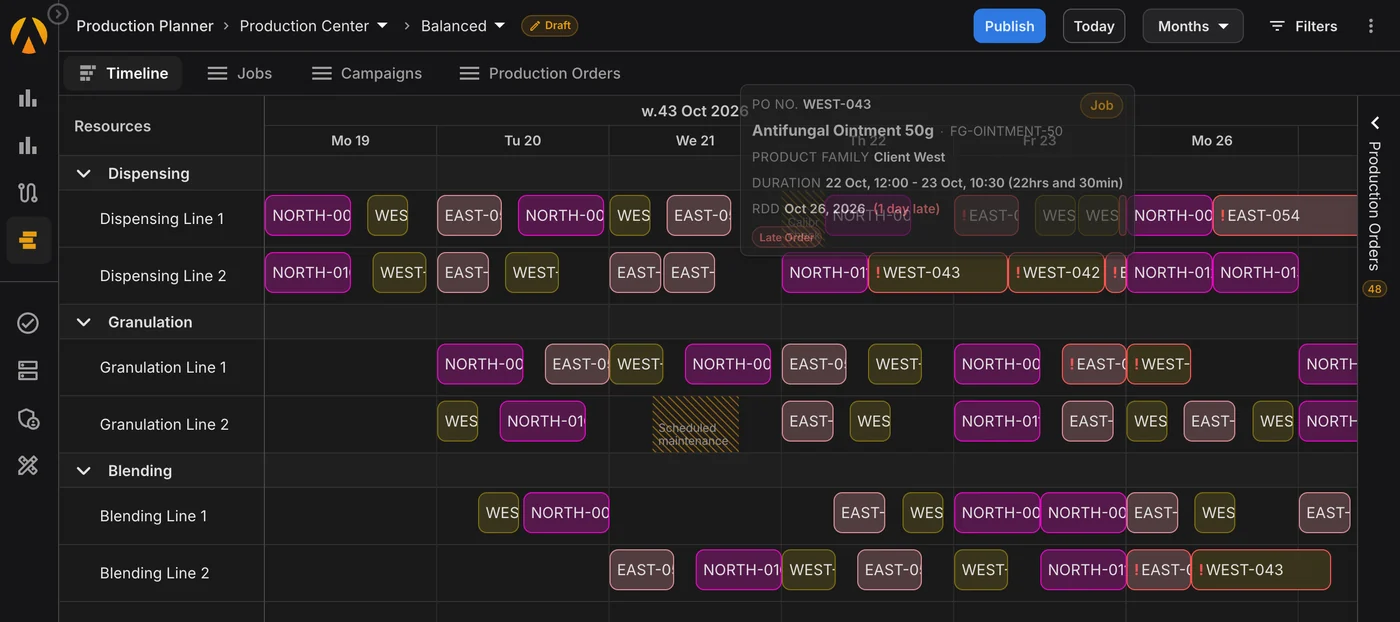
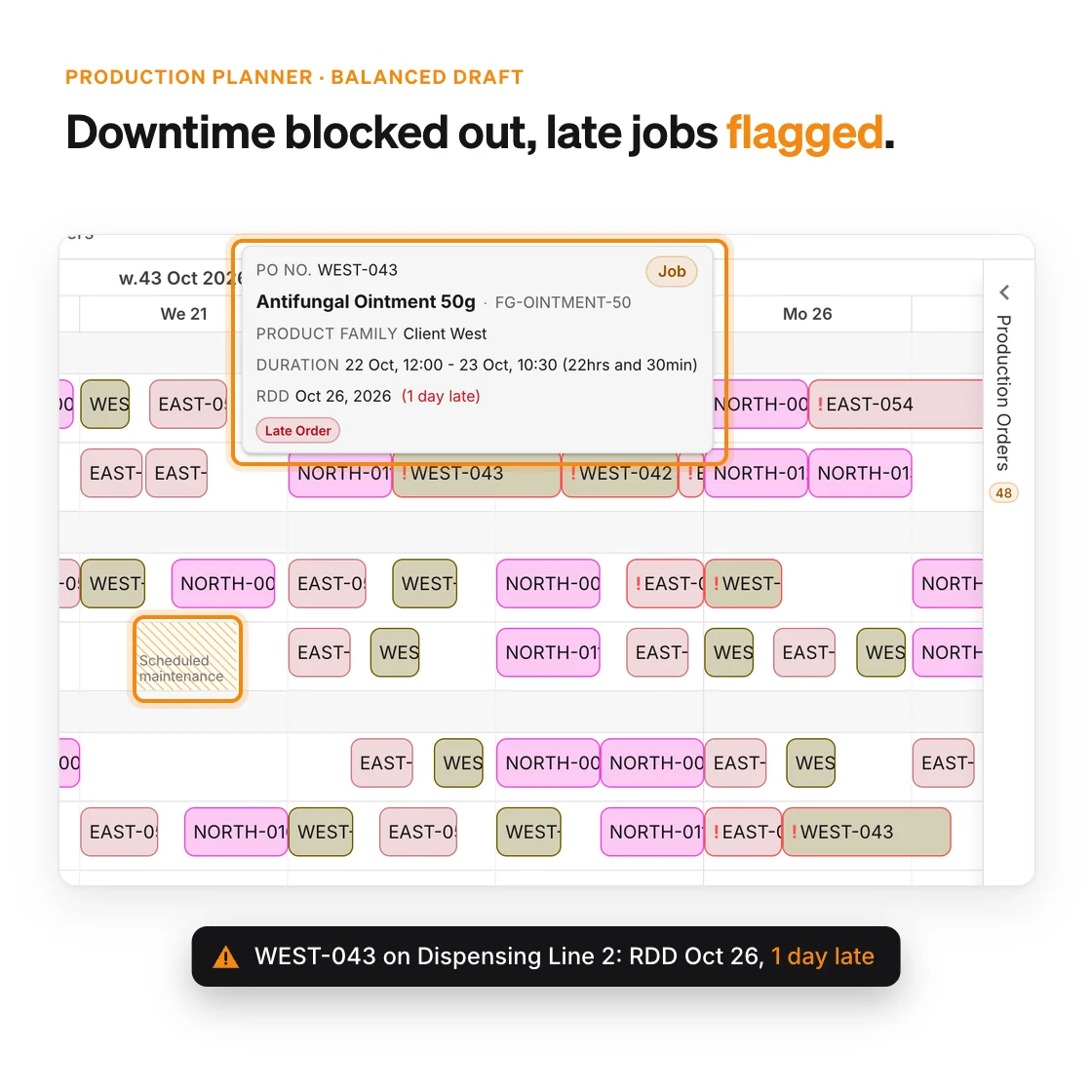
Scheduling is a module of PLAIO, on the same data as the supply plan. Every job has a line, a start and a stop, and follows the item’s routing. PLAIO checks setup, run and cleaning times, changeovers that depend on what ran before, minimum and maximum waits, shifts and downtime. Add a downtime and smart reschedule lifts every job off the line from that point and fits them back in14.

Kinaxis Maestro

Detailed scheduling isn’t native to Maestro. Kinaxis sells Production Scheduling by PlanetTogether, which pairs PlanetTogether’s scheduler with Maestro’s planning6, and lists production scheduling as an application you add to Planning One9. So the schedule runs on a second vendor’s engine, and the link between the two is one more thing your team has to validate.

Week 43 on dispensing, granulation and blending lines: a scheduled-maintenance downtime on Granulation Line 2 with no job on it, and the tooltip for order WEST-043 showing its 22-hour job and a Late Order flag

ERP, SAP and who does the work

PLAIO

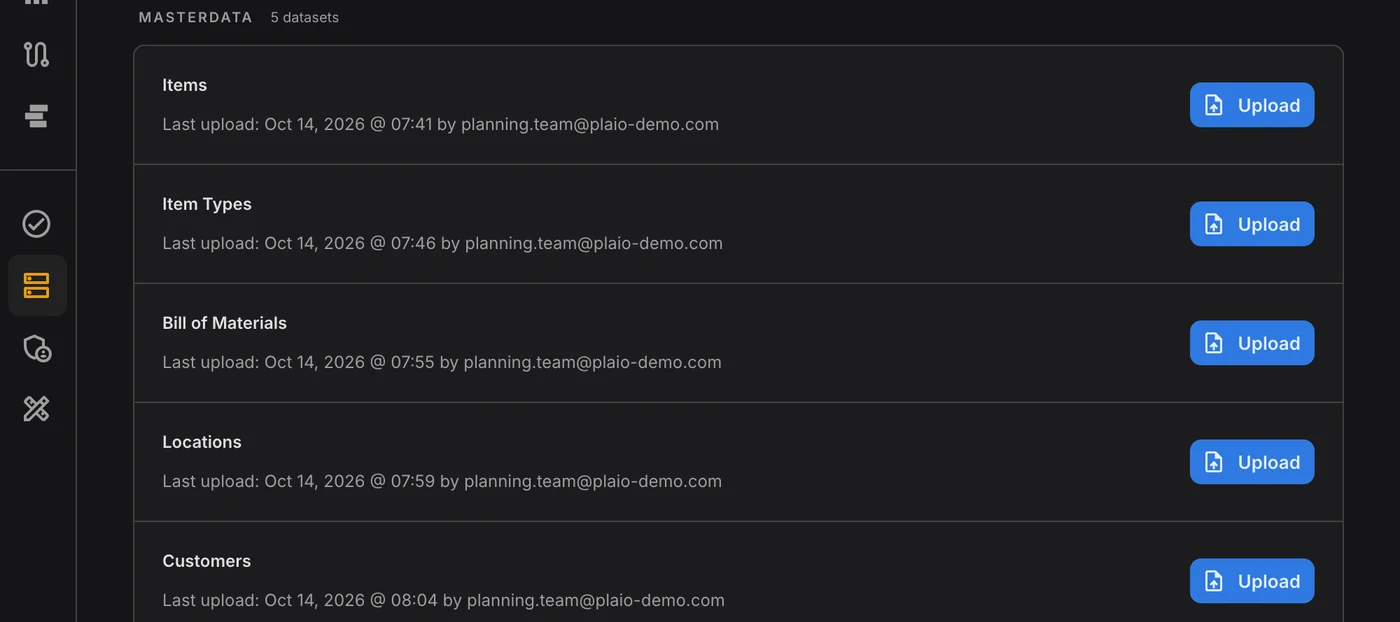
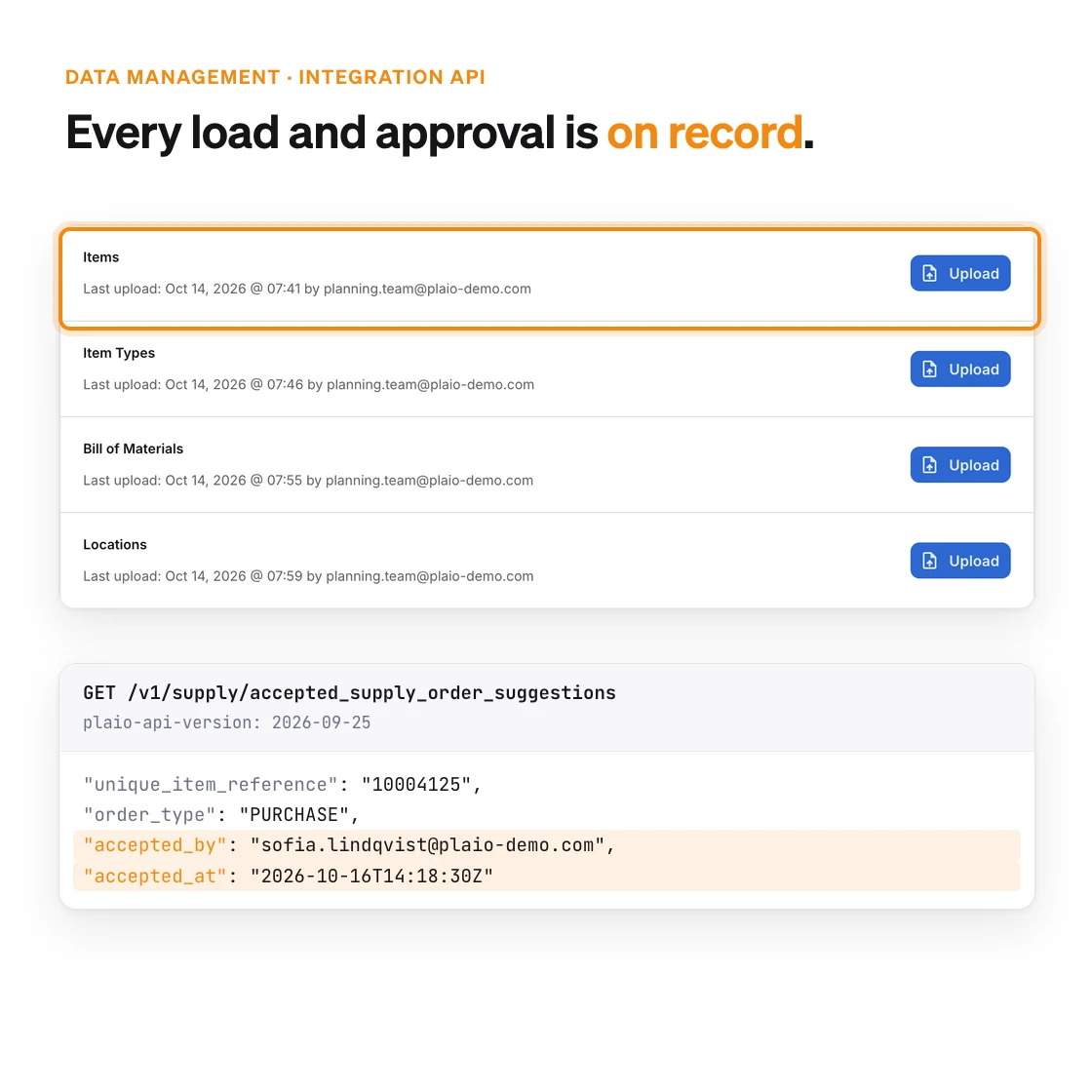
Your IT team grants access to the ERP, or the data warehouse it feeds, and PLAIO’s own team builds the connection. AI drafts each mapping and a consultant checks it. Planning starts on spreadsheet uploads before the feed is live. Approved orders go back to the ERP with the approver’s name and a timestamp. Customers run SAP ECC and S/4HANA, NetSuite and Business Central15,17.

Kinaxis Maestro

Kinaxis has an S/4HANA integration on SAP-standard APIs with pre-built accelerators7. The rollout runs through its RapidStart approach or a certified partner, and the partner list is led by large system integrators such as Accenture, Deloitte and Capgemini9,10. For a mid-market team, that is usually a bigger programme than the planning problem calls for.

Data Management listing items, item types, bills of materials and locations with each last load’s time and account, and the Integration API returning an approved CMO order with the ERP item number, the approver and the approval time

Which one fits you

Why pharma teams choose PLAIO over Kinaxis

  • Production scheduling is part of the product, so there is no partner scheduling application to add14.
  • Shelf life, batches and CMO lanes are in the data model on day one, because PLAIO plans nothing but medicines12,13.
  • You start planning on your current spreadsheets while the ERP connection is built, even mid-way through an ECC to S/4HANA move15,17.
  • PLAIO’s own team builds the integration, so there is no system-integrator programme to staff15.
  • The supply plan gives the same answer from the same inputs, and every order is approved by a named planner16.

Kinaxis may suit you if…

  • You plan several industries besides pharma and want one platform for all of them1.
  • You run a global enterprise programme with a large system integrator already engaged10.

PLAIO vs Kinaxis FAQ

For a pharma planning team, yes, and with less to assemble. Demand, supply and production scheduling come in one product, so there is no separate scheduling application to buy. What PLAIO won’t do is plan your other industries. If medicines are your whole business, that focus works in your favour.

Yes. PLAIO takes its data from the ERP or the data warehouse it feeds, not from another planning tool, so it can cover one site, one module or one set of markets while the rest stays put. Most teams start with one module and one planning scope, then move the rest across once the results are in.

No replacement. The ERP stays the system of record for items, stock, open orders and execution. Our customers run SAP ECC and S/4HANA, NetSuite and Business Central. Approved orders go back through the Integration API with the approver and a timestamp, and the ERP creates them in its usual process, so its validated state doesn’t change.

Yes. Upload the exports you have, including ones from Kinaxis, and match their columns to PLAIO’s once. Data Exceptions then lists what is missing item by item, such as an item with no inventory policy or a warehouse no lane supplies, so you close the gaps while you plan.

Teams plan with real data within weeks. How soon depends mostly on how many modules, datasets and sites you bring in at the start. The first plan doesn’t wait for the ERP integration, and there is no partner programme to schedule.

We ask how you plan today, which markets and CMOs the plan has to cover, and where it breaks. Then we show a few SKUs like yours in PLAIO with shelf life, MOQs and lane lead times applied, and the production schedule on the same data. Bring the scenario you would ask Kinaxis to show. Book a time.

Kinaxis, Maestro, RapidResponse and Planning One are trademarks of Kinaxis Inc. PlanetTogether is a trademark of its owner. PLAIO is not affiliated with or endorsed by Kinaxis.

Bring a few SKUs. See them planned with pharma rules

30 minutes on your own products, markets and CMOs, with shelf life, lane rules and the production schedule in one place.

Book my 30-minute demo Prefer to read first? What pharma planning software has to handle

Cookie settings

To enhance your experience on our site and to analyze traffic, we use cookies. By clicking "Accept All," you agree to the storing of cookies on your device for analytics purposes. You can manage your settings or learn more in our Privacy Policy.

Manage Settings
  • Your Privacy Matters to Us

    We use cookies to improve your browsing experience and analyze how our website is used. These cookies allow us to understand trends, monitor website traffic, and gather insights to make the site better for you.

    We respect your privacy and are committed to transparent data usage.

    Why Do We Use Cookies?

    Necessary Cookies: These ensure that the website functions properly.

    Analytics Cookies: These help us track site traffic, user behavior, and performance metrics. The data collected is anonymous and allows us to continuously optimize the site.

    Preferences Cookies: We may use cookies to remember your preferences and tailor your experience.

    Marketing Cookies: We may use cookies for marketing purposes.

    Your Control, Your Choice

    By clicking "Accept All," you consent to the use of all cookies. If you prefer, you can customize your choices and opt out of certain cookies. You can learn more about how we handle data and cookies in our Privacy Policy.