Planning on SAP Business One

SAP Business One planning, minus the spreadsheet

Shelf life by market, CMO lead times and MOQs live in spreadsheets. PLAIO plans them on Business One’s data. Approved orders return to it.

Get a 30-minute review of your Business One planning

Pick a time and we’ll show you what we’d change first.

Map your columns once

Item No. becomes SKU No, Item Description the item name and Item Group the product family.
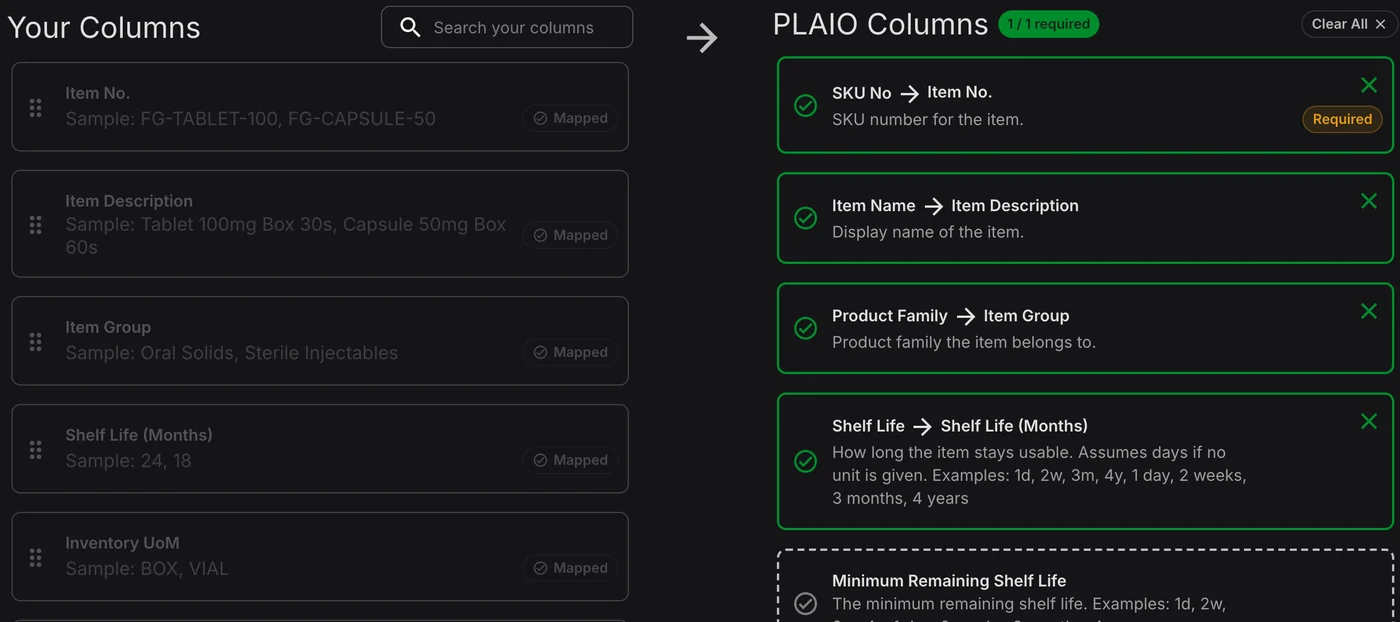
Map your columns once. Column mapping for an uploaded item export onto PLAIO's columns.
Trusted by

Leading pharmaceutical companies

Azurity
Coripharma
MS Pharma
Navamedic
AGM Pharma
Adalvo
Frostpharma
CNX Therapeutics
Arcera
Sun Wave Pharma

In their words

What planning teams say when the plan runs in PLAIO

A new MRP in production in ten weeks

Standard product on top of your ERP, real data, planners trained at go-live.

  • Specialty pharma company 10 weeks from kickoff to the new MRP in production
  • Generics manufacturer 3 months to go live, ERP data flows included
  • B2B pharma company 94% UAT pass rate, tested on their own data
  • Specialty pharma company 1 planner runs supply for four markets, forecast to purchase order

Where the plan really lives on Business One

Business One records what you bought, made and sold. Shelf-life minimums by market, CMO lead times and MOQs often sit in emails and PDFs.

One person rebuilds the plan from Monday’s export, every cycle.

CMO commitments arrive as PDFs, the commercial forecast as a workbook. Shelf-life rules are unwritten. The plan is as current as its last rebuild.

Nobody sees quickly how a supplier slip hits stock and service. No record shows who changed an assumption, or why.

Why it matters:

Business One can stay your system of record. What’s missing is a planning layer on top. It doesn’t touch your validated ERP.
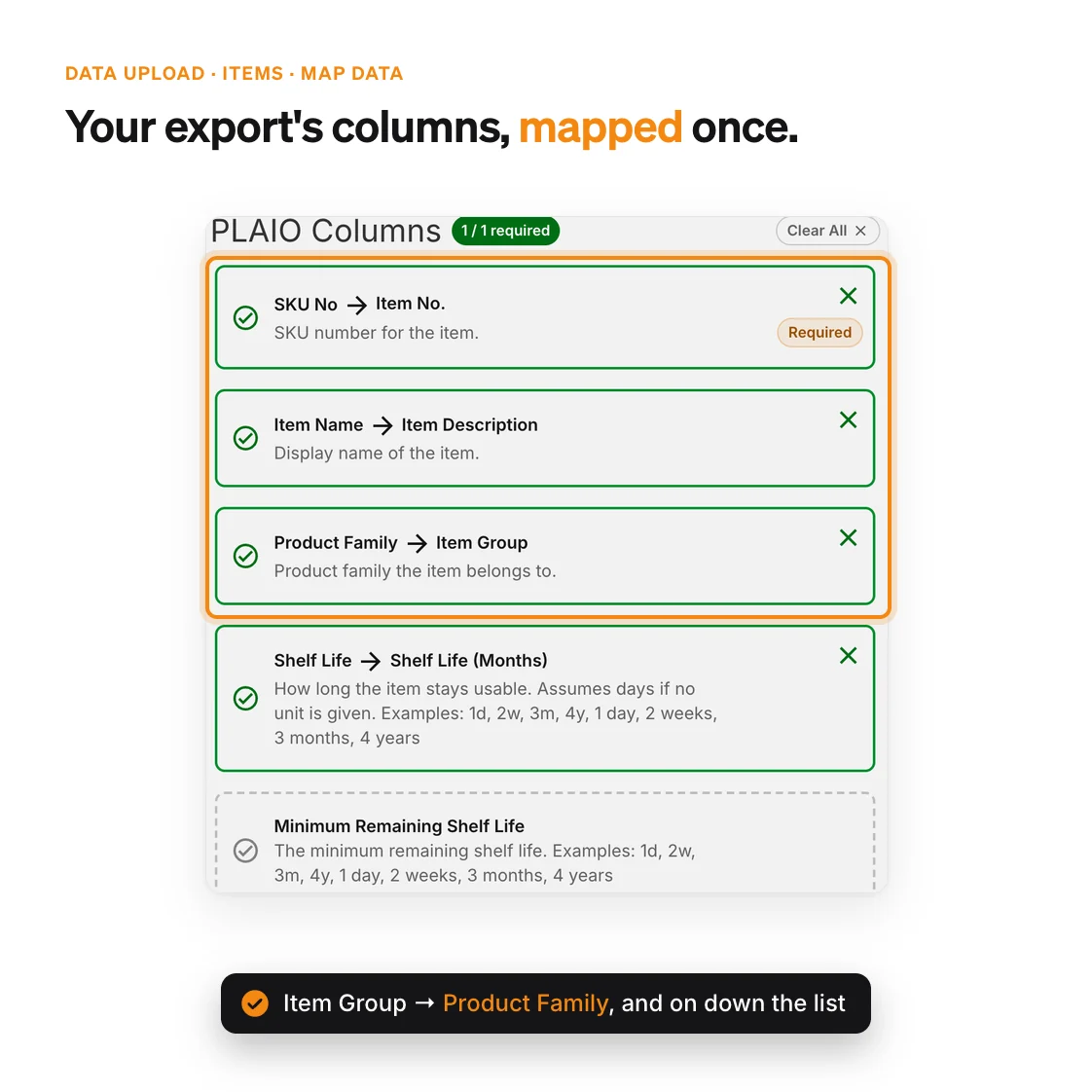
PLAIO's column mapping for an uploaded item export: SKU No from Item No., Item Name from Item Description, Product Family from Item Group, shelf life and unit of measure.

What you can do with PLAIO on Business One
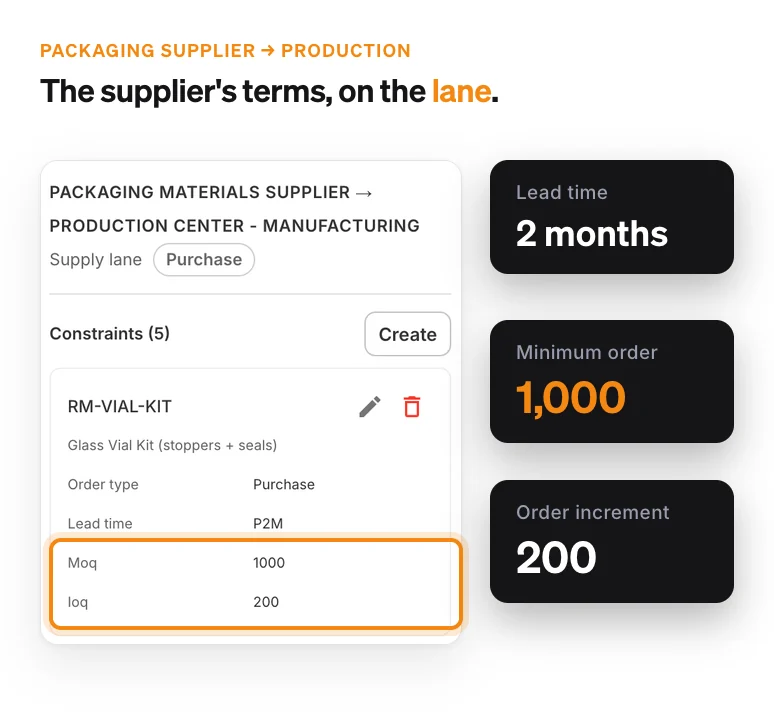
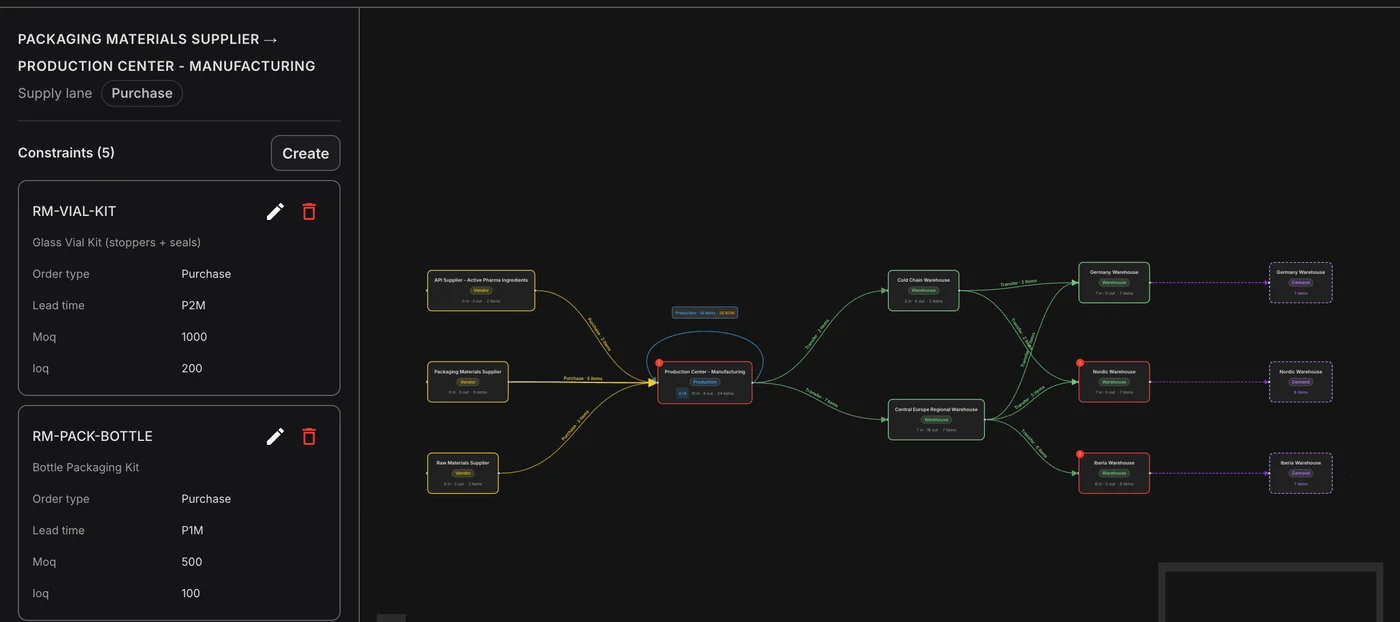
Supply lane rules for the packaging supplier: Glass Vial Kit bought on a two-month lead time with a minimum order of 1,000 in steps of 200.

Put CMO and supplier rules on every lane

Lead times, MOQs and order increments sit on each supply lane. Planned orders round to them. Everyone plans from the same numbers, not five files.
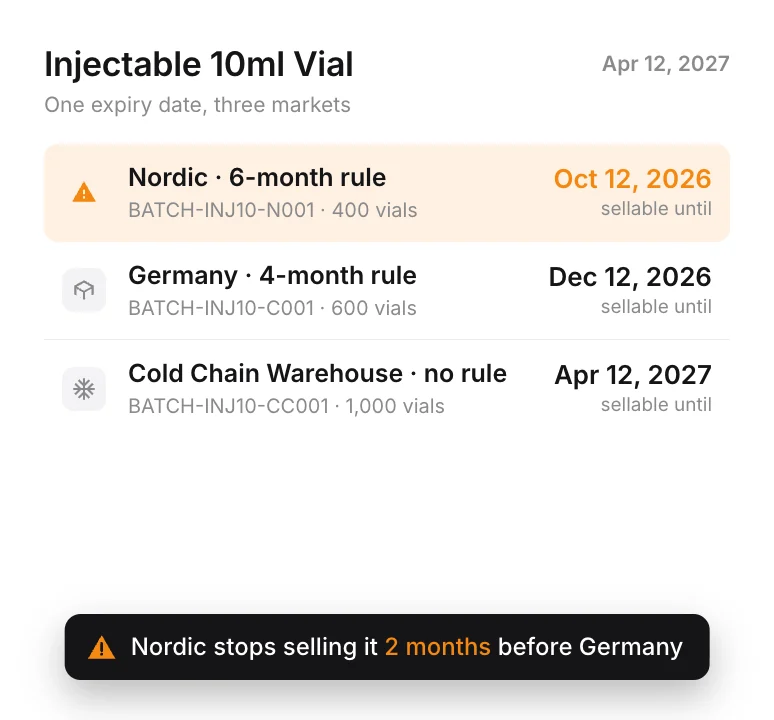
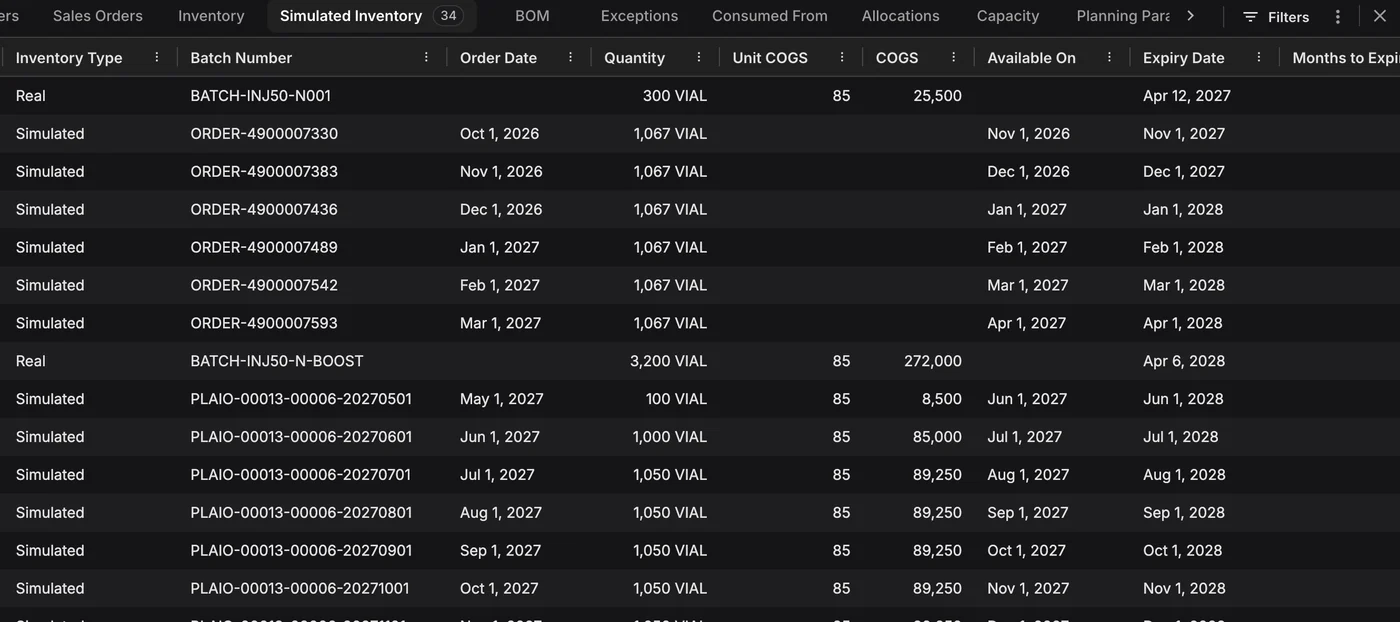
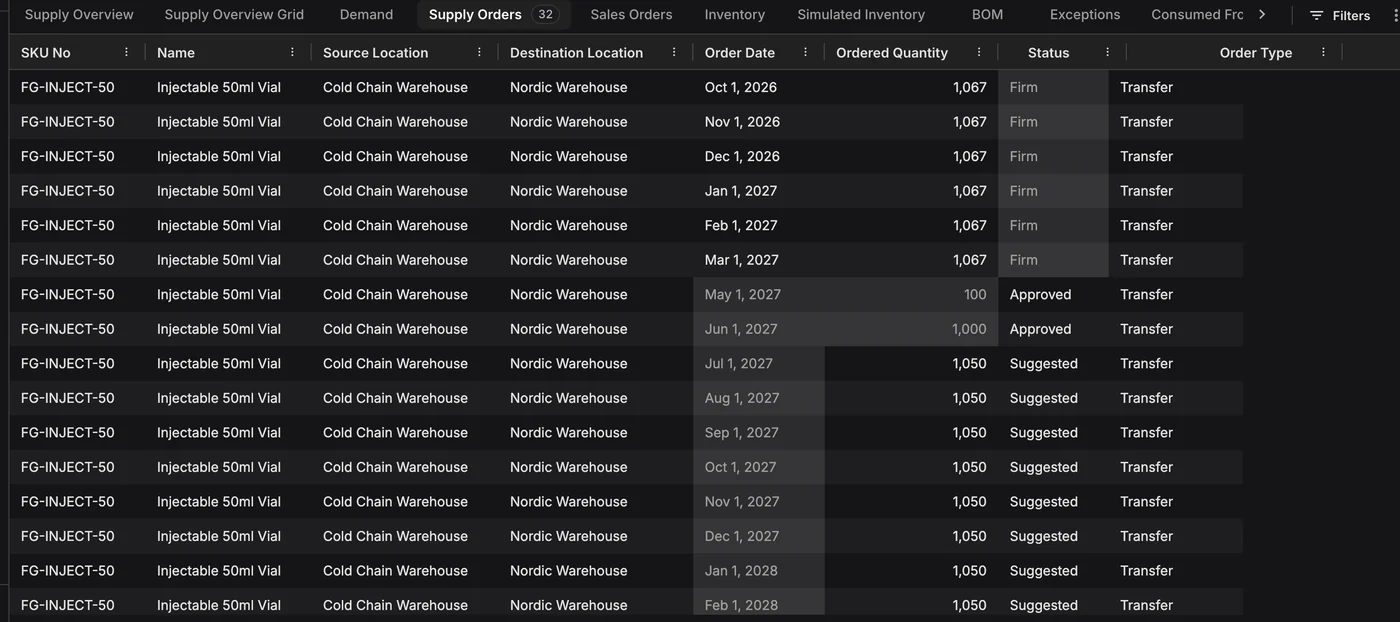
Three batches of Injectable 10ml that all expire on 12 April 2027: sellable in Nordic until October 2026, in Germany until December 2026 and at the cold chain warehouse until expiry.

Plan with shelf life by market

Batches are used first-expiry-first-out against each market’s minimum remaining shelf life. Stock that is too short-dated for a market doesn’t count against its demand.
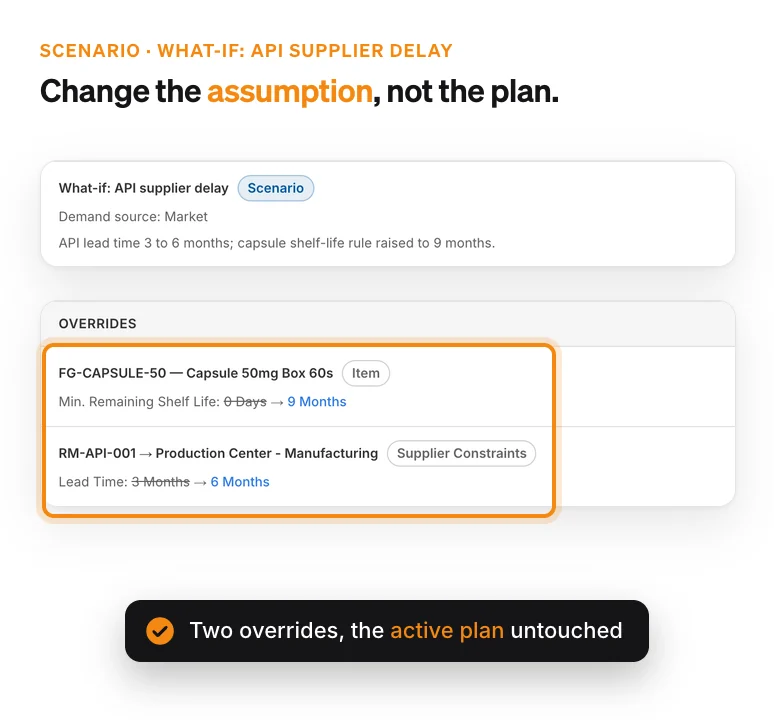
A what-if scenario that raises the API supplier's lead time from 3 to 6 months and a capsule's minimum remaining shelf life to 9 months, kept apart from the active plan.

Test a what-if before it happens

Delay a supplier, cap a capacity or tighten a shelf-life rule in a scenario. It stays beside the active plan until you decide.

How PLAIO works with Business One
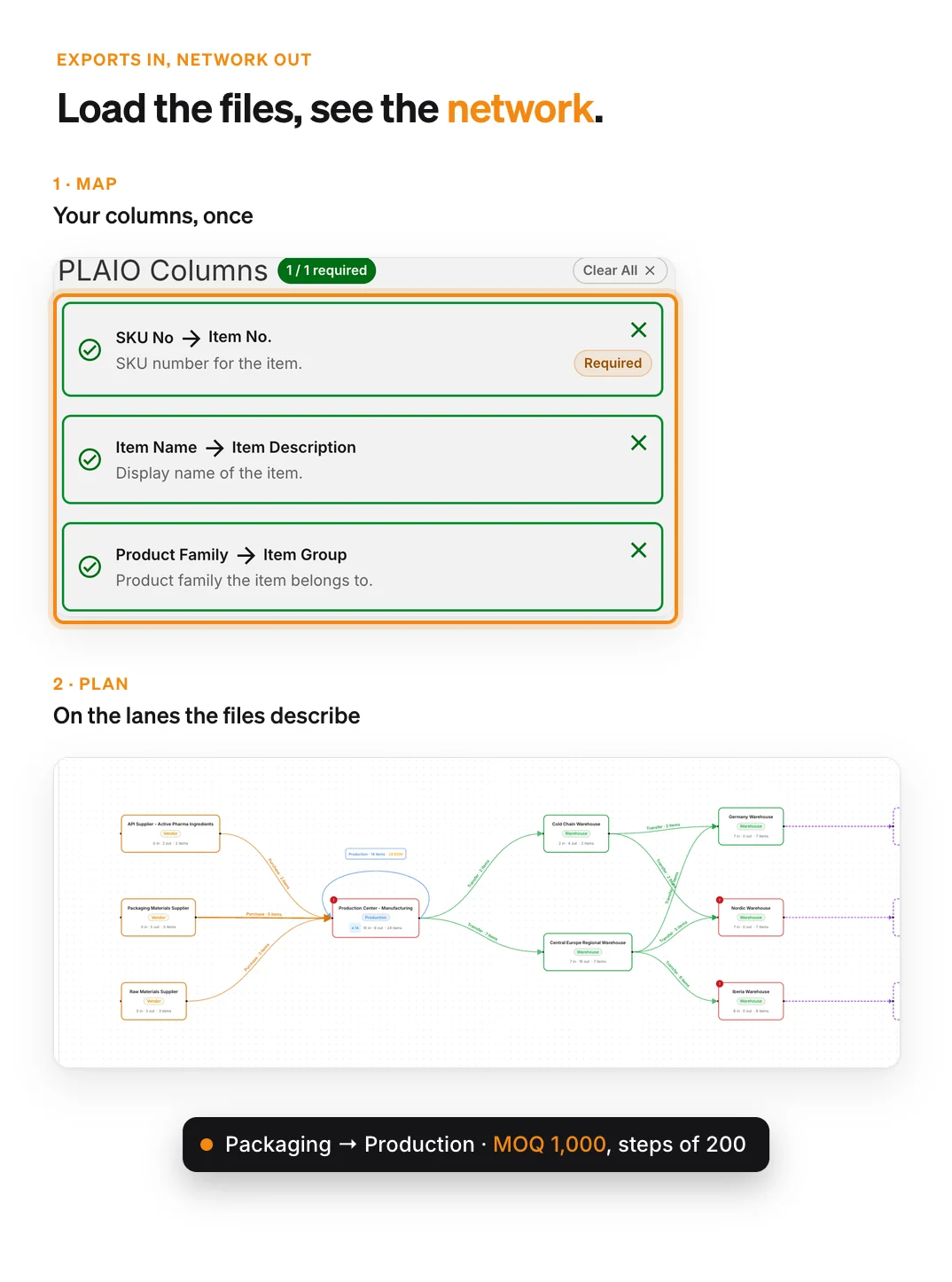
An uploaded item export mapped onto PLAIO's columns, above the supply network of suppliers, production, warehouses and markets that PLAIO plans on.

Business One stays the system of record

PLAIO plans on items, shelf life, CMOs and orders. It also uses BOMs, lead times, MOQs and batch-level stock.

Start on the exports you already have

Load every dataset from a spreadsheet and map its columns once. Later, each switches to a live feed without a rebuild.

We build the connection

There’s no ready-made Business One connector. We build the connection and mapping via the Integration API or your data warehouse.

Planners approve every order

Suggested orders go back only after a planner signs off. Business One creates them in its own process. Every write is logged.

Planning on SAP Business One FAQ

No. Business One stays the system of record for orders, inventory and financials. PLAIO is a planning layer on top of it, so there’s no ERP replacement project. PLAIO plans on its items, shelf life, locations including CMOs, sales orders, and open purchase and production orders.

Not a ready-made one. PLAIO connects through its Integration API or a data warehouse your ERP already feeds. The API doesn’t depend on any one ERP vendor. Our team builds the connection and the data mapping. AI drafts the mapping and a consultant checks it before it reaches the plan.

Yes. Start on the Business One exports and spreadsheets you already have. Every dataset can be uploaded from a spreadsheet, and your planners map their columns once. When the connection is ready, each dataset moves to the live feed and the plan carries on without a rebuild.

Only after a planner has signed them off. Approved orders are published through the Integration API for your ERP to pick up. Business One creates each order in its own process. Every write is logged, and a batch that fails validation is rejected in full with an error per row.

Your ERP stays exactly as it was validated, and the planning layer is what gets qualified. That keeps validation to a scoped exercise. PLAIO’s integration contract is versioned by date and pinned per customer. A PLAIO release does not silently change the interface your connection was validated against.

You talk with a PLAIO planning specialist about how you plan on Business One today. We look at where the plan lives and which CMOs and constraints it covers. Then you see a few of your SKUs as they would look in PLAIO. Book a time.

SAP and SAP Business One are trademarks or registered trademarks of SAP SE. PLAIO is not affiliated with or endorsed by SAP.

Bring a few SKUs. See them planned on Business One data

30 minutes on your own products, your CMOs and the spreadsheet you plan in today.

Test it on a few SKUs Prefer to read first? When the plan lives in a spreadsheet, the risk lives everywhere else
Cookie settings

To enhance your experience on our site and to analyze traffic, we use cookies. By clicking "Accept All," you agree to the storing of cookies on your device for analytics purposes. You can manage your settings or learn more in our Privacy Policy.

Manage Settings
  • Your Privacy Matters to Us

    We use cookies to improve your browsing experience and analyze how our website is used. These cookies allow us to understand trends, monitor website traffic, and gather insights to make the site better for you.

    We respect your privacy and are committed to transparent data usage.

    Why Do We Use Cookies?

    Necessary Cookies: These ensure that the website functions properly.

    Analytics Cookies: These help us track site traffic, user behavior, and performance metrics. The data collected is anonymous and allows us to continuously optimize the site.

    Preferences Cookies: We may use cookies to remember your preferences and tailor your experience.

    Marketing Cookies: We may use cookies for marketing purposes.

    Your Control, Your Choice

    By clicking "Accept All," you consent to the use of all cookies. If you prefer, you can customize your choices and opt out of certain cookies. You can learn more about how we handle data and cookies in our Privacy Policy.