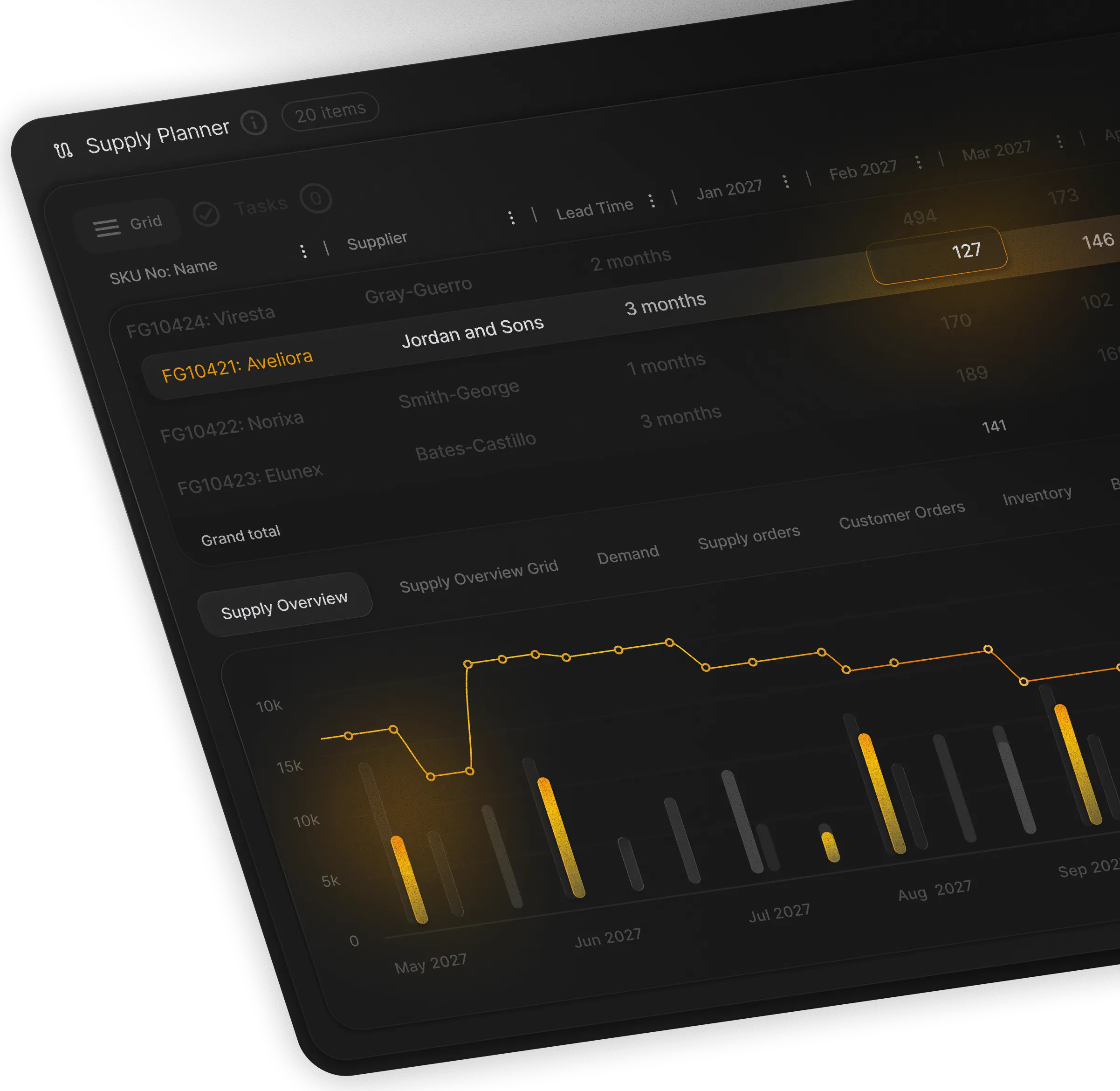


A pharmaceutical procurement strategy cannot be a stand-alone cost-reduction exercise. Direct materials are named in regulatory filings, they age from the day they are made, and they cannot be used until quality control has released them. Purchasing tactics borrowed from other industries lead to stockouts on one side and expiry write-offs on the other. A procurement strategy that works in pharma runs from the supply plan and balances four things: regulatory lock-in, supplier capacity, shelf life and QC release.
Why standard purchasing playbooks break in pharma

Most procurement playbooks assume suppliers can be swapped. Bargaining power comes from switching vendors when the price is wrong. A pharma company usually can’t. The API manufacturer, and often the excipient and primary packaging suppliers too, are named in the marketing authorisation and the drug master file. Adding or changing one means a regulatory variation, method transfer, validation batches and stability data. That often takes a year or more, and it costs real money.
The stakes are high. In Sievo’s benchmarks, supplier spend in pharma is equivalent to a median 51.5% of revenue[1]. And three more things make pharma buying different:
- Lead times are long. An API order can take three to six months from purchase order to released material, and longer if the supplier runs its own production in campaigns once or twice a year.
- Material has a clock on it. APIs have retest dates and finished goods have expiry dates, so buying extra is not a safe hedge. It becomes a write-off.
- Volumes are small and lumpy compared with supplier minimums, especially for niche products and small markets.
So pharma procurement is less about haggling over price and more about four questions:
- Which suppliers can you not afford to lose?
- How much do you buy, and when, with lead times measured in quarters and material that starts ageing as soon as it is made?
- What annual minimums and maximums did you agree with each supplier, and is the plan on track to meet them?
- How well are suppliers keeping their promises on dates, quantities, paperwork and lead times?
The five kinds of direct material, and how to manage each
Pharma spend splits into indirect (IT, services, lab consumables) and direct. Indirect spend follows the usual playbook. Direct materials, everything that goes into the product or packs it, are bought under GMP and the marketing authorisation. Contract manufacturers belong here too. This guide is about direct spend, which falls into five groups:
| Category | Typical lead time | Switching supplier | Main risk |
|---|---|---|---|
| API | 3 to 6 months or more | Regulatory variation, impurity and stability data; often a year or more | Single source, supplier campaigns, retest dates |
| Excipients | 4 to 12 weeks | Grade and site are often filed; a new grade can change dissolution | Price spikes, quality deviations |
| Primary packaging (vials, stoppers, blister foil, bottles) | 2 to 6 months | Needs extractables and leachables data and machine trials | Capacity shortages at a few global makers |
| Printed packaging (cartons, leaflets, labels) | 4 to 10 weeks | Easy | A label change makes stock obsolete overnight |
| Contract manufacturing (CMO, CDMO) | Slots booked quarters ahead | Technology transfer, often a year or more | Lost slots, minimum annual volumes with penalties |
The table shows the trap. The categories with the longest lead times are also the hardest to switch. A late API order can’t be fixed by finding someone else. It can only be avoided by ordering on time.
Map your supply network, then adjust the Kraljic matrix
Start with a picture of where each material comes from and where it goes: which vendor supplies which item, to which plant, and through which warehouses to which markets. Many teams only have this as purchasing records in the ERP. Nobody can see at a glance that one excipient plant feeds three tablet lines.
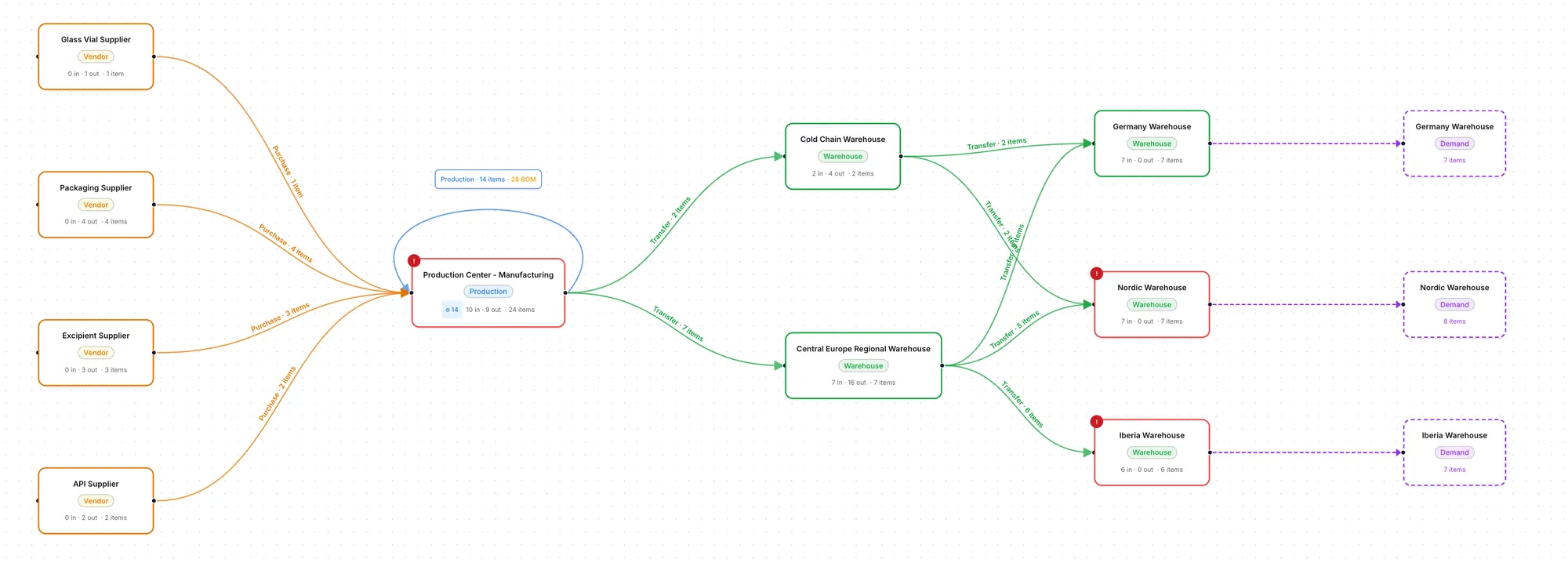
PLAIO models this as a network of locations and supply lanes. With the map in place, segment the supply base. The classic tool is the Kraljic matrix, which sorts suppliers by spend and by supply risk. Pharma needs one change: regulatory lock-in counts as supply risk.
A stopper that costs €40,000 a year but is the only closure in your European marketing authorisation is a strategic supplier. Losing it stops a product line worth many times that. Move single-source, low-spend components into the bottleneck or strategic quadrant, whatever the spend:
- Strategic (high risk, high spend): main APIs, key CMOs. Long-term agreements, shared forecasts, quarterly business reviews, and a qualified second source where the volume justifies it.
- Bottleneck (high risk, low spend): niche APIs, special glass, filed stoppers. Secure supply first and price second. Hold more safety stock and qualify alternatives early.
- Leverage (low risk, high spend): common excipients, standard packaging. Tender, consolidate volumes, negotiate.
- Routine (low risk, low spend): printed materials, consumables. Simplify ordering and cut admin.
The usual objection is the 80/20 rule: category managers should spend their time where the money is. In most industries that is right. In pharma, spend and disruption are not linked. You cannot negotiate your way out of a stopped line caused by a cheap excipient when approving a substitute takes a year.
Buy from the plan, with QC release in the lead time

Every purchase order is a forecast in disguise. Nventic found that raw materials inventories at big pharma companies are almost double what they were before the pandemic[2]. Ordering from reorder points and moving averages makes a plant swing between stockouts and write-offs. Direct purchases should start from the demand plan, exploded through the bill of materials.
If the demand plan says 100,000 packs in October, material requirements planning (MRP) walks that demand back through the network and down the bill of materials into kilograms of API, excipients, blisters and cartons. Where projected stock drops below safety stock, it suggests an order, sized to the supplier’s rules. Two pharma rules decide whether this works.
Put QC release in the lead time
Material is not usable when it reaches goods-in. It is quarantined, sampled, tested and released by QA, which can take 10 to 30 days. If the system holds a 60-day supplier lead time and leaves out a 20-day release, every order is three weeks late on paper. The lead time should be the whole time until the material can be used:
Lead time = supplier manufacturing + transport + QC sampling and testing + QA release.
Plan against sellable-until dates
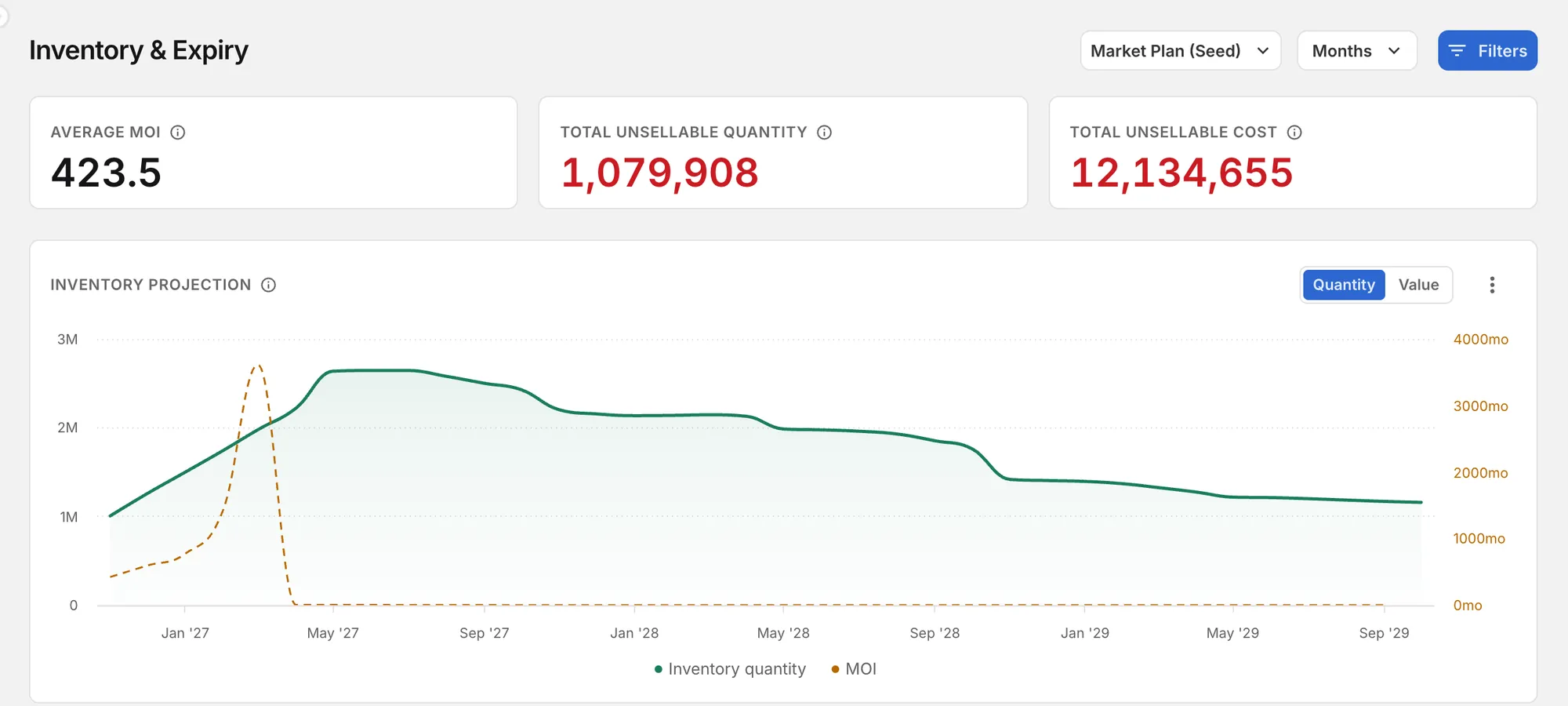
APIs have retest dates; excipients and packaging have shelf lives. If you hold 500 kg of API whose retest date falls before the next campaign, it is not available stock, even though it is on the shelf. Plan each batch against its sellable-until date (expiry minus the minimum remaining shelf life you or your customers accept) and use stock first expired, first out (FEFO). These are standard pharma constraints in PLAIO.
Understanding how demand planning and supply planning fit together lets buyers stop chasing emergency orders and review order suggestions instead. In the PLAIO Supply Planner, suggestions take lead times, minimums and order steps into account. A buyer approves them, and approved order suggestions go to the ERP, where they become purchase orders.
A specialty pharma company using PLAIO runs supply for four markets with one planner, from forecast to purchase order.
Check minimum order quantities against shelf life

The quickest way to waste working capital in pharma is to accept a supplier’s minimum order quantity (MOQ) without checking shelf life. Nventic found that the 28 largest drugmakers wrote off about 4% of their inventory in 2022[3], more than $11 billion at production cost. Suppliers set minimums around their own equipment, a glass furnace run or a reactor batch, not around your demand.
Here is a worked example, with illustrative numbers. A packaging supplier’s minimum print run for a market-specific leaflet is 120,000. The product uses 5,000 a month, so one order covers 24 months. The large run earns a 25% unit-price discount, which looks good on the buyer’s scorecard. Nine months later the regulator approves a label update. The remaining 75,000 leaflets are scrap, and destroying them costs more than the discount saved.
The same maths applies to API. If an API has a 24-month retest period and the supplier’s minimum batch covers 20 months of use, one delayed launch or one lost tender pushes part of that batch past its retest date. The real cost of a material is what you paid for the part you used, not the price on the invoice.
Three rules help:
- Check coverage before you order. Divide the minimum by forward monthly use. If it buys more months than the material has shelf life left on arrival, renegotiate the minimum, share the material across products, or accept a planned write-off with your eyes open.
- Set order policies by category. Order policies decide how much each suggestion covers. For printed packaging that changes often, keep it to three or four months, even at a slightly higher unit price. For a stable bulk excipient, longer coverage can be worth the volume discount.
- Put write-offs on the procurement scorecard. If buyers are measured only on purchase price variance (PPV), they are rewarded for buying big minimums cheaply, and the plant writes off the rest two years later. Track expiry write-offs by supplier, so the cost of a large minimum is visible when the contract comes up. Our guides to minimizing API and excipient waste and multi-echelon inventory optimization go further.
Track annual commitments all year
Pharma supply agreements often include annual volume commitments: a minimum you promise to buy, in return for a maximum the supplier reserves for you. Sterile fill-finish and high-potency API contracts almost always have them, with penalties for a shortfall. They are agreed once a year, filed in a contract folder and then mostly forgotten. In November someone finds that purchases are running 30% below the minimum. The choice is then between buying stock you don’t need, which may expire, and paying the penalty.
The fix is to count orders against each commitment all year: closed orders, open orders and the order suggestions still to come from the plan. The question changes from “did we hit the minimum?” to “will the current plan hit it, and by how much will it miss?” If demand softens six months out, there is still time to renegotiate or move volume to a related product.
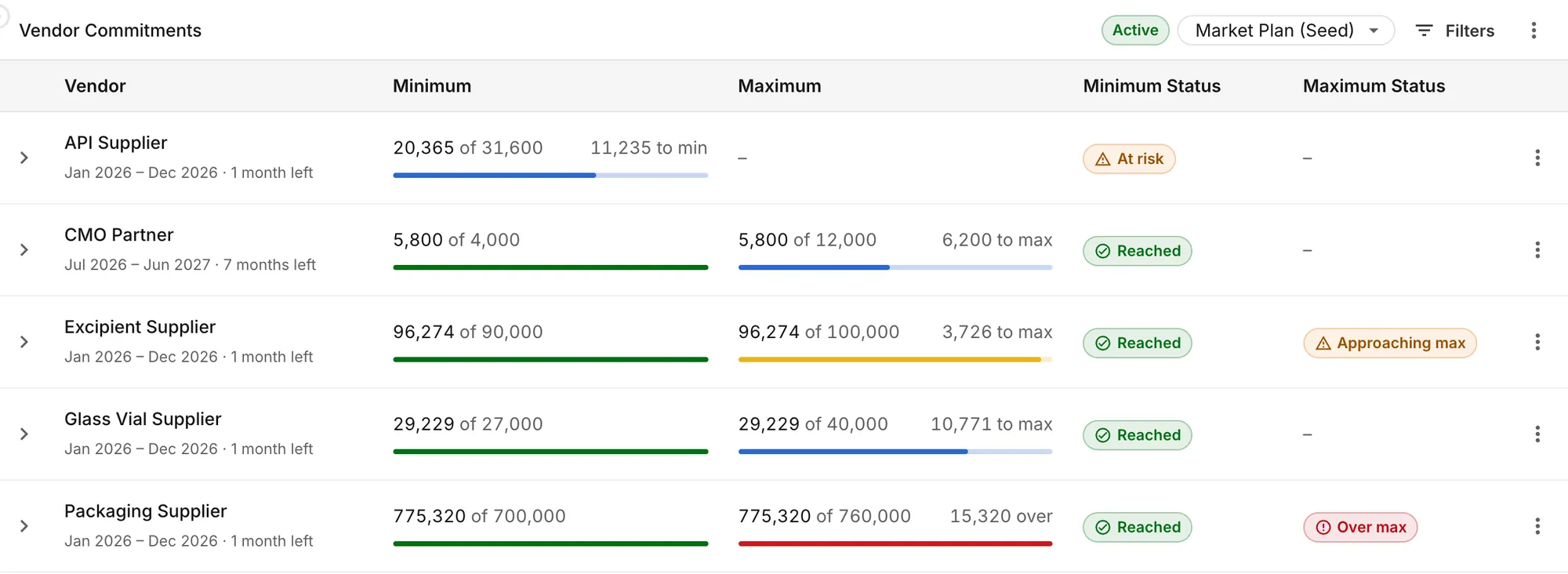
Maximums matter just as much. If the plan buys more than the supplier agreed to reserve, the extra may arrive late or at a higher price. A planner who sees “Over max” in October can move or split orders. A buyer who finds out from a supplier email in December cannot. Vendor Management in PLAIO tracks both.
Plan against supplier capacity, month by month
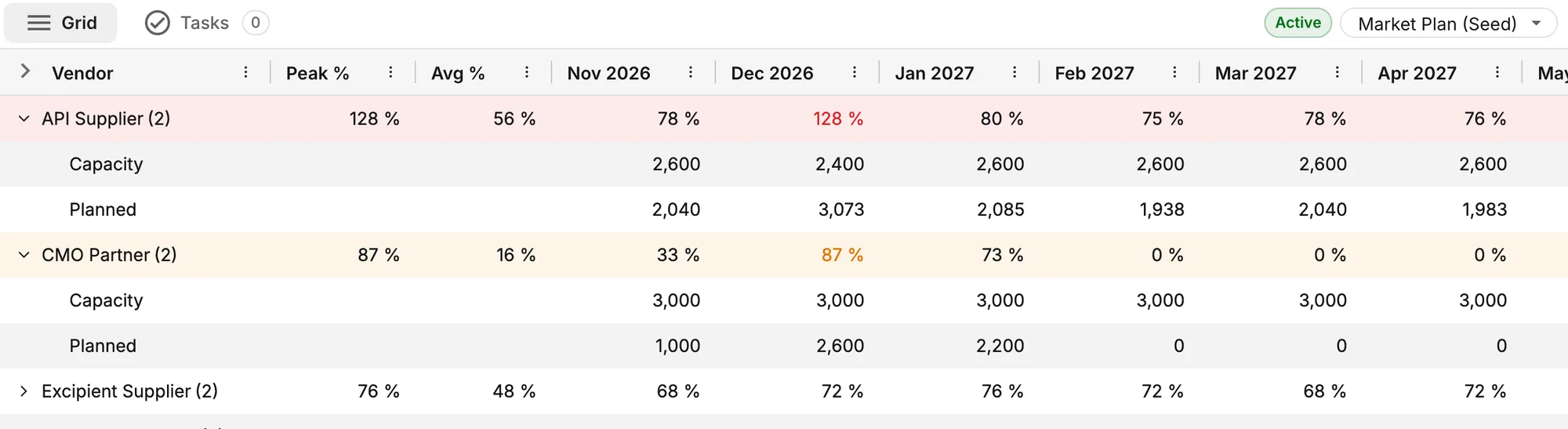
An annual commitment can be fine while one month is impossible. If a contract allows 12,000 kg of an API a year but the supplier’s plant can release 1,000 kg a month, a 3,000 kg order for October will not arrive on time, even though the year adds up.
Ask your strategic and bottleneck suppliers what they can supply per month, and enter it next to the plan as part of your supplier constraints. Compare it with the plan’s monthly load. The month that goes over is the one to discuss with the supplier now: pull some volume earlier, push some later, or split it with a second source.
Measure suppliers on delivery, not just price
Procurement teams spend hours on price variance and much less on delivery. But a late API delivery costs far more than a few percent on the price: an idle line, a delayed release, a stockout in a market, an air shipment. Two measures matter most.
On time, in full
OTIF is the share of orders that arrive both on the confirmed date and in the ordered quantity. KAIZEN describes an OTIF above 95% as excellent[4], with critical industries often aiming for 98 to 100%. In pharma, “in full” includes the paperwork. A partial delivery splits the QC release, complicates batch traceability and can mean testing twice. An early delivery uses up warehouse space, often temperature-controlled, and shelf life before the material is needed.
Lead-time drift
Lead-time drift is the gap between the lead time in your system and the time deliveries actually take. Celonis names inaccurate planning parameters, such as supplier lead times that are not updated often enough, as one of the most common and most controllable causes of stockouts[5]. If the system says 60 days for an excipient and deliveries average 85, every order suggestion is 25 days late before anyone approves it. Compare receipt dates with order dates, update the lead time, or raise safety stock for that lane.
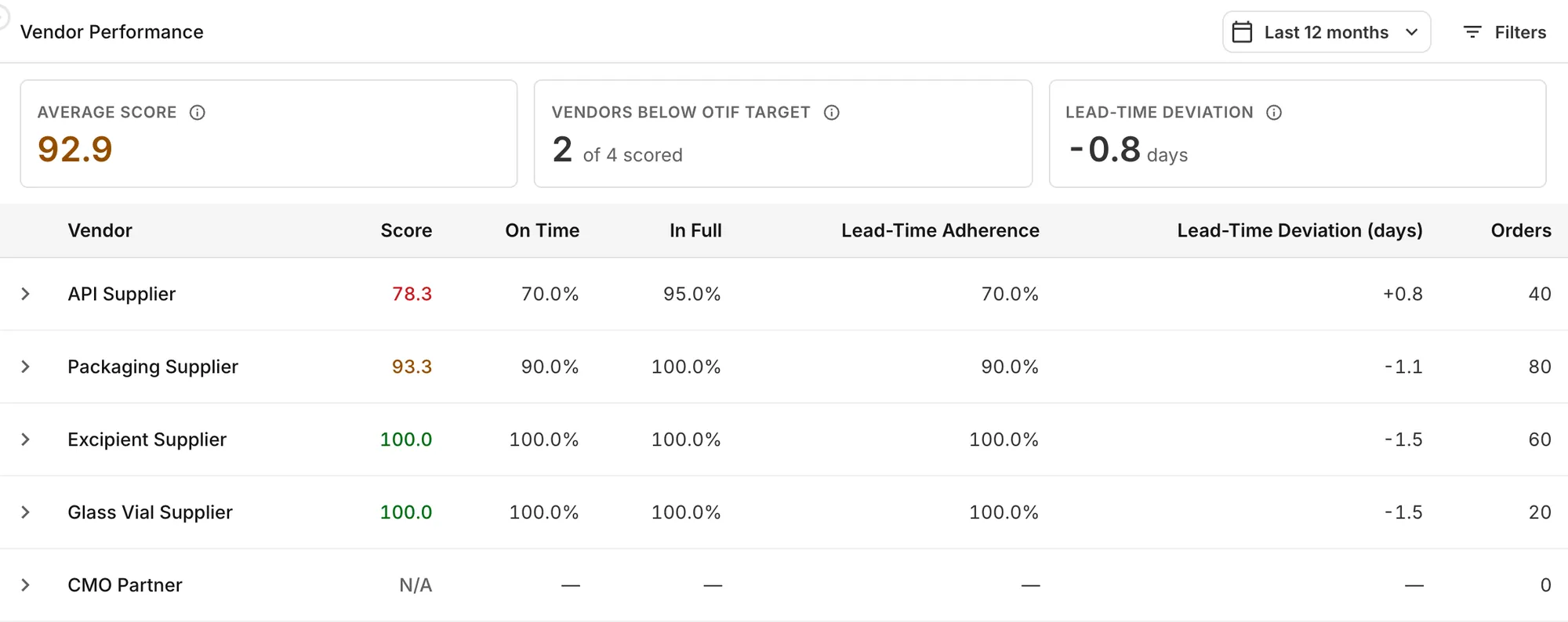
Bring these numbers to supplier reviews. “You were late on 12 of 40 orders this year, by four days on average” is a better start to a negotiation than “we feel deliveries have slipped”. It is also the basis for asking for safety stock at the supplier, vendor-managed inventory or a service level agreement.
Build resilience where it pays

Supply risk in pharma is concentrated. A large share of the world’s API and key starting materials comes from a small number of countries and plants, and policymakers in the EU and the US are pushing manufacturers to diversify. Resilience costs money, so spend it where the risk is.
- Dual sourcing for strategic APIs with enough volume to keep two suppliers interested. Qualifying a second source takes a year or more, so start before you need it.
- Contractual safeguards where a second source doesn’t pay. For a low-volume orphan drug or a low-margin generic, transfer and validation can cost more than several years of the product’s margin. Hold more API as strategic stock, book reserved production slots, or agree a buffer held by the supplier.
- Strategic safety stock for single-source and bottleneck materials, sized in months of demand so it follows the season, and checked against shelf life so the buffer does not expire.
- Scenarios before contracts. Before you sign, test the plan with the new minimum, the longer lead time or the second supplier. What happens to stock, expiry and the commitment if demand drops 20%?
Run procurement from exceptions, not spreadsheets
Many mid-sized pharma companies still run purchasing from spreadsheets. Buyers export ERP data, paste it into workbooks and work out order timing by hand. Visibility is a wider problem too: in Coupa’s own survey of CFOs, only 5% could access all of their spend data instantly[6], and 49% couldn’t see all of it.
Spreadsheets feel flexible. A buyer can move a date in seconds. But a workbook can’t see the bill of materials, batch expiry dates or the rest of the network, so moving a date there prevents nothing. It only hides the coming shortage from the production planner until the line stops. We have written more on the limits of supply chain planning in Excel.
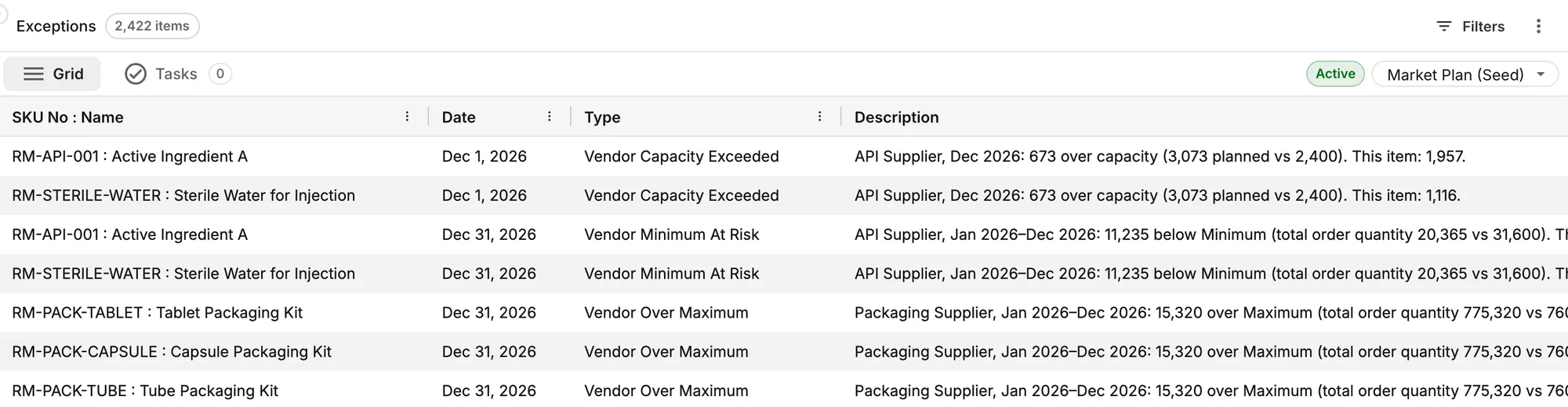
A weekly review against the latest supply plan works better, and the fastest way to run it is from a list of exceptions, not the whole plan. Each one names the item, the supplier, the date and the gap:
- an API delivery date that slips past the start of a campaign;
- an order suggestion over a supplier’s monthly capacity;
- material projected to pass its retest or expiry date before it is used;
- a demand change that pulls stock below safety stock;
- an annual minimum that the plan will miss.
Link the weekly review to the monthly S&OP cycle. S&OP sets the volumes. The weekly review turns them into orders, checks them against what suppliers can do, and escalates what procurement can’t fix alone. Integrations with the ERP keep the plan on today’s stock and open orders.
“Use PLAIO, not the Excel files. That’s our tool now.” — the head of supply chain at a Nordic virtual pharma company
A checklist for your pharma procurement strategy
- Every direct material and CMO is mapped to the items, plants and markets it supplies.
- Suppliers are sorted by spend and supply risk, with regulatory lock-in counted as risk.
- Purchases start from the demand plan, through the bill of materials, as order suggestions a buyer approves.
- Lead times include QC and QA release, and are checked against what suppliers actually deliver.
- Stock is planned to its sellable-until date and used first expired, first out.
- MOQs are checked against shelf life, and expiry write-offs are tracked by supplier.
- Annual minimums and maximums are tracked all year, including orders the plan has not placed yet.
- Monthly supplier capacity is entered for strategic and bottleneck suppliers and compared with the plan.
- Every supplier is scored on on time, in full and lead-time drift, and the scores are used in reviews.
- A weekly review works through exceptions and feeds the monthly S&OP cycle.
Frequently asked questions
What is a pharmaceutical procurement strategy?
It is the plan for how a pharma company sources the materials and services it needs to make its products: which suppliers it uses, how it segments them, what it commits to buy, how it decides when and how much to order, and how it manages supply risk. For direct materials, the hard part is timing and risk, more than price.
Why is changing suppliers so hard in pharma?
Because suppliers of API, and often of excipients and primary packaging, are part of the product’s regulatory file. Changing one needs a variation, method transfer, validation batches and stability data, which often takes a year or more. So pharma companies keep suppliers for a long time and manage risk through planning, safety stock and second sources rather than frequent switching.
Is dual sourcing always worth it?
No. It is the standard safeguard for high-volume products, but for low-volume or low-margin products the cost of qualifying a second supplier can exceed years of margin. There, hold more strategic stock, reserve supplier capacity, or agree a buffer held by the supplier instead.
How do you stop supplier minimums causing expiry write-offs?
Plan against the sellable-until date, not the expiry date. Check how many months of demand each minimum buys against the shelf life the material has left on arrival. Use order steps and coverage-based order sizes, renegotiate minimums on slow movers, and track write-offs by supplier so the cost is visible at contract renewal.
What KPIs should pharma procurement track besides price?
On time, in full; lead-time drift; progress against annual commitments; monthly load against supplier capacity; stock below safety stock; and expiry write-offs. Price variance on its own rewards buying large minimums cheaply and writing them off later.
See your own supply base in PLAIO
PLAIO plans demand, supply and production for pharma companies in one model. Vendor commitments, vendor capacity and vendor performance sit next to the plan you order from, and order suggestions follow each supplier’s lead time, minimum and order steps. Book a 30-minute plan review and we will walk through your current supply plan with you.
References
- Sievo. “Pharmaceutical Procurement Benchmarks and KPIs for 2027.” Sievo (blog), 23 November 2026. https://sievo.com/blog/pharmaceutical-procurement-benchmarks-2027
- Nventic. “Big Pharma inventory trends benchmarking report 2024.” Nventic, 30 July 2024. https://nventic.com/insights/nventic-big-pharma-inventory-trends-benchmarking-report-2024
- Nventic. “Inventory write offs in pharmaceutical manufacturing.” Nventic, 13 August 2024. https://nventic.com/insights/inventory-write-offs-in-pharmaceutical-manufacturing
- KAIZEN Institute. “OTIF: an essential supply chain performance indicator.” KAIZEN Institute. https://kaizen.com/insights/otif-supply-chain-indicator/
- Celonis. “What Is OTIF? The How, Why & What of Optimizing It.” Celonis (blog). https://www.celonis.com/blog/otif-explained-the-what-why-and-how-of-optimizing-for-on-time-in-full-delivery
- Coupa. “Procurement Benchmarks & KPIs: Measuring What Matters.” Coupa (blog). https://www.coupa.com/blog/procurement-benchmarks/