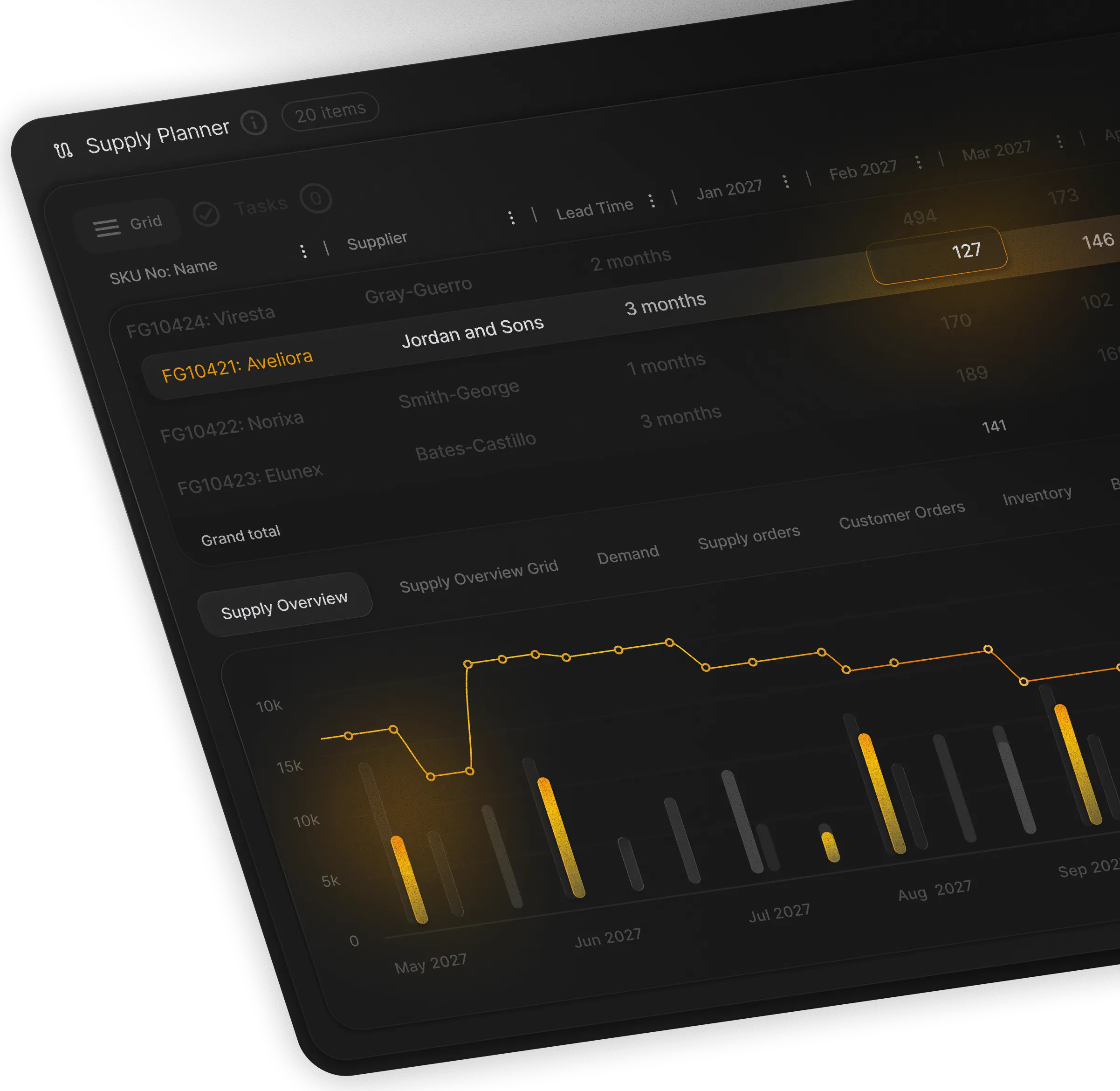


Sterile product lines run at a median OEE of 23%[1], and I have spent years watching planners firefight schedules that ignore how a GMP plant actually works. Conventional planning tools treat cleaning, hold times, QC release and shelf life as offline assumptions rather than constraints. Following best practices in pharmaceutical production planning means building them into the schedule itself, so planners stop firefighting and patient supply is protected without inflating working capital.
Schedule validated cleaning as its own production phase
Treating line clearance, Clean-in-Place (CIP) and Sterilize-in-Place (SIP) as generic gaps between shifts creates phantom capacity that the plant cannot legally use under FDA 21 CFR Parts 210 and 211. In typical facilities, operations dedicate over 30% of staffed time to planned losses like cleaning[2], which accounts for 60% of all availability losses. Validated sanitization is not idle time. It is a discrete manufacturing step that needs qualified crews, cleaning skids, clean utilities and strict regulatory limits.
Cross-industry data shows that availability losses represent the largest source of operational downtime[3] across pharma and CDMO suites. I advise building the schedule around two time limits that cannot be broken:
- Enforce Dirty Hold Time (DHT) limits. Set a hard ceiling on how long equipment can sit uncleaned after a run before bioburden growth or dried residue invalidates the cleaning validation protocol. If a tablet press reaches its 24-hour DHT limit on a Sunday morning, the cleaning job has to be scheduled before that deadline, weekend premiums or not.
- Track Clean Hold Time (CHT) windows. Monitor how long cleaned equipment has been standing, so a sterile line or compounding tank past its validated clean window gets a re-wash before the next batch loads.
The trade-off. The objection I hear most often from schedulers is that hard-coding cleaning phases makes the schedule rigid, so it collapses whenever a run finishes early or late. What I have seen in practice is the opposite: a constraint-based model is far more flexible than a static spreadsheet. When a fluid-bed granulation run finishes three hours early, the cleaning moves with it. When a breakdown threatens a hold-time limit, the conflict shows up straight away, before the equipment drifts into an unvalidated state that needs a multi-day chemical strip-down and a deviation investigation.
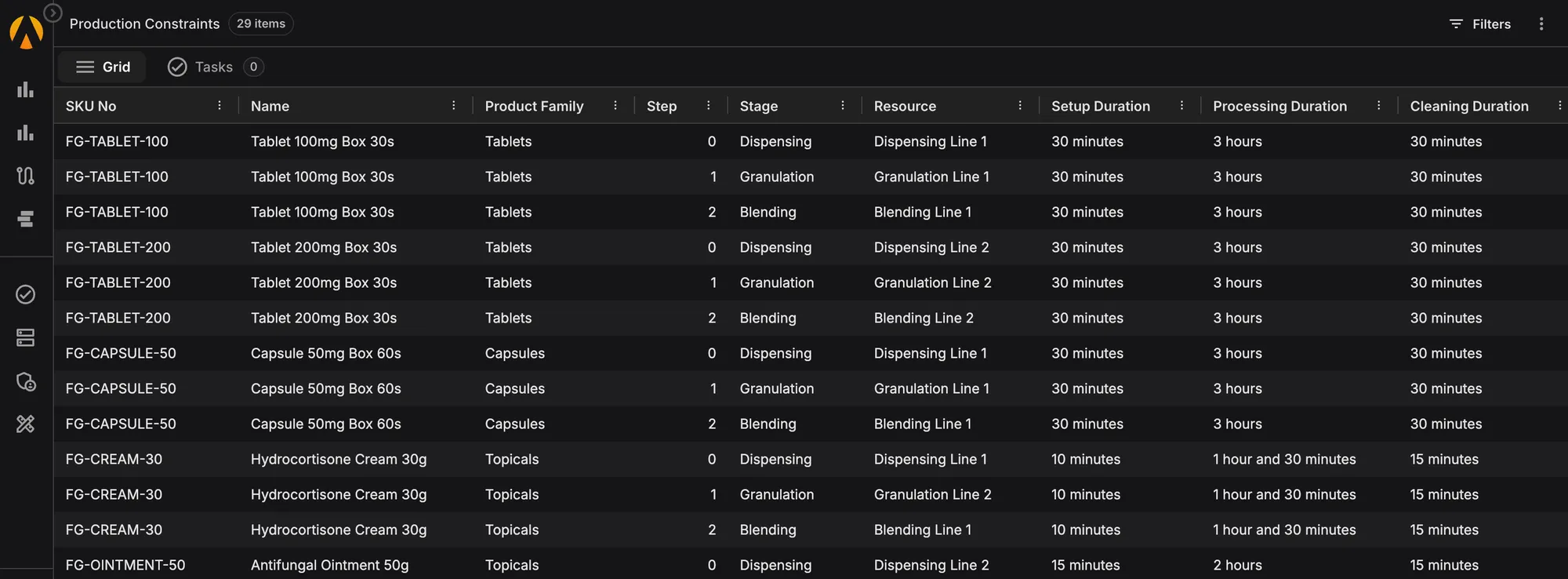
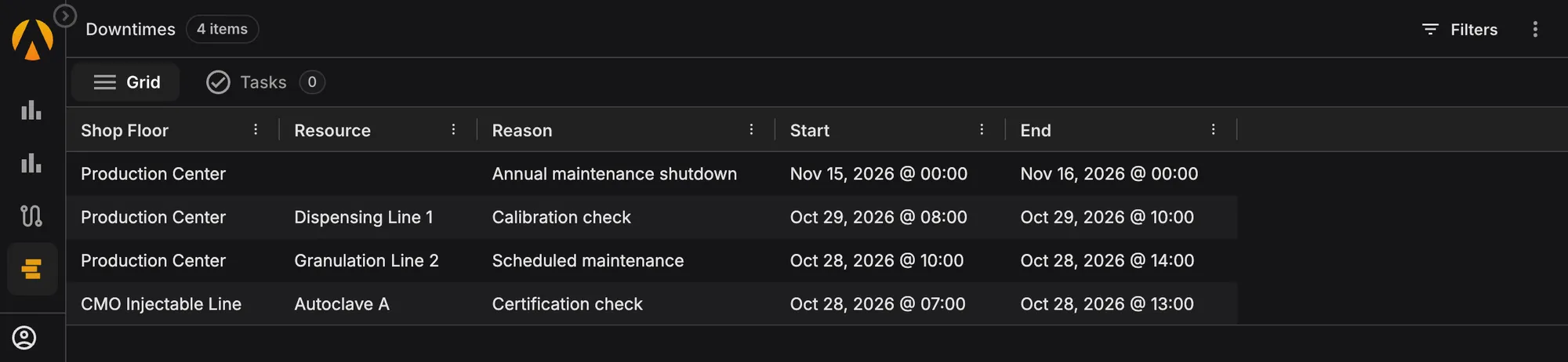
In the PLAIO Production Planner, every job is made up of four distinct, non-overlapping phases: changeover, setup, processing and cleaning. Each step of each product carries its own setup, processing and cleaning duration, so cleaning time is booked against the line rather than assumed. Because sanitation and validation holds constrain cleanroom assets so heavily, world-class performance is defined at ≥70% OEE[4] in pharma packaging and filling, lower than in discrete manufacturing. Building these manufacturing constraints into the asset model means the dispatch board reflects real cleanroom availability, not theoretical run rates.
Size manufacturing campaigns against multiple line constraints
Campaigns increase throughput by replacing full line clearances with quick minor cleans between identical formulations and strengths. Top manufacturers reduce capacity loss from changeovers by a factor of four[5] compared with the laggards. But I have yet to see a spreadsheet that can balance all the economic and regulatory variables that go into sizing a campaign.
When I work with a planning team on campaign length, we weigh it against four things:
- Turnover overhead. Set minimum run lengths so that line clearances, air flushes, swab tests and turnaround time do not eat more than your target share of capacity.
- Warehouse and shelf-life cost. Cap run lengths before finished stock outgrows cold-chain storage or burns too much shelf life sitting on pallets.
- Intermediate stability. Match the number of batches to the maximum hold time for exposed blends, unprinted blister rolls or sterile bulk solutions waiting downstream.
- Product-mix volatility. Stop oversized campaigns for high-volume products from starving packaging lines needed for small, high-priority orphan drug orders.
The trade-off. Operations teams often push for the longest possible campaigns, because that keeps changeover numbers down and utilization up on executive dashboards. I understand the pull, but in a regulated plant maximum campaigns create working-capital traps and risk expiring bulk intermediates before a packaging suite is free. Planners have to balance changeover efficiency against intermediate stability and downstream availability, minimizing API and excipient waste while keeping the cleanroom flexible.
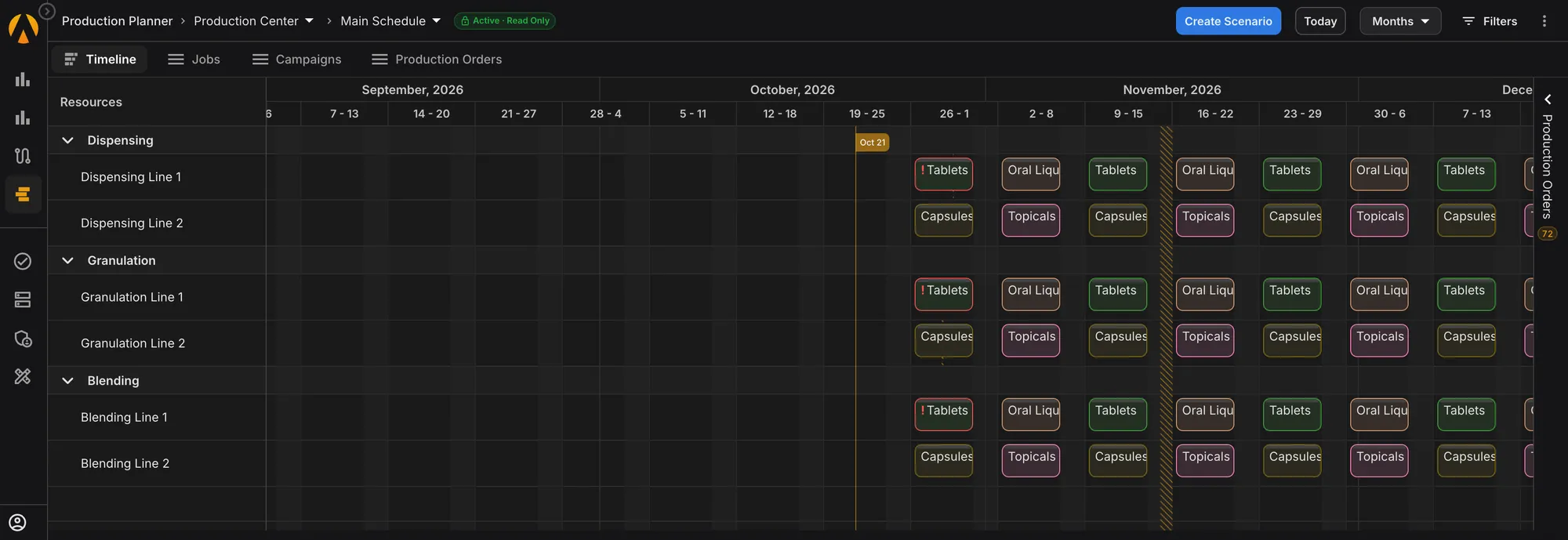
To move beyond spreadsheets, I recommend a constraint-based scheduling engine. PLAIO Production Scheduling groups orders into family-level campaigns, checks run durations against the capacity of each line, and lays campaigns out on an interactive Gantt timeline alongside planned maintenance and calibration. The approach pays off: a peer-reviewed study of a solid oral dosage facility[6] found that including sequence-dependent cleaning times and maintenance calendars cut makespan by up to 88.1% and total tardiness by up to 72.1%, compared with plans that ignored detailed site rules.
Put QC release and lab hold times on the critical path
A pharmaceutical batch is not ready for sale when it comes off the packaging line. It is ready when Quality Assurance (QA) has reviewed the batch record and issued a Certificate of Analysis (CoA). Batch release takes an average of 8.5 days for oral solid doses and 12.3 days for sterile injectables[7], so a Master Production Schedule (MPS) that leaves out lab testing builds bottlenecks into every warehouse and packaging hall. Researchers studying industrial control laboratories found that QC lead times are a major cause of lost time[8] in pharmaceutical manufacturing, because of long setups and limits on running tests in parallel.
I ask every team to put three quality milestones on the critical path:
- In-process testing. Reserve line time for line-side checks: blend uniformity, loss-on-drying moisture analysis, and tablet hardness, friability and disintegration.
- Bulk intermediate holds. Enforce quarantine periods between upstream synthesis or wet granulation and tableting, encapsulation or fill-finish.
- Finished product release. Allow realistic time for HPLC potency assays, dissolution profiling, endotoxin testing and 14-day sterility incubation before stock is allocated to distribution.
The trade-off. Lab testing times vary, and Out-of-Specification (OOS) investigations are unpredictable, so some planners argue QC cannot be scheduled at all. I disagree. Leaving QC out of the plan guarantees that packaging suites book labor against material that has not been released. Modeling standard testing as a visible, dependent step gives you a true critical path. When an OOS investigation does happen, you can see at once which downstream packaging jobs it affects and move them before crews turn up to an empty room.

Shop floor scheduling software improves production efficiency because physical output depends on laboratory speed. Moving to concurrent workflows and parallel QA review reduces total cycle time by 40% to 50%[7] compared with sequential handoffs. In PLAIO, a job whose materials will not be ready in time is flagged as an exception, so a slipped release shows up in the plan before it shows up on the floor.
Connect demand, materials and line schedules in one loop
A shop-floor sequence fails when it is cut off from incoming materials and market demand. Leading supply chain teams replace isolated spreadsheets with unified demand, supply and production planning in a single loop. As how PLAIO works shows, balancing commercial forecasts with line capacity means keeping three planning horizons in step:
- Capture clean market signals in Demand Planning. Combine commercial baselines, tender commitments and hospital consumption trends, using machine learning to filter out one-off order spikes and bullwhip distortion.
- Explode multi-level bills of materials in Supply Planning. Confirm that APIs, excipients, vials, stoppers and printed cartons will be ready before committing a line to a manufacturing order.
- Dispatch feasible jobs in Production Planning. Assign batches to qualified lines based on live equipment availability, shift patterns and material release dates.
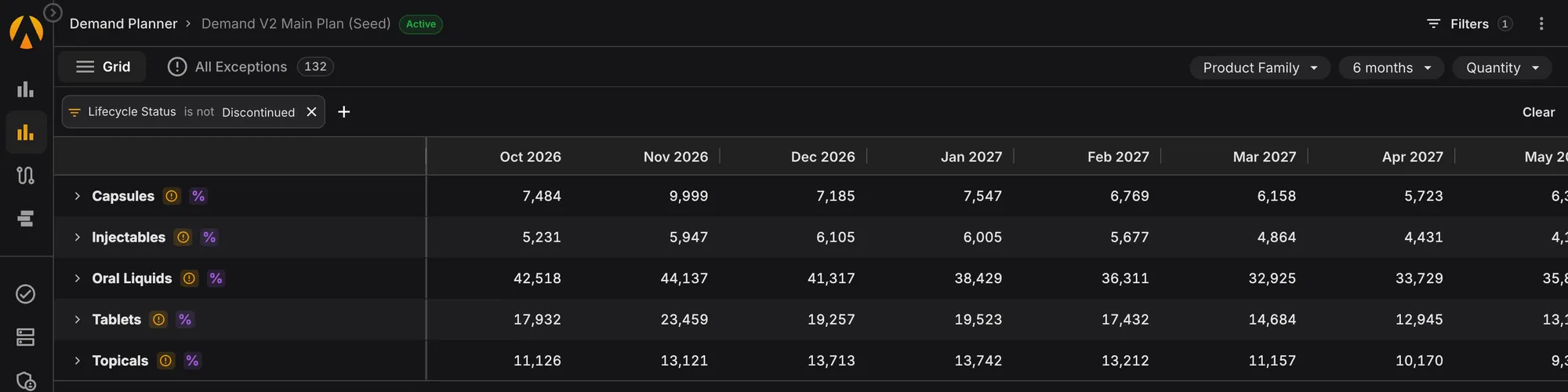
In the Demand Planner, a sudden change in a hospital tender or a distribution channel flows through to the supply plan built on it. Planners can see within minutes whether compounding suites and material pipelines can take on new work orders without putting committed delivery dates at risk.
Enforce batch-level expiry and market shelf-life rules with FEFO
Treating pharmaceutical inventory as interchangeable part numbers leads to rejected shipments at the border and scrapped batches. Every lot has its own manufacturing date, degradation profile and expiry date, and needs strict First-Expiry-First-Out (FEFO) allocation.
These are the market-specific shelf-life rules I build into allocation:
- Set a minimum remaining shelf life per country. For example, 18 months for European destinations and 12 months for domestic distributors.
- Replace default FIFO dispatching. Match shorter-dated batches to markets that accept them, and keep fresh stock for distant channels with strict import thresholds.
- Track re-test dates. Distinguish hard expiry from API re-test intervals, so re-certification is scheduled in time without interrupting packaging.

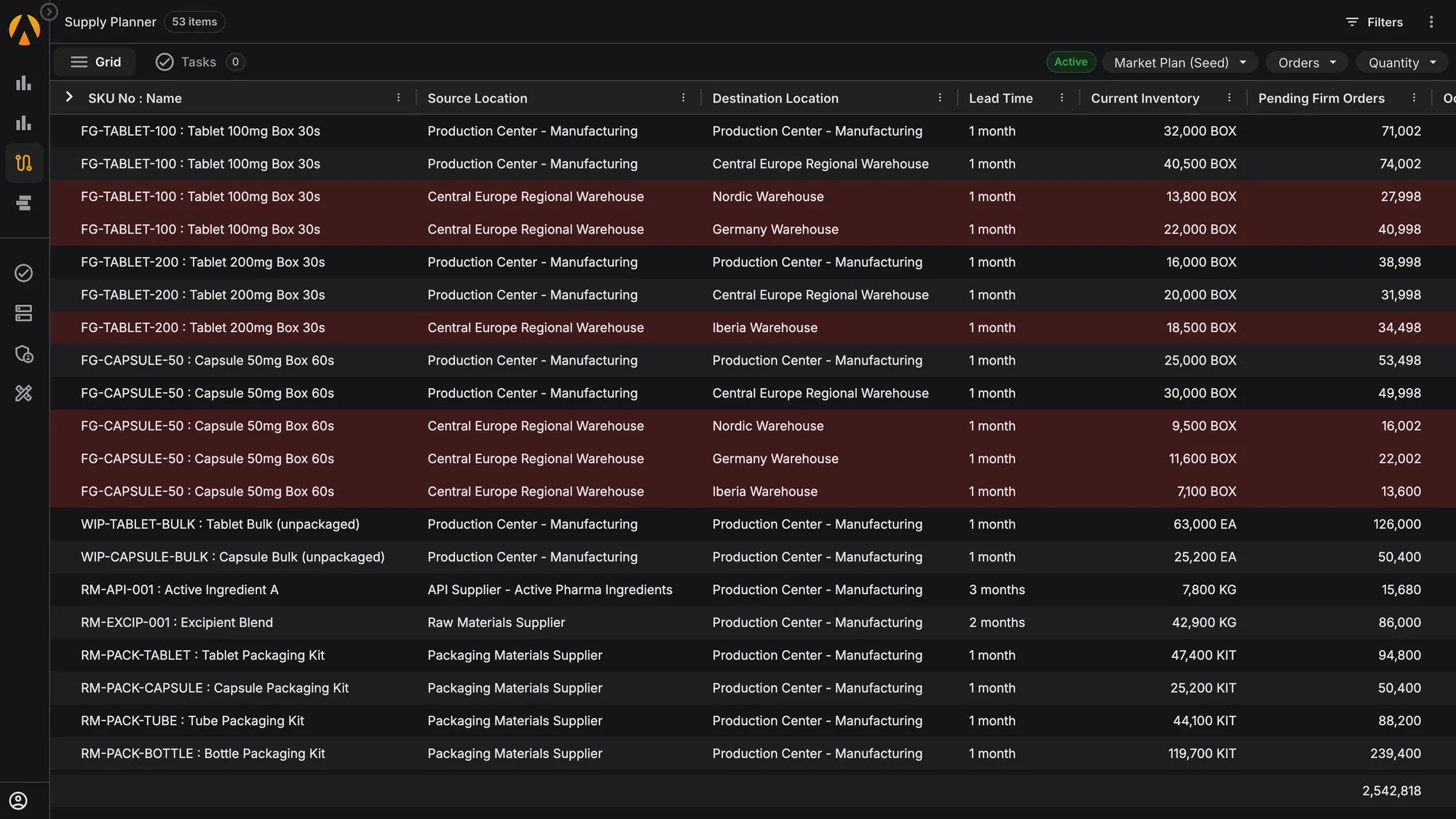
When choosing pharma supply chain software, I treat native FEFO allocation as non-negotiable. In the PLAIO Supply Planner, each batch carries its expiry and a sellable-until date for each market, and stock is allocated first-expiry-first-out against those dates. Planners follow the balances in the Supply Overview Grid and spot at-risk inventory before it expires.
Sequence products by potency to prevent cross-contamination
Running high-potency active pharmaceutical ingredients (HPAPIs) on shared equipment needs strict sequencing, to remove cross-contamination risk, protect technicians and avoid unnecessary cleaning validation cycles. Relying on a planner’s memory for toxicological changeovers is an unacceptable regulatory and health risk.
I recommend three sequencing rules on shared solid-dose and liquid lines:
- Light to dark. Run uncoloured or lightly tinted film coatings before heavily dyed formulations, to simplify inspection and wash-down.
- Low to high strength. Run low-dose formulations before high-strength formulations of the same molecule, so high-potency residue cannot contaminate a low-dose run.
- Hazardous compounds last. Put the highest-potency products at the end of a campaign, right before a major validated strip-down or preventive maintenance shutdown.
The trade-off. In my experience, the friction comes when commercial teams ask for an urgent high-potency batch out of sequence. Agreeing without checking leads either to cross-contamination risk or to an unplanned 48-hour major clean that disrupts the rest of the schedule. When changeover times are defined in the planning system, the cost of breaking sequence is explicit, and leadership can judge whether the expedite is worth the lost capacity.
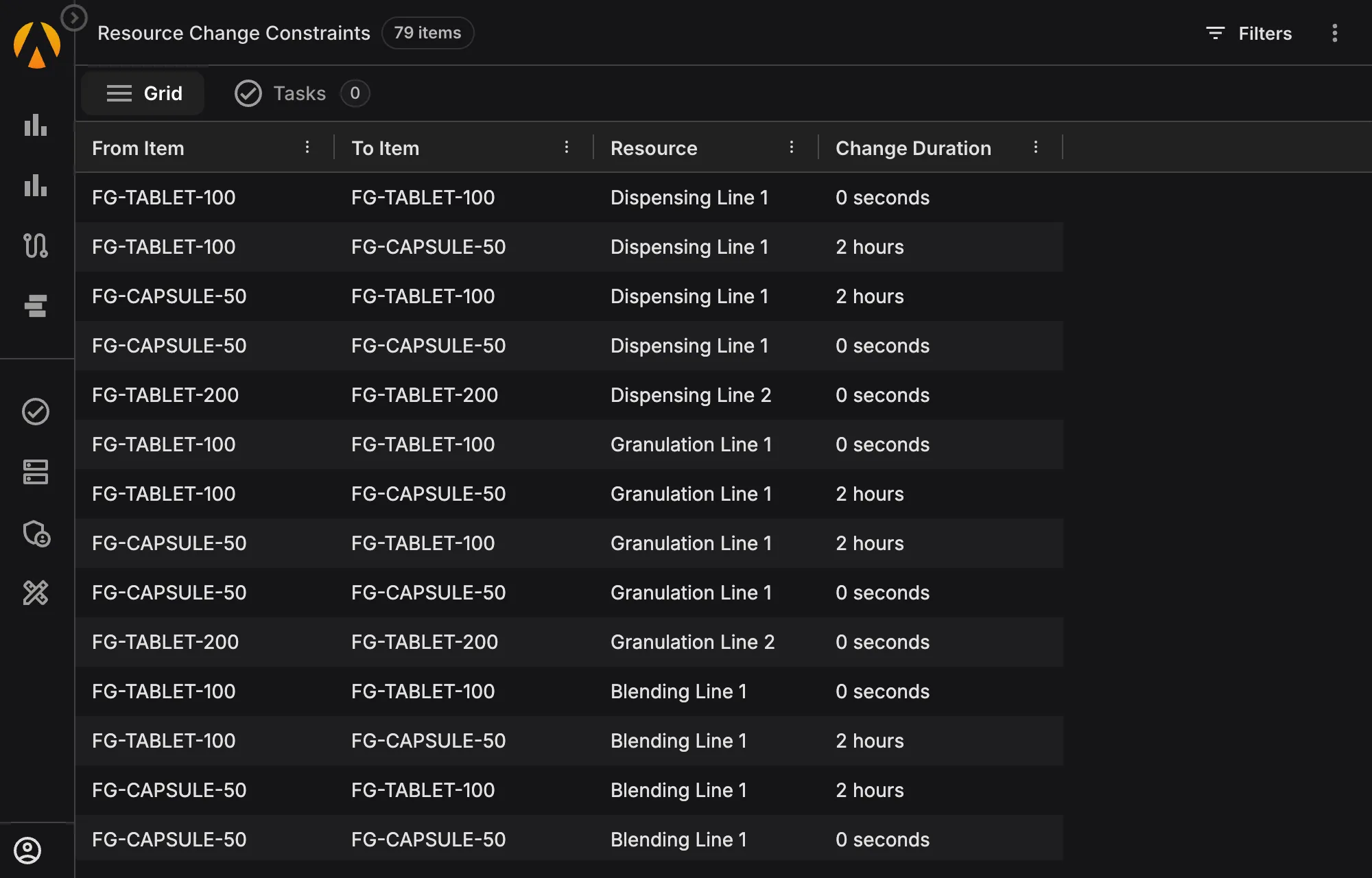
Set clear routing boundaries across your plant locations and give every product pair on a shared line its own changeover time. The schedule then reflects the real cost of each sequence, and an out-of-sequence change is a visible decision rather than a mistake found during equipment setup.
Constrain replenishment with exact supplier and CMO lead times
Schedules built on a generic 30-day supplier lead time fail as soon as they meet reality. Real procurement involves long synthesis cycles, ordering tiers and minimum runs across global Contract Manufacturing Organization (CMO) networks. Effective pharma capacity planning links external supplier constraints directly to the internal master production schedule.
These are the external realities I build into the plan:
- Model realistic procurement times. Allow for multi-month API synthesis, customs clearance and post-receipt quarantine sampling, not just the supplier’s delivery date.
- Include supplier minimums and increments. Set exact Minimum Order Quantities (MOQs) and order increments for foils, stoppers, printed cartons and custom vials, so the plan never generates orders that cannot be filled.
- Set firm and frozen horizons. Lock the schedule within agreed time fences, so late order changes do not ripple out to contract suppliers.
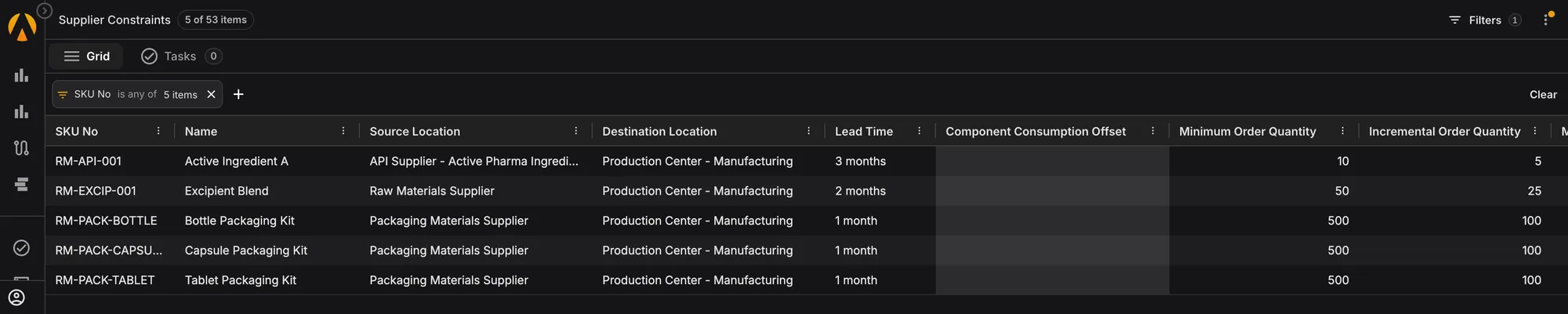
Manage these limits in Supplier Constraints, with exact lead times and order multiples for each supplier. Combine them with Order Policies and a structured review in Supply Orders to set forward inventory coverage and avoid generating procurement orders that cannot be filled.
Calibrate safety stock using rolling forecast error and bias
Static annual sales targets put inventory in the wrong places: excess carrying cost for slow movers and stockouts for high-velocity therapies. Planners need rolling forecasts across several horizons, with statistical tracking, so buffers can be adjusted as conditions change.
I measure forecasts on two complementary metrics, explained in PLAIO’s guide to Forecasting Approach and Performance Evaluation and tracked in Forecast Accuracy:
- Forecast error shows variance. Measure the absolute gap between forecast and actual demand, and size buffer stock for volatile SKUs accordingly.
- Forecast bias shows direction. Spot systematic over-forecasting, which inflates carrying cost and write-offs, or under-forecasting, which causes stockouts.
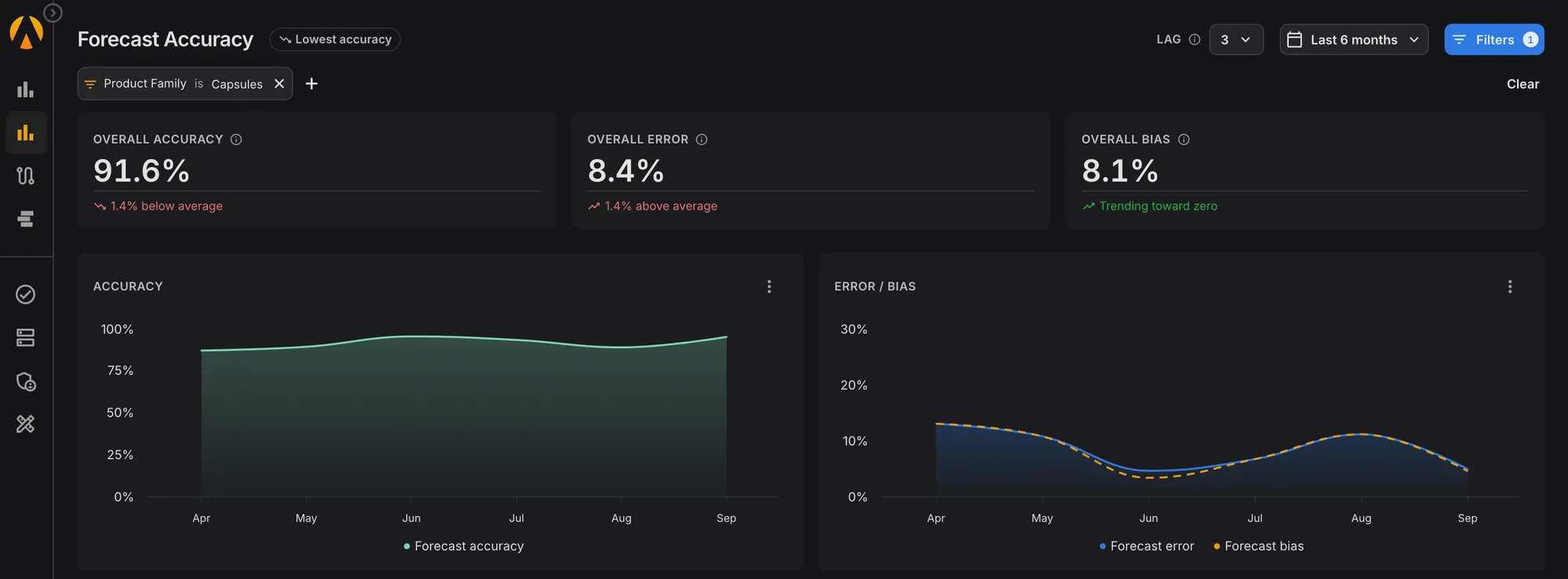
The trade-off. Many supply chain leaders I work with keep large, static safety stocks to protect service levels on every SKU. In life sciences that leads to big write-offs when batches expire, and strains cold-chain storage. Calibrating buffers on error and bias means safety stock grows where demand is volatile and stays lean on predictable lines, protecting On-Time In-Full (OTIF) delivery without building excess stock.
Manage shop-floor disruption by exception
Scanning hundreds of schedule rows across disconnected spreadsheets wears planners out and lets critical shortages slip through. My advice is always the same: manage by exception.
Use automated Exception Management to flag high-risk issues as they arise:
- Projected stockouts. Alert as soon as projected stock falls below safety stock before the next replenishment arrives.
- Upstream process delays. Flag when a granulation hold or fluid-bed run slips and threatens downstream compression.
- Shelf-life expiry. Highlight quarantined or warehouse stock approaching its sellable-until date while there is still time to act.
- Cleanroom sequence conflicts. Warn schedulers when a breakdown or a delayed line clearance causes overlapping runs on a shared suite, or breaks a minimum wait between steps.
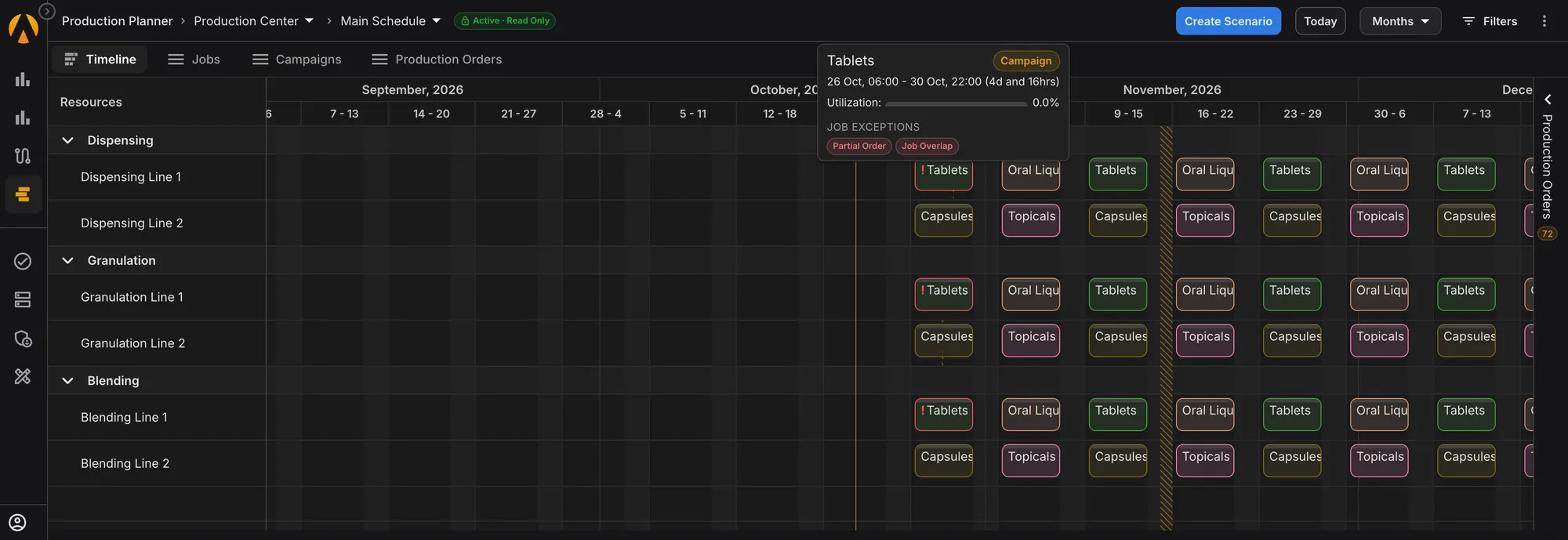
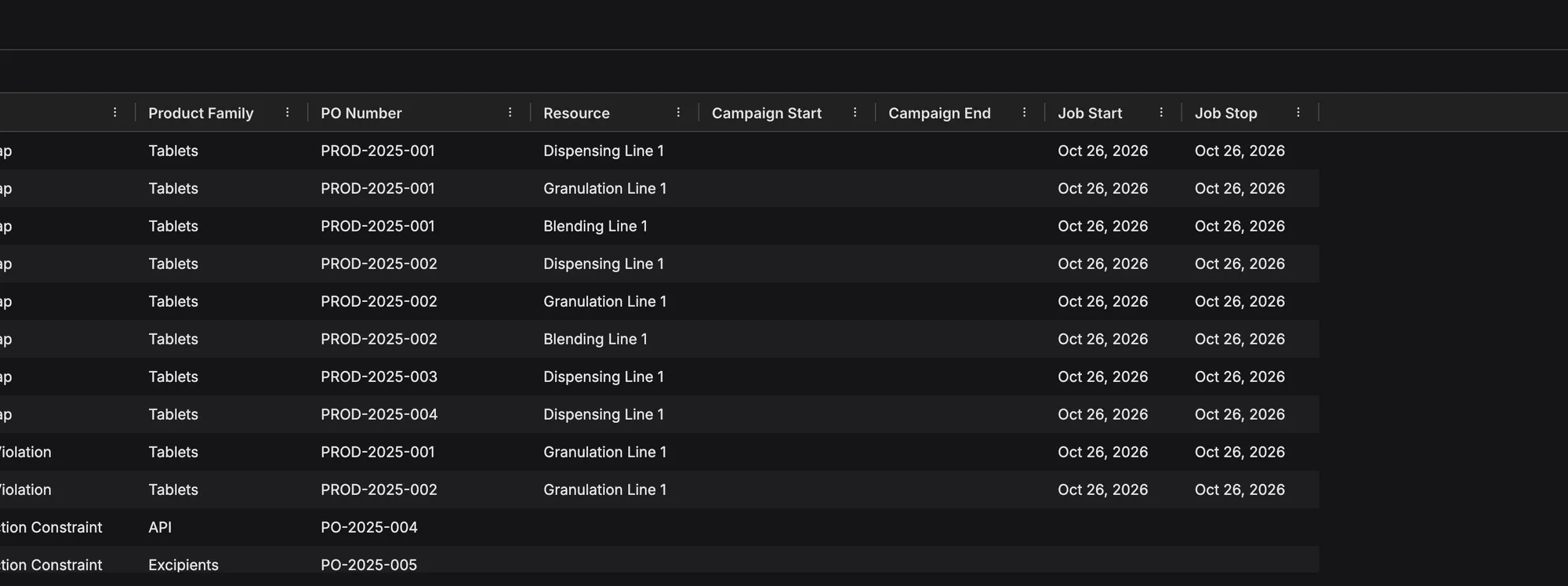
Our guide to understanding exceptions helps teams fix the root causes of supply failures instead of reacting to the same crises every day.
Separate cleanroom dispatching from rigid ERP master records
ERP databases are essential transaction records, but their rigid architecture cannot support the fast simulation the packaging floor needs. Trying to run cleanroom schedules inside the ERP drives planners back to desktop spreadsheets. Getting past the limits of supply chain planning in Excel means separating dispatch from the transactional database and adopting dedicated shop floor scheduling software.
The IT vs. operations trade-off. IT departments often resist specialized scheduling software, arguing that the ERP should handle all planning to keep a single system of record. But ERP production modules rely on static run rates and ignore cleaning windows, potency rules and hold times. Forcing planners to schedule inside the ERP pushes them to export data into uncontrolled spreadsheets, bringing back exactly the compliance risk IT wanted to avoid. The answer I recommend is to keep the ERP as the financial and transactional system of record and use a dedicated engine to separate pharma planning from ERP transaction execution.
Connect the transactional ledger to a planning layer through modern supply chain integrations:
- Bring in ERP data. Stream inventory balances, purchase orders, BOMs and commercial commitments into the planning tool continuously.
- Simulate schedules quickly. Use drag-and-drop Gantt views, constraint checks and AI-driven optimization to balance capacity, campaigns and shifts.
- Agree the plan. Align commercial, production and finance teams on one plan through consensus planning.
- Publish approved orders back to the ERP. Send firm start dates and batch quantities back to the ledger for official shop-floor execution.


Combining structured pharma data management with fast software onboarding lets a facility go live with a compliant, constraint-aware scheduling platform in weeks rather than a year-long IT project. Our technical reference on understanding your data makes sure cleanroom parameters, bills of materials and asset hierarchies map cleanly between systems from day one. Getting that mapping right is what lets the process and the system work together in practice.
Anchor pharmaceutical production plans in cleanroom reality
A schedule that looks balanced on an executive dashboard is worthless if it breaks physical constraints on the cleanroom floor. Dependable execution means building shop-floor realities into the plan itself: validated cleaning, hold-time limits, QC lead times, potency sequences and market shelf-life rules.
When you put these best practices in pharmaceutical production planning into your planning software, plant stability follows. Planners stop firefighting and line utilization rises; a 10-percentage-point increase in OEE can unlock 15–25% more throughput on existing equipment[9] without capital expenditure. Cleanroom compliance stays intact, and finished therapies reach patients on time and in full.
References
- IntuitionLabs. “2026 Pharma KPI Benchmarks: OEE, Batch Release & R&D.” IntuitionLabs, 9 May 2026. https://intuitionlabs.ai/articles/pharma-kpi-benchmarks-2026
- “World Class OEE in Pharma: A Benchmarking Analysis for 2026.” SCW.AI. https://scw.ai/blog/world-class-oee-in-pharma/
- “2026 Pharmaceutical Manufacturing Performance Benchmark Report.” Vimachem. https://www.vimachem.com/download/2026-pharmaceutical-manufacturing-benchmark-report
- “OEE Benchmarks: Realistic Values by Industry 2026.” SYMESTIC. https://www.symestic.com/en-us/blog/oee/oee-benchmarks
- “Pharmaceutical Equipment Effectiveness: Benchmarking Shows Need to Improve Uptime, Capacity Utilization.” Pharmaceutical Manufacturing. https://www.pharmamanufacturing.com/facilities/op-ex-lean-six-sigma/article/11363072/pharmaceutical-equipment-effectiveness-benchmarking-shows-need-to-improve-uptime-capacity-utilization-pharmaceutical-manufacturing
- Balatsos, Ioannis; Liakos, Athanasios; et al.. “Efficient Data-Driven Production Scheduling in Pharmaceutical Manufacturing.” arXiv. arXiv:2602.13668. https://arxiv.org/abs/2602.13668
- “5 Ways to Reduce Batch Record Cycle Time (FDA Guide).” GMP Pros. https://gmppros.com/how-to-reduce-batch-record-cycle-time/
- Lamothe, Jacques; Marmier, François; et al.. “Scheduling rules to minimize total tardiness in a parallel machine problem with setup and calendar constraints.” arXiv. arXiv:1509.02099. https://arxiv.org/abs/1509.02099
- “OEE in Pharmaceutical Manufacturing: Benchmarks and Improvement.” iFactory. https://ifactoryapp.com/industries/pharmaceuticals/oee-pharmaceutical-manufacturing-benchmarks-improvement